



Aqueous battery material that outperforms lithium-ion even in water has been developed
 Published2021.02.26 19:55
Using multivalent metal sulfides as electrode materials
Overcoming the limitations of existing lithium-ion and water-based batteries
The research team led by Professor Jeong-gu Kang of the Department of Materials Science and Engineering at the Korea Advanced Institute of Science and Technology (KAIST) announced on the 25th that they have developed a hybrid battery that operates in water and can be rapidly charged. The research was published in the February 9th issue of 'Advanced Energy Materials (IF 25.245),' an international academic journal in the field of materials.
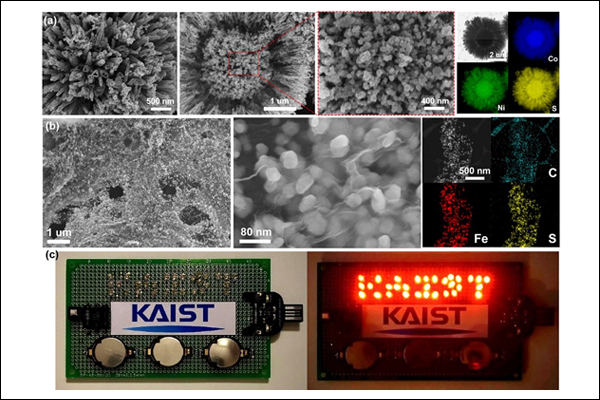
Actual image and driving image [Image = KAIST]
The research team utilized a multivalent metal sulfide (a state in which electrons are lost and a positive charge is generated) that is more conductive than the metal oxides that are currently most commonly used as electrode materials, as an electrode material. And based on a mesoporous electrode structure with a high surface area, they implemented a hybrid aqueous ion energy storage material with high energy density and high output.
The new water-based battery is expected to be safer, more economical, and more suitable for use in portable devices that require rapid charging and in situations where safety is a priority, as it is superior to lithium-ion batteries or other water-based batteries currently in use.
◇ Multivalent metal sulfides, large surface area and abundant ion diffusion channels
Lithium-ion batteries are high-energy-density energy storage systems. However, there are still issues such as safety problems such as battery fire and electrolyte leakage, the high price of lithium, low output due to slow insertion/de-insertion process of ions, and short lifespan, so improvement is needed.
On the other hand, metal oxide-based energy storage devices that operate in water are safe and environmentally friendly, relatively inexpensive, and have the advantage of rapid charging and discharging since electrolyte ions react only on the surface of the electrode material. Therefore, they are attracting attention as next-generation energy storage devices that can replace lithium ions and overcome existing problems.
However, existing metal oxides with low electrical conductivity had poor charge/discharge performance in terms of speed, and had low surface area per mass, making it difficult to achieve high capacity because a large amount of ions could not react. The research team achieved high capacity and high output performance by utilizing multivalent metal sulfides, which have 100 times higher conductivity than metal oxides, as the positive and negative electrodes of an aqueous battery.
Nickel cobalt sulfide used as the positive electrode material and iron sulfide used as the negative electrode material both exist in two oxidation states, and are materials that can achieve high capacity by inducing abundant redox reactions within the operating voltage range. The positive electrode material, which has a mesoporous core-shell structure surrounded by thorns on the surface, has a high surface area and abundant ion diffusion channels because it is composed of nickel cobalt sulfide nanoparticles with a size of 30 nm (nanometers).
The cathode material is a 3D reduced graphene oxide aerogel structure in which reduced graphene oxide is not stacked but rather randomly tangled, and countless 30 nm-sized multivalent iron sulfide nanoparticles are placed on top. High-power energy storage is possible thanks to the abundance of nanoparticles, high active surface area, and ion diffusion channels of the 3D graphene structure.
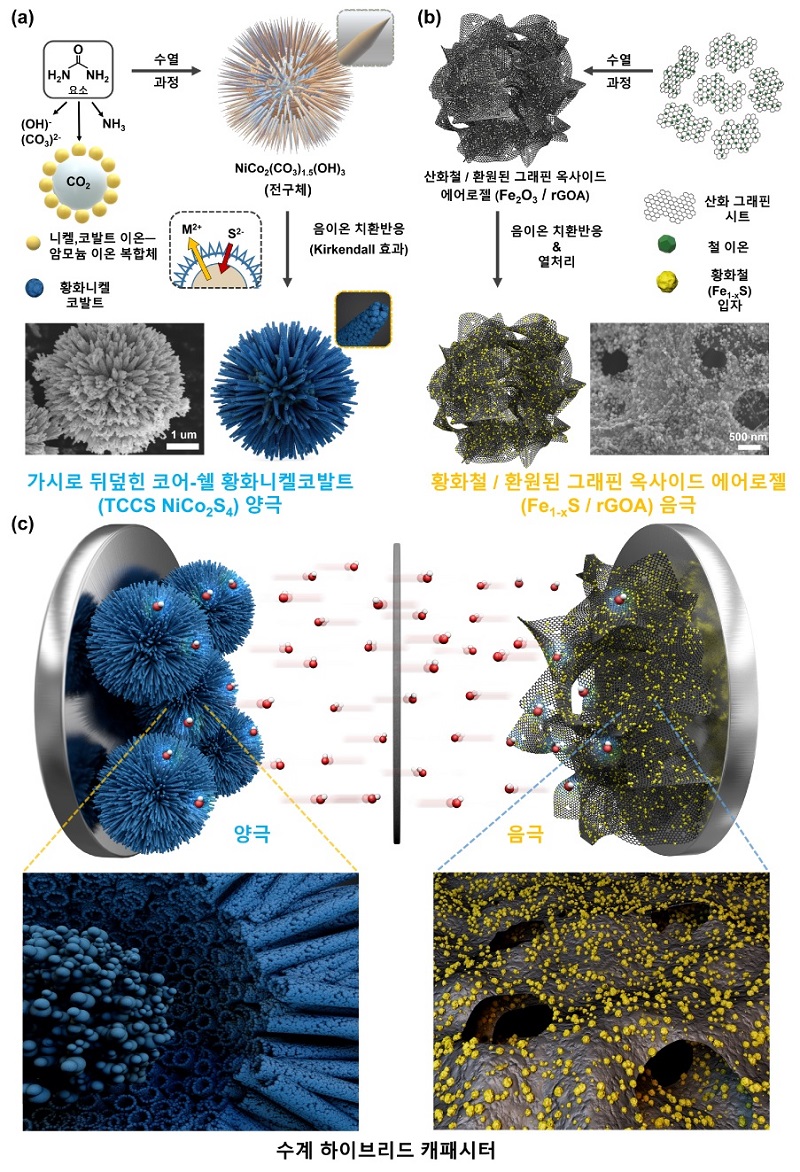
Schematic diagram of energy storage mechanism [Figure = KAIST]
(Open in new tab to enlarge)
This structure with rich mesoporous ion diffusion channels enables electrolyte ions to penetrate deep into the electrode at a high speed, thereby realizing high-power charge/discharge rates. In addition, since all active materials are composed of nanoparticles, it solves the problem of low capacity of conventional low-surface-area metal oxide electrodes.
The new water-based battery is expected to be used in energy storage systems (ESS) that require safety as it has an energy storage capacity that is 100 times higher than that of existing water-based batteries of the same volume, a higher power density than existing lithium-ion batteries, and can be rapidly charged within tens of seconds.
Comments
Related news
Wireless BMS: How to Increase EV Driving Range?
Many consumers are hesitant about purchasing electric vehicles due to their shorter maximum driving range compared to internal combustion engine vehicles. The battery management system (BMS) is the component that has the greatest impact on the efficiency of electric vehicles. If wireless solutions could replace the currently widespread wired BMS solutions, it would provide a competitive advantage in the emerging electric vehicle industry through increased driving range.
2021.02.12by 이수민 기자
Fast charging of large-capacity lithium-ion batteries becomes possible.
A research team at UNIST consisting of Professors Choi Nam-soon and Kwak Sang-gyu from the Department of Energy Chemical Engineering, and Professor Hong Sung-yu from the Department of Chemistry, has developed battery electrolyte additives that address the instability of electrode materials, a key challenge in large-capacity lithium-ion battery development. The two developed additives prevent degradation caused by volume expansion of silicon-based anodes and suppress nickel dissolution from nickel-rich cathodes through fluoride ion removal, thereby extending battery cycle life.
2021.02.16by 이수민 기자

5 Winds of Change to Blow Through the Automotive Industry in 2021
This year's automotive industry is expected to continuously embrace new technologies and approaches to establish a foundation for autonomous driving business. Willard Tu, Senior Director of Xilinx's Automotive Business Division, predicts five changes that will sweep through the automotive industry this year: the expansion of AI technology to areas beyond ADAS, autonomous commercial vehicles laying the groundwork for autonomous passenger vehicles, suburban areas growing alongside electric vehicle infrastructure, the emerging battery recycling business, and the beginning of adaptive platformization of personally-owned vehicles.
2021.02.19by 명세환 기자

Intel Unveils Next-Generation 'Core Ultra Series 3' and vPro Platform for Enterprise PCs
Intel has officially unveiled the "Intel Core Ultra Series 3" for next-generation enterprise PCs and the latest vPro platform, addressing a wide range of demands from enterprise notebooks to high-performance workstations.
2026.03.26by 배종인 기자

ROHM Launches ESD Protection Diode Compatible with High-Speed Interfaces of 10Gbps or Higher
Semiconductor specialist ROHM has developed the 'RESDxVx series' of ESD (electrostatic discharge) protection diodes capable of responding to next-generation high-speed data communication environments exceeding 10Gbps, simultaneously enhancing both signal quality maintenance required in high-speed interfaces and IC protection performance.
2026.03.26by 배종인 기자











