


Maxim Unveils Two New DC-DC Step-Down Converters with Reduced Board Space
 Published2021.03.23 09:21
72% less board space, 35% less energy consumption
Support for simplifying negative output voltage rails
Maxim Integrated Products, Inc. today announced the availability of its synchronous inverting DC-DC step-down converters, the MAX17577 and MAX17578. These two new DC-DC converters reduce size, heat generation, and cost, while simplifying the negative output voltage rails required for analog signals within smart IoT devices used in factory and building automation and communication systems.
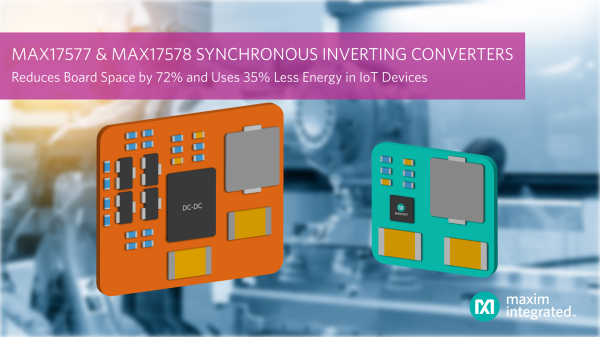
DC-DC Step-Down Converter Launched [Graphics = Maxim]
By integrating level shifting circuitry, it reduces component cost and count by up to 50% compared to competing solutions, while also reducing component area to 60mm2, resulting in a 72% reduction in board space. Furthermore, its input voltage range of 4.5V to 60V protects against input transients. It also generates less heat, increases efficiency by 6%, and reduces energy consumption by 35%.
Comments
Related news
.jpg)
Vicor Releases Radiation-Fault Tolerant DC/DC Converter Module
Vicor announced the launch of its first radiation-hardened DC-DC converter module fabricated in a new plated SM-ChiP package. The module can deliver up to 300W of power to low-voltage ASICs from a 100V nominal supply, and Boeing testing has demonstrated resilience to a total ionizing dose of 50Krad and immunity to single event upset.
2021.01.05by 이수민 기자
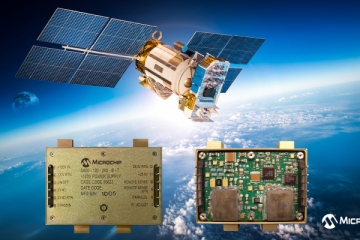
Microchip Expands Space-Ready 120V DC-DC Converter Family
Microchip has added nine new units based on commercial off-the-shelf (COTS) technology to its SA50-120 DC-DC power converter product family, which is the only non-hybrid space-grade qualification in the industry. The SA50-120S units are offered with 3.3/5/12/15/28V output. The SA50-120T units are offered with 3.3/5V main output and 12/15V auxiliary output. The nine units are now available for mass production and limited sampling.
2021.02.25by 강정규 기자
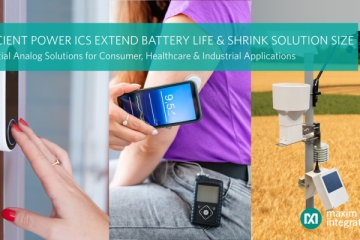
Maxim Unveils Three Power ICs to Extend Battery Life in IoT Systems
Next-generation IoT systems are oriented toward ultra-compact, low-power, and high-performance designs. To enable designers to extend battery life and reduce solution size in industrial, consumer, and medical IoT systems, Maxim Integrated has launched three Essential Analog Efficient Power ICs.
2021.03.16by 강정규 기자

Intel Unveils Next-Generation 'Core Ultra Series 3' and vPro Platform for Enterprise PCs
Intel has officially unveiled the "Intel Core Ultra Series 3" for next-generation enterprise PCs and the latest vPro platform, addressing a wide range of demands from enterprise notebooks to high-performance workstations.
2026.03.26by 배종인 기자

ROHM Launches ESD Protection Diode Compatible with High-Speed Interfaces of 10Gbps or Higher
Semiconductor specialist ROHM has developed the 'RESDxVx series' of ESD (electrostatic discharge) protection diodes capable of responding to next-generation high-speed data communication environments exceeding 10Gbps, simultaneously enhancing both signal quality maintenance required in high-speed interfaces and IC protection performance.
2026.03.26by 배종인 기자











