



Will paper-thin soft robots for underwater exploration be released?
 Published2021.04.24 09:31
Paper-thin underwater soft robot technology concept demonstrated
Seoul National University College of Engineering announced on the 22nd that a joint research team led by Professor Kyu-Jin Cho of the Department of Mechanical Engineering has developed paper-thin underwater soft robot technology.
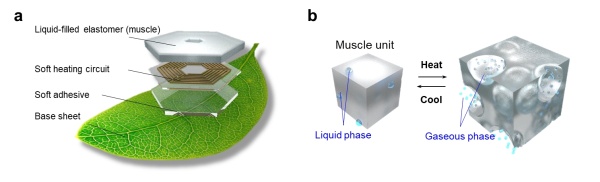
Schematic diagram of a leaf (a) and buoyancy control principle (b) [Figure = Seoul National University College of Engineering]
The research team succeeded in creating a new underwater behavioral pattern with a paper-thin structure by developing a density distribution control technology in the form of thin skin. This research, supported by the National Research Foundation of Korea’s Leading Research Center Program and the Basic Research Program’s Next Generation Academic Training Program, was published in the April 21 issue of 'Science Robotics,' a prestigious journal in the field of robotics.
Light and thin objects, such as leaves or paper, create colorful movements without special propulsion due to air resistance. The research team identified that this movement depends heavily on the density distribution of the object, and that this effect is further maximized in underwater environments. Furthermore, they succeeded in actively controlling the density distribution of the entire system by patterning a flexible composite material, whose density changes significantly in response to heat, into a skin-thin layer.
Density distribution control technology enables arbitrary, paper-thin structures to move to desired locations with fluttering underwater behavior resembling leaves, without extreme body deformation or propeller-like thrusters. It can be applied across a wide range of sizes, from millimeter-scale dimensions to large areas exceeding several meters, and holds the potential to integrate various functions required for exploration and marine environmental maintenance.
To demonstrate this feasibility, the research team showcased a concept in a small water tank where an oil-absorbing sheet autonomously swims to reach an oil spill site and removes contaminants. Although it is not yet equipped with batteries or electronic circuits, and further research is needed regarding movement control in flowing water, it is expected that further development of this current conceptual study will demonstrate new possibilities for underwater soft robots.
Comments
Related news
CEVA Unveils Software Solution to Improve Indoor AMR Pathway Accuracy
CEVA has launched MotionEngine Scout, a precision navigation software solution from Hillcrest Labs. MotionEngine Scout is utilized to improve the accuracy of intelligent navigation systems in indoor robots such as commercial robotic vacuum cleaners and autonomous mobile robots (AMRs). Additionally, Pixart's PAA5101 optical flow sensor is provided as standard.
2021.03.25by 명세환 기자
Industrial Robot Design: 'Human-Centered' is Most Important
In industrial robot design, the concept of human-centered design is emphasized as the most important, and opinions were presented that safety is the top priority since collaboration with humans is considered critical.
2021.04.13by 배종인 기자
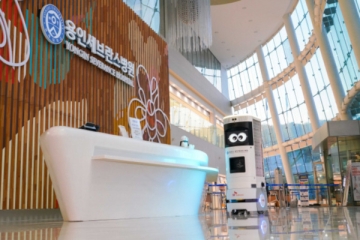
Yongin Severance Hospital uses SKT's 5G disinfection robot to disinfect the hospital.
SK Telecom and Yongin Severance Hospital have commercialized a 5G integrated disinfection robot solution based on 5G network and real-time location tracking system (RTLS). The disinfection robot solution, based on SKT's non-contact care service robot brand 'Kymi', is being utilized in the operation of infection control systems within Yongin Severance Hospital. Kymi identifies people's faces using AI technology to measure body temperature of visitors and check whether masks are being worn. Additionally, through crowd density analysis, when a certain number of people gather, it provides voice guidance for social distancing. It is also equipped with ultraviolet (UV) disinfection capability to autonomously perform disinfection and sterilization of spaces used within the hospital.
2021.04.19by 명세환 기자
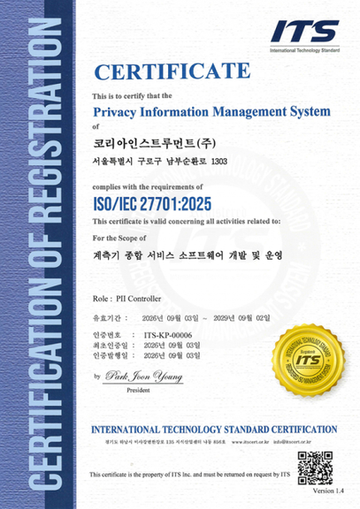
Korea Instrument, KOLAS Accredited Calibration Agency First to Simultaneously Acquire ISO/IEC 27,001·27,701
Korea Instrument has become the first among KOLAS accredited calibration agencies to simultaneously acquire ISO/IEC 27,001 and ISO/IEC 27,701 certifications. Through its proprietary platforms CWIZ Enterprise and CWIZ Partners, the company has embedded information security and personal data protection requirements across all business processes including customer information, equipment data, and calibration reports, with plans to continuously advance its management system through regular audits and security inspections.
2026.10.12by 배종인 기자
TeamViewer One, IT Incident Automation Workflow and Resolution Center Enhanced
TeamViewer has added IT incident automation capabilities and an advanced Resolution Center to its integrated digital workplace management platform 'TeamViewer ONE'. Recurrent service disruptions, configuration errors, and capacity shortages are automatically handled according to preset policies, and device status verification through script deployment can be managed in a unified interface, significantly reducing repetitive tasks for IT teams.
2026.10.12by 배종인 기자











