


The Ministry of Land, Infrastructure and Transport will launch the "2021 Smart City Certification Competition" in June.
 Published2021.05.06 09:11
The Korea Research Institute for Human Settlements Evaluation Committee accepts applications in June and announces them in August.
3 major fields, 10 evaluation items, and 63 detailed indicators
On the 6th, the Ministry of Land, Infrastructure and Transport launched the "2021 Smart City Certification Competition" to promote government-level smart city certification. The Smart City Certification System assesses the level of domestic smart cities using smart city performance indicators and grants certification and ratings to facilitate cross-city comparisons. It is used for smart city performance evaluations, the identification of outstanding smart cities, and the promotion of them.
Smart city diagnostic indicators are already being introduced overseas as tools for evaluating and disseminating smart city performance, such as the European Union's (EU) European Smart City Index, the International Organization for Standardization (ISO) Smart City Standard, Cisco's Smart City Index, and IBM's Smart City Performance Index.
Due to the lack of a standardized means of assessing the current status and level of smart cities in Korea, domestic smart cities have been undervalued overseas, and some local governments have had to individually challenge international evaluations, limiting the systematic development and self-sustaining advancement of smart cities.
The Ministry of Land, Infrastructure and Transport established the basis for introducing a certification system in the Smart City Act in 2017. In 2019, a pilot certification contest was held for 37 local governments with a population of over 300,000. As a result, 19 local governments applied and 10 local governments, including Seoul, Daejeon, Daegu, Ulsan, Sejong, Goyang, Gimhae, Bucheon, Suwon, and Changwon, obtained pilot certification.
Based on this, the Ministry of Land, Infrastructure and Transport established and announced the Smart City Certification Operational Guidelines in February of this year, detailing detailed evaluation indicators and certification methods after reviewing the pilot certification results and gathering feedback from experts and local governments. Smart City Certification will be granted to local governments that demonstrate high levels of innovation, have well-established governance and institutional environments, and effectively apply smart service technologies to local conditions, based on smart city indicators.
Smart city certification targets are categorized by local government size: large cities with a population of 500,000 or more, and small and medium-sized cities with a population of 500,000 or less. The certification evaluation is conducted by an evaluation committee comprised of experts from the Korea Research Institute for Human Settlements, the operating agency. The evaluation committee conducts written assessments and on-site inspections of quantitative and qualitative indicators across three major categories: ▲innovation, ▲governance and systems, and ▲service technology and infrastructure. The evaluation consists of 10 evaluation items and 63 sub-indicators.
The Ministry of Land, Infrastructure and Transport will receive proposals from local governments from June 28 to 30, evaluate them, and select the target cities in August. Each local government is evaluated on a five-level scale and certification is granted from level 1 to level 3. The level of the certified local government is made public, and the local government is given the opportunity to promote its smart city both domestically and internationally through the award of the Minister of Land, Infrastructure and Transport's commendation and bronze plaque.
We plan to provide evaluation results to all local governments that participated in the certification process, so that they can be used as reference material for diagnosing smart cities and promoting future smart city projects.
Choi Im-rak, Director General of Urban Policy at the Ministry of Land, Infrastructure and Transport, said, “If you look at each indicator, the structure is such that local governments that have actively established smart city plans and promoted smart city projects can be recognized as smart cities,” and added, “We will actively support cities that have received smart city certification so that they can grow into representative smart cities in Korea.”
Comments
Related news
South Korea’s Smart City Market Faces Challenges and Opportunities Amid COVID-19 Pandemic
As each nation's response to COVID-19 has become a focal point, the establishment of post-COVID measures that address not only quarantine system infrastructure but also changes in the overall social living environment and lifestyle has emerged as a new challenge in the smart city industry. While inter-organizational data sharing to prevent the spread of COVID-19 mitigates silos and generates an advanced level of smart city services, it simultaneously highlights the social agenda of privacy infringement.
2020.05.15by 이수민 기자
Demonstration of "smart city" services based on 5G's low-latency characteristics begins.
ETRI has developed a 5G drone-based control service solution and 5G CCTV-based intelligent road safety support service technology, and completed demonstration for precision control services. It can also be utilized for density analysis for quarantine management within buildings, making it useful for security control within buildings as well.
2020.12.07by 이수민 기자
Launching Mid-to-Long-Term Policy Council with Goal of Building 5G Industrial Ecosystem
The Ministry of Science and ICT held a launching meeting for the 5G+ Industrial Ecosystem Policy Council to foster a 5G+ convergence ecosystem. The policy council was organized in accordance with the 2021 5G+ Promotion Plan to lead the 5G+ industrial ecosystem globally. In addition to the industrial ecosystem policy council launched today, the policy council to strengthen public-private collaboration related to 5G comprises a total of seven entities, including five 5G services (smart factory, immersive content, digital healthcare, autonomous vehicles, and smart city) and 5G networks.
2021.03.25by 강정규 기자
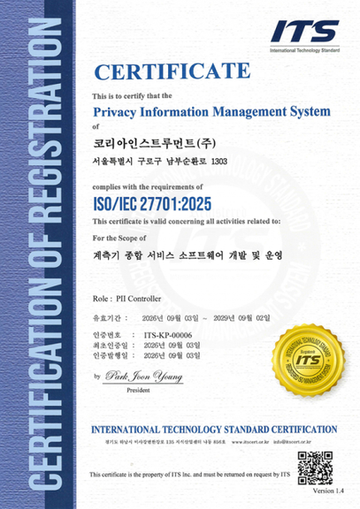
Korea Instrument, KOLAS Accredited Calibration Agency First to Simultaneously Acquire ISO/IEC 27,001·27,701
Korea Instrument has become the first among KOLAS accredited calibration agencies to simultaneously acquire ISO/IEC 27,001 and ISO/IEC 27,701 certifications. Through its proprietary platforms CWIZ Enterprise and CWIZ Partners, the company has embedded information security and personal data protection requirements across all business processes including customer information, equipment data, and calibration reports, with plans to continuously advance its management system through regular audits and security inspections.
2026.10.12by 배종인 기자
TeamViewer One, IT Incident Automation Workflow and Resolution Center Enhanced
TeamViewer has added IT incident automation capabilities and an advanced Resolution Center to its integrated digital workplace management platform 'TeamViewer ONE'. Recurrent service disruptions, configuration errors, and capacity shortages are automatically handled according to preset policies, and device status verification through script deployment can be managed in a unified interface, significantly reducing repetitive tasks for IT teams.
2026.10.12by 배종인 기자











