


Collaborative Robots: Reasons to Consider Before Transitioning to Smart Factories
 Published2021.05.13 08:48
Smaller than industrial robots and with fewer safety device restrictions
Smart factories, a convergence of information and communication technologies (ICT), are being adopted by many companies worldwide. The government is also implementing smart factory support projects, and funding for the robotics industry has increased. Domestic companies are also considering converting existing factories to smart factories.
In Europe, collaborative robots are being introduced as an early step in the transition to smart factories.
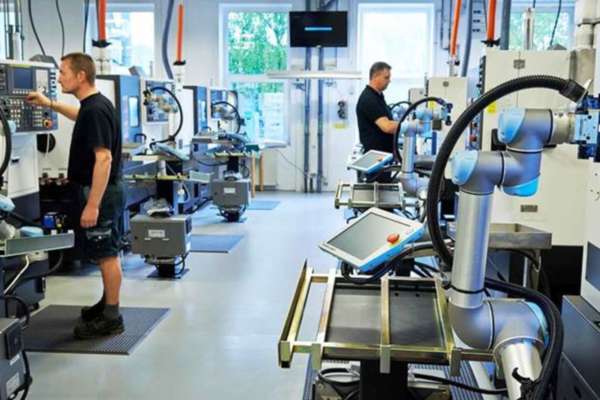
Denmark's Trelleborg Sealing Solutions has deployed the Universal Robots (UR) UR5 robot into its production facility to handle plastics and polymers and more efficiently process orders ranging from one unit to millions.
[Photo = Universal Robots]
UR robots, which take up little space and are relatively easy to deploy and programmable, have modernized the overall machinery in the workshop, enabling rapid production of large quantities. Trelleborg has installed a total of 42 UR robots to manage CNC machines, and the increased production has led to the hiring of approximately 50 additional employees.
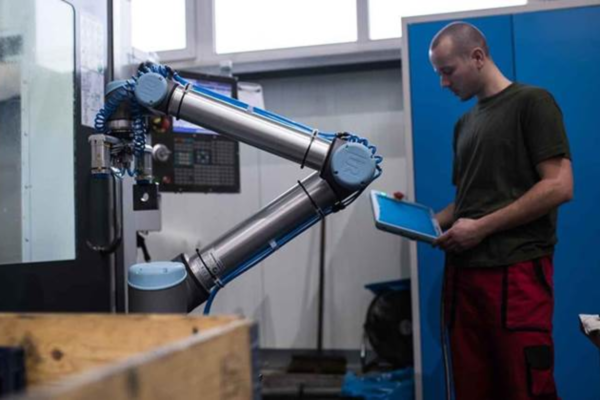
Czech company BAUMRUK&BAUMRUK has been partially automating processes such as warehouse storage and manufacturing using industrial robots. We also tried to automate the process of loading small parts into the milling center, but the factory space was so small that it was difficult to provide safety fences for industrial robots and space for workers.
[Photo = Universal Robots]
They decided to automate using collaborative robots, which do not require separate safety fencing. The company leveraged the flexibility of UR cobots to automate the loading process of its milling center, alternating machine tending with human workers.
Conventional industrial robots are large and pose safety risks. To prevent these risks, they are used in workplaces where workers are replaced by separate safety fences and other safety devices. Collaborative robots are smaller than industrial robots, requiring no additional safety devices, and they automatically stop working when they detect a certain level of power or force.
Furthermore, collaborative robots are not intended to replace workers, but rather to work alongside them, increasing work efficiency. Furthermore, they are more affordable than industrial robots, so many companies are implementing automation through collaborative robots. Rather than abruptly implementing full-scale automation to transition to a smart factory, introducing collaborative robots in small portions of the factory allows for sufficient partial automation at a lower cost.
Comments
Related news

ExoAtlet Asia Shows Off Wearable Robot Technology
Exo Athlete Asia unveiled wearable robot technology designed to assist in efficient rehabilitation treatment for patients with lower limb mobility impairment.
2021.04.23by 배종인 기자
.jpg)
Will paper-thin soft robots for underwater exploration be released?
A joint research team led by Professor Jo Kyou-jin from the Department of Mechanical Engineering at Seoul National University's College of Engineering has successfully developed a density distribution control technology in the form of thin skin and created new underwater behavioral patterns in paper-thin structures. Light and thin objects, such as tree leaves or paper, create diverse movements without special propulsion due to air resistance. The research team has identified that these movements are heavily dependent on the density distribution of the object, and that this effect is further maximized in underwater environments.
2021.04.24by 이수민 기자

KT Announces Service Robot Plan Based on AI Technology and 5G Infrastructure
KT held a meeting with promising robot companies attended by experts in the robotics field and announced its robot platform business plan. Lee Sang-ho, head of KT's AI Robot Business Division, stated that while the current robot market is dominated by industrial robots, service robots will take the lead from 2025 onwards, emphasizing that KT will elevate the level of the domestic robot market through service robots.
2021.04.28by 명세환 기자
Korea Instrument, KOLAS Accredited Calibration Agency First to Simultaneously Acquire ISO/IEC 27,001·27,701
Korea Instrument has become the first among KOLAS accredited calibration agencies to simultaneously acquire ISO/IEC 27,001 and ISO/IEC 27,701 certifications. Through its proprietary platforms CWIZ Enterprise and CWIZ Partners, the company has embedded information security and personal data protection requirements across all business processes including customer information, equipment data, and calibration reports, with plans to continuously advance its management system through regular audits and security inspections.
2026.10.12by 배종인 기자

TeamViewer One, IT Incident Automation Workflow and Resolution Center Enhanced
TeamViewer has added IT incident automation capabilities and an advanced Resolution Center to its integrated digital workplace management platform 'TeamViewer ONE'. Recurrent service disruptions, configuration errors, and capacity shortages are automatically handled according to preset policies, and device status verification through script deployment can be managed in a unified interface, significantly reducing repetitive tasks for IT teams.
2026.10.12by 배종인 기자











