



Will C-V2X surpass DSRC and become the cornerstone of autonomous driving infrastructure?
 Published2021.05.24 09:05
The Ministry of Land, Infrastructure and Transport and the Ministry of Science and ICT will finalize the C-ITS system within this year.
5G development must come first to prepare for the era of autonomous vehicles.
The U.S. government plans to adopt 'Cellular-Vehicle-to-Everything (C-V2X)' as a single standard for next-generation vehicle-to-everything (V2X) technology and implement it starting July 2.
The U.S. Federal Communications Commission (FCC) announced that it will proceed with its original plan to change the frequency use of the 5.9 GHz band, which limits the upper 30 MHz of the 75 MHz bandwidth to C-V2X use and the lower 45 MHz bandwidth to unlicensed services centered on next-generation Wi-Fi.
This will phase out WAVE, the vehicular short-range communication (DSRC) technology that has dominated the 5.9GHz band in the US for over 20 years. DSRC is an Intelligent Transport System (ITS) technology that uses the 5.8GHz band for short-range wireless communication between small roadside base stations and onboard equipment (OBEs) to exchange various types of information. In Korea, it is used for highway tollgate Hi-Pass and city bus location notifications.
The FCC finalized its Notice of Proposed Rulemaking (NPRM) for the 5.9 GHz band frequency change and held a public committee meeting in November last year to revise the administrative rule. Here, the five-member commission unanimously approved the change of use. Despite objections from the U.S. Department of Transportation (DOT), the National Transportation Safety Board (NTSB), the Association of State Highway and Transportation Officials (AASHTO), and ITS America, nothing changed.
This is because the FCC determined that a single C-V2X standard would be effective in the future, not only for vehicle safety but also for revitalizing the future automotive industry ecosystem. Furthermore, the move appears to take into account the growth potential of the C-V2X market, with the Chinese government adopting C-V2X as a single standard and the European automotive industry also promoting C-V2X activation.
The 5G Automotive Association (5GAA), an organization promoting the commercialization of 5G-based connected cars, supported the FCC's decision. Future 5G networks will enable real-time vehicle-to-vehicle communication, as well as various payment services linked to vehicles and central mobile communication servers.
◇ The Ministry of Land, Infrastructure and Transport and the Ministry of Science and ICT will finalize the C-ITS method within this year.
In Korea, the Ministry of Land, Infrastructure and Transport and the Ministry of Science and ICT (MSIT) formed a joint research team in November 2019 to examine the use of Wi-Fi-based DSRC standard WAVE and 5G-V2X as C-ITS. C-ITS is a next-generation intelligent transport system that provides drivers with real-time information on surrounding traffic conditions and accident risks while driving. The two ministries plan to finalize the C-ITS communication method and frequency band channel allocation for each method within this year.
The Ministry of Science and ICT (MSIT) maintains that prior to the commercialization of 5G-V2X, it must first verify the technological stability and practicality of its parallel use with WAVE through LTE-V2X demonstrations. Furthermore, with plans to decide on the use of the 5.9 GHz band in the first half of this year, attention is focused on the impact of this US decision. The Ministry of Land, Infrastructure and Transport plans to consider reflecting this when 5G-V2X is commercialized after implementing a WAVE-centric ecosystem rich in empirical data.
Some argue that with the FCC's finalization of the C-V2X single standard, Korea should also quickly select the C-V2X standard and build an industrial ecosystem early to respond to the US market, the largest automobile export market.
Korea Expressway Corporation, under the Ministry of Land, Infrastructure and Transport, plans to deploy C-ITS on all 4,075 km of domestic highways by 2025 through the Korean New Deal plan. The company began research on 5G-V2X technology adoption and service operation by ordering a research service through its electronic procurement system on March 22. Based on the research, the company plans to develop a plan for introducing 5G-V2X technology development services and support the promotion of V2X communication policies.
The study will examine the following: △Analyzing the 5G-V2X technology roadmap, case studies, and requirements reports; △Determining the interference impact of simultaneous operation of 5G-V2X and WAVE; and △Presenting a technology roadmap for parallel operation. Furthermore, the study will examine how the seven 5.9 GHz channels (each 10 MHz wide) should be allocated to WAVE and C-V2X and develop an operational plan for each channel.
◇ 5G-V2X, a technology that underpins autonomous driving
Level 3 autonomous vehicles are expected to be commercialized in earnest this year and next. According to the Society of Automotive Engineers (SAE)'s autonomous driving standards, Level 3, Conditional Automation, essentially involves a driver, but allows autonomous driving under limited conditions. While the driver must be able to intervene at any time, vehicle control can be delegated to the autonomous driving system (ADS), marking the true beginning of the autonomous driving era.
The FCC's decision to finalize a single C-V2X standard is interpreted as a move to prepare for the era of autonomous driving. It's nearly impossible to achieve safe autonomous driving solely with in-vehicle detection devices like sensors. This requires the development of C-ITS, a communication device and technology capable of transmitting real-time information collected from other vehicles and objects outside the vehicle.
Considering vehicle speeds of tens of kilometers per hour on average, 5G NR, with its ultra-low latency of 1 ms, is currently the optimal wireless communication technology available. Autonomous vehicles cannot develop without C-ITS infrastructure. For South Korea to take the lead in the autonomous driving market, close cooperation between the Ministry of Land, Infrastructure and Transport (MOLIT), which manages road infrastructure, and the Ministry of Science and ICT (MSIT), which oversees communications infrastructure, is essential, as is swiftly determining frequency usage.
Comments
Related news
u-blox Launches VERA-P3 Module, Increasing Accessibility of V2X Technology
u-blox announced a new V2X module product, VERA-P3. VERA-P3 packages the UBX-P3 chip into an easy-to-use module form, enabling automotive OEMs, Tier 1 suppliers, and traffic management infrastructure manufacturers to integrate and commercially deploy V2X technology into their platforms and solutions.
2020.05.20by 이수민 기자

Activating 5G V2X infrastructure hinges on mobile relay technology.
5G services must now guarantee performance satisfactory to diverse users in various environments. Relay technology extends mobile communication coverage and enables cost-effective network construction. In particular, mobile relays offer high handover efficiency by relaying between base stations and terminals while in motion through methods such as vehicle-mounted installation.
2020.05.26by 이수민 기자
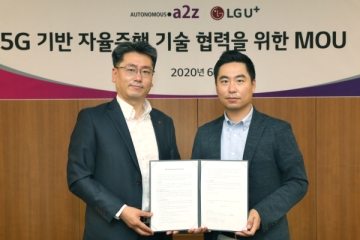
U+ Signs MOU with a2z for 5G-Based Autonomous Vehicle Demonstration
LG Uplus and Autonomous A2G are launching an autonomous driving service demonstration project together. The two companies have signed an MOU and agreed to establish detailed cooperation plans, including the formation and operation of a working-level consultative group. Under this agreement, LG Uplus will provide V2X technology support, while Autonomous A2G will supply the autonomous vehicle platform.
2020.06.14by 명세환 기자
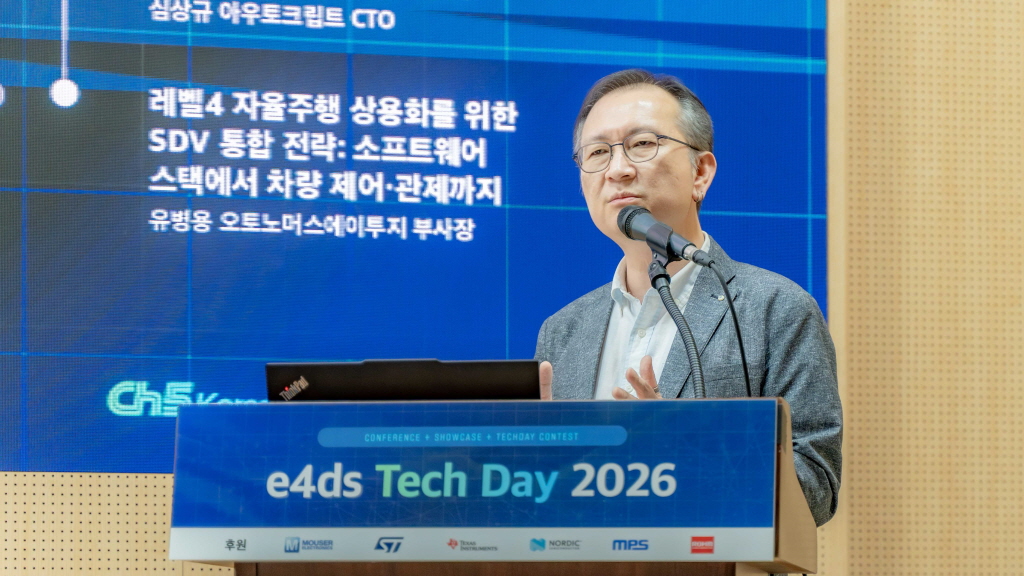
[e4ds Tech Day 2026 ⑨] Sim Sang-gyu, Autocrypt CTO: "In the Physical AI Era, Automotive Security Must Extend Beyond the Vehicle"
At e4ds Tech Day 2026, Sim Sang-gyu, CTO of Autocrypt, explained automotive cybersecurity strategies in the era of Physical AI and SDV (Software-Defined Vehicle). Automobiles are evolving as part of an ecosystem connected to AI, cloud, chargers, IoT, and robots, and he emphasized that the scope of security must expand beyond the vehicle interior to the entire connected environment. In particular, AI model tampering, adversarial attacks, OTA updates, and EV charger hacking were identified as major threats. He explained that response measures require zero trust, AI model integrity protection, intrusion detection, Security by Design and Default, and full lifecycle security management, and that proactive security system establishment beyond regulatory compliance is critical for securing future mobility competitiveness.
2026.10.12by 배종인 기자

Practical HIL Construction Strategy for Automotive and Off-Highway Controller Validation
As vehicle E/E architecture transitions to zonal structures and shifts to software-defined vehicles (SDV), the number of controllers (ECUs) requiring validation and software complexity are surging dramatically. Meanwhile, real vehicle testing cannot provide repeated verification under identical conditions and entails lead time and safety concerns. This white paper explains the principles of HIL (Hardware-in-the-Loop) validation and the structure of the NI platform composed of PXI, SLSC, and VeriStand, and through two actual implementation cases—Camera Record & Replay HIL for In-Cabin Monitoring Controller (ICMU) and Forklift Controller (VCU) HILS—describes how controller-level regression testing becomes possible. Additionally, it explicitly states application boundaries and limitations, such as lack of A2B support.
2026.10.12by 편집부











