


Maxim, Provides EoAT Reference Design for Industrial Robots
 Published2021.05.27 10:05
Trinamic TMCM-1617-GRIP-REF Launched
Hardware-Based Vector Control and IO-Link Integration
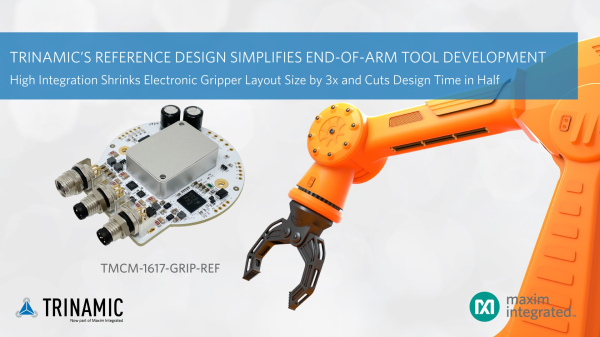
Maxim Integrated Korea announced on the 27th the launch of Trinamic's open-source, fully integrated 'TMCM-1617-GRIP-REF' reference design that simplifies EoAT (End-of-Arm Tooling) development for industrial robots.
[Image=Maxim]
The TMCM-1617-GRIP-REF reference integrates hardware-based vector control (Field-Oriented Control; FOC), software-configurable input/output, and three communication protocol stacks within 4,197 mm² to reduce gripper size by up to one-third. Additionally, it provides motor control algorithms and protocol stacks, cutting EoAT development time in half.
Equipped with Maxim's 'MAX22000' industrial high-precision configurable input/output and 'MAX14906' quad-channel digital input/output, it enables control of various modes in Trinamic's 'TMCM-1617' single-axis servo driver, enhancing flexibility for improved factory productivity.
Designed to the standard EoAT gripper form factor, it supports EtherCAT, IO-Link, and RS-485 communication. Software-programmable analog/digital input/output is also provided. Configuration is possible using Trinamic's 'TMCL-IDE' motion control language integrated development environment.
Jeffrey DeAngelis, Vice President of Industrial Communication Business at Maxim, stated, "Industrial automation engineers need toolkits that simplify the development and test operation of robot EoAT solutions," and added, "The TMCM-1617-GRIP-REF reference design simplifies the tooling development process, enabling automation engineers to focus on state-of-the-art real-time EoAT solutions that deliver true intelligence at the edge."
Regarding this reference design, Jonas Proeger, Business Management Director at Trinamic, stated, "It relieves the burden of implementing motor control algorithms and protocol stacks for EoAT," and noted, "By providing state-of-the-art bus options, control algorithms, and diagnostic functions as a single solution, it enables increased factory productivity and intelligent edge implementation."
Comments
Related news
U+ to Deploy 5G MEC-Based Robots at Gwangju May 18 Center
LG UPlus announced that it has secured a contract for a business project to discover 5G convergence services utilizing MEC and lead public sector application at the 5.18 Memorial Culture Center in Gwangju Metropolitan City and other venues. MEC is a network technology that processes data at locations close to users, such as base stations and exchanges, without transmitting it to backbone networks or data centers. It reduces traffic load on backbone networks and minimizes latency for specific services.
2021.05.17by 이수민 기자
Maxim Launches Trinamic Servo Controller and Driver Module
Maxim Integrated has launched the TMCM-1321, a single-axis servo controller and driver module from Trinamic, which offers ultra-compact size and lowest power consumption. It enables the implementation of 2-phase bipolar stepper motors in robotics and automation equipment, optimizing axis speed and synchronization. It features Trinamic's six-point ramping technology with advanced S-curve ramping as well as linear ramping, increasing processing speed and effective transmission rate.
2021.05.20by 강정규 기자
Universal Robots Unveils '12.5kg' UR10e with Increased Payload
Universal Robots has announced the launch of the UR10e with an improved payload capacity increased by 25% from 10kg to 12.5kg at the same price as before. It can be operated even in space-constrained environments and can be utilized for palletizing, machine tending, and packaging applications. The enhanced payload capacity reduces strain on workers' hands and shoulders, improving the working environment.
2021.05.21by 이수민 기자
Camera for Both Humans and Machines: ST BrightSense 5MP Dual Shutter Image Sensor
Video consumed by humans and imagery analyzed by machines impose different requirements on the sensor in terms of shutter method and wavelength band. Until now, sensors had to be separated or supplemented with companion chips and high-performance processors, and this cost and complexity became a bottleneck in vision system design. The ST BrightSense next-generation 5MP image sensor (VD5943, VD1943, VB5943, VB1943) with 2.25 µm pixels supports both global and rolling shutters, and through on-chip staggered HDR (up to 100 dB), on-chip RGB-IR separation and 5MP NIR smart upscaling, and frame-by-frame context switching, absorbs both requirements internally at the sensor level. This white paper describes the rationale, choices, trade-offs, and results of each design decision based on presentation slides and technical Q&A, and specifies application boundaries. The product is scheduled for mass production in February 2026, and evaluation and sampling are currently available.
2026.10.13by 편집부

AI-based Universal Robots Automation Solution
In manufacturing environments where declining labor populations overlap with frequent production item changes, existing programming-based robot automation requires reconfiguration from weeks to several months each time product models change. This white paper takes this flexibility gap as its starting point and synthesizes, based on webinar presentation materials and technical Q&A, what collaborative robots gain and forfeit compared to industrial robots, why process automation is transitioning from rule-based to learning-based (4th generation) approaches, and how Universal Robots' hardware, software, and partner ecosystem implement this. Additionally, it clarifies the application boundaries and limitations, including that AI Accelerator is still at the development kit stage.
2026.10.13by 편집부











