


U+ Builds Quantum Cryptography Communications Pilot Infrastructure at Power Plant
 Published2021.05.27 10:30
Construction of a PQC line between the South Chungcheong Provincial Office and the Civil Service Training Institute.
Development of security services for entertainment and energy companies
Quantum-resistant cryptography (PQC) offers high scalability, applicable to key security elements such as cryptographic key exchange. It can transmit data over long distances, exceeding hundreds of kilometers, and can be implemented solely through software without any additional equipment, making it a key security technology for the upcoming era of quantum computing.
The LG Uplus consortium, comprised of LG Uplus, Seoul National University, Crypto Lab, ICTK, and Dream Security, announced on the 27th that it had won a PQC-related project, hosted by the Ministry of Science and ICT and commissioned by the National Intelligence Information Society Agency (NIA). Following last year's efforts in the medical and industrial sectors, the consortium expanded the scope of its PQC demonstration to include the public and private sectors this year.
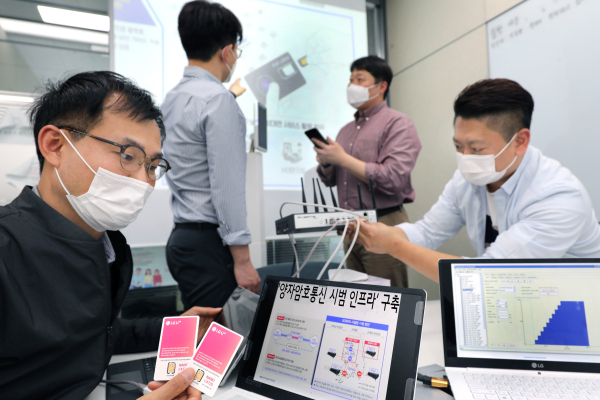
[Photo = LG U+]
In the public sector, the consortium plans to build a dedicated PQC line between the South Chungcheong Provincial Office and the Civil Servants Training Institute. The distance between the provincial office in Hongseong, South Chungcheong Province, and the Civil Servants Training Institute in Gongju is 137km. Personal information such as resident registration numbers, driver's licenses, and account numbers must be encrypted when stored in databases. The consortium plans to utilize PQC to encrypt the database of sensitive information of residents generated during the Chungnam Provincial Government's operations.
In the private sector, dedicated PQC lines are built for entertainment companies and power plants.
The consortium will apply PQC technology to entertainment companies' dedicated lines to strengthen the security of their intellectual property and creative works. They plan to develop a PQC-based authentication platform and utilize it for concert ticket reservations and authentication, thereby expanding PQC technology to the B2C sector.
GS EPS plans to establish a PQC line between its Dangjin and Seoul offices, power generation facilities requiring high security, to proactively prevent large-scale power outages caused by cyberattacks. Security will also be enhanced by developing a facial recognition access system utilizing PQC technology.
LG Uplus is expanding the scope of PQC applications through the government's New Deal initiatives. Following its application to optical communication equipment (ROADM) and USB-type security tokens (Q-PUF USB), which can be used in small devices, LG Uplus is expanding its scope to include other applications. The strategy is to create a full-layer security system that will remain effective even in the era of quantum computing.
The consortium recently received testing and verification from the Telecommunications Technology Association (TTA) for the PQC dedicated lines it built in the industrial and medical fields, proving their effectiveness.
Comments
Related news
Korea's first quantum security chip for IoT devices to be commercialized in the first half of next year
LG Uplus, LG CNS, ICT-K Holdings, and IWL announced that they have successfully developed Korea's first quantum security chip (QPUF) for IoT terminals. The chip employs a quantum random number generator (QRNG) to increase the randomness of encryption, making it safer against hacking threats compared to products equipped with a true random number generator (TRNG).
2020.12.27by 이수민 기자
U+, USB Type PQC Security Token "Applied to Medical Fields"
In the quantum computing era, authentication technology that identifies the target for encrypted communication and verifies that data has not been tampered with is critical. LG Uplus has developed Q-PUF USB, a USB-type security token, by upgrading post-quantum cryptographic algorithms to address security threats during authentication in collaboration with ICTK Holdings.
2021.01.20by 이수민 기자
.jpg)
KT Unveils Quantum Cryptography Technology to Strengthen ‘Eavesdropping Prevention’ Secret Communications
KT and EYL have developed technology that enables quantum cryptographic encrypted communication without the use of dedicated terminals. By applying this technology, encrypted communication is possible using standard smartphones, allowing private enterprises to easily build quantum cryptographic encrypted communication systems. The two companies have enhanced security by combining a quantum random number generator (QRNG) and a quantum key distribution system (QKD).
2021.03.11by 이수민 기자
.png)
Databricks Unveils Open AI Security Monitoring 'Lakewatch'
Databricks entered the security market on March 24 by unveiling LakeWatch, an open-source agentic SIEM. The core functionality of this product is to integrate and analyze security, IT, and business data in a single environment to support AI-based threat detection and investigation. The company explained that it reduces the limitations of existing security operations centers, which have had to forgo some data due to high cost structures, and enables large-scale data analysis and automation based on open formats and ecosystems. LakeWatch is currently offered as a private preview, with Adobe and Dropbox mentioned as early customers. Databricks also announced an expanded partnership with Anthropic as well as the acquisition of Antimatter and SiftD.ai.
2026.03.26by 배종인 기자
Kaspersky Unveils Revamped 'NEXT' Combining SOC Integrated Management and AI Analytics
As enterprises increase demand for integrated management and automation in the construction and operation of Security Operations Centers (SOC), Kaspersky has disclosed updates to its B2B security product suite 'Kaspersky Next'. This update expands EPP, EDR, XDR, and SIEM integration through a single console based on OSMP, incorporates AI capabilities such as DLL hijacking detection and suspicious account takeover behavior identification, and includes integration with generative AI assistant tool KIRA. The company stated that in large-scale deployment environments, EDR Expert can reduce resource requirements by up to 30%, and XDR Expert by up to 60%.
2026.03.25by 배종인 기자











