



Selectively generate quantum light sources at room temperature
 Published2021.06.22 14:18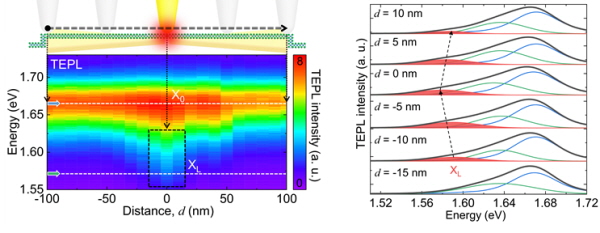
▲Room-temperature quantum light source measurement results using a resonant nanomicroscope. (Left) Spectra measured by adjusting the probe position of a probe-enhanced photoluminescence nanomicroscope. A single quantum light source is observed near the center where the triple antenna structure is formed. (Right) Spectra observing the trend of a single quantum light source more precisely near the center.
A technology has been developed that can generate a bright quantum light source at a desired location at room temperature without the need for cumbersome cryogenic equipment such as existing liquid nitrogen, liquid helium, or temperature control equipment, and it is expected to contribute to the commercialization of light-based quantum communication in the future.
The National Research Foundation of Korea (NRF, President Jeong-Hye Noh) announced on the 22nd that a joint research team (co-authors Professor Moon-Seok Jeong of Sungkyunkwan University, Professor Hong-Gyu Park of Korea University, etc.) including Professor Kyung-Deok Park (Ulsan National Institute of Science and Technology, first author Researcher Hyeong-Woo Lee), Professor Jun-Seok Noh (Pohang University of Science and Technology, joint first author Dr. In-Ki Kim) and others have developed a technology that can stably generate a quantum light source of a two-dimensional material at room temperature.
In order to actually use it as a light source for a device, it was necessary to control the location of the quantum light source, which exists randomly at any location. Another challenge that had to be overcome was the possibility of generating and detecting quantum light sources only at low temperatures.
Existing nano-optical resonators can control the position of the light source, but have limited spatial resolution, and probe-enhanced photoluminescence nanomicroscopes have high resolution, but it is difficult to generate quantum light sources.
Accordingly, the research team combined these two and designed a light control and measurement system using a new concept called resonant nanomicroscopy.
Through prior research, a nano-optical resonator with an atomic-level sharp bow-tie shape was fabricated using a continuous domino lithography process, enabling the generation of a quantum light source from a two-dimensional semiconductor material at a desired location.
In this study, by combining a photoluminescence nano-microscope with this resonator and inducing a triple antenna effect, a quantum light source was generated with high efficiency, and the quantum light source could be detected with a spatial resolution of approximately 15 nanometers (about one-tenth of the thickness of a human hair) at room temperature.
In fact, it was confirmed that the quantum light source created in this way was 40,000 times brighter than a semiconductor quantum light source that did not apply the antenna effect.
This means that the light emitted from one LED with the triple antenna effect is equivalent to the brightness of light emitted from 40,000 existing LEDs.
The research team expects that it can be used as a light source for quantum information communication devices and as a tool for understanding quantum materials at the nanoscale.
It is also explained that it can be applied to detect weak optical signals of various nanomaterials with high sensitivity.
To further improve the stability and quality of quantum light sources, the research team is conducting comparative studies on various plasmonic structures.
The results of this research, which was supported by the New Researcher Program and Mid-career Researcher Program of the Ministry of Science and ICT and the National Research Foundation of Korea, were published in the international academic journal in the field of materials physics, Advanced Functional Materials.It was published (online) on June 18 in ‘Journal of Functional Materials’.
Comments
Related news

UNIST Dino Team Wins Hackathon
A zombie game created by UNIST students with their distinctive ideas and technical skills was selected as the best work at the hackathon.
2021.06.08by 강정규 기자

UNIST, Durability and Efficiency of Honeycomb-Type Thermoelectric Generators ↑
A research team at UNIST (President Lee Yong-hoon) comprising Professors Son Jae-sung and Chae Han-ki from the Department of Materials Science and Engineering, along with Professor Kwon Beom-jin from Arizona State University, has developed a technology to enhance thermoelectric generator durability and efficiency by 3D printing copper-selenide (Cu2Se), a thermoelectric material, into a honeycomb structure. The ability to produce complex honeycomb structures through 3D printing was made possible by newly developing an ink composed of thermoelectric material.
2021.06.16by 강정규 기자

UNIST Integrates Adaptive Optics Technology with Scanning-Enhanced Nanoscopy
Professor Park Kyung-deok's team in the Department of Physics at UNIST has developed a new optical analysis technique that integrates adaptive optics technology into tip-enhanced nano-microscopy. Like a chameleon that can freely adapt its observation method depending on the target being observed, it is garnering expectations that it will enable analysis of characteristics of various types of ultra-fine particles—such as biological viruses, chemical single molecules, and semiconductor particles—using a single microscope.
2021.06.17by 배종인 기자
Schneider Aims for Building Energy Savings and Operational Stability with Next-Generation HVAC Drives
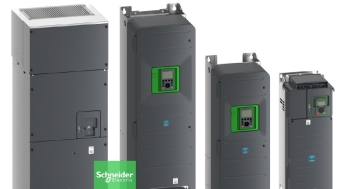
Schneider Electric has unveiled its next-generation HVAC drive product line 'Altivar HVAC'. The new product line's key features center on enhanced energy savings, system operational stability, and building management system integration. The products are divided into 'ATH200' for OEM and small equipment applications, and 'ATH600' for environments requiring continuous operation and advanced control. The company plans to expand the application scope from commercial buildings to facilities where HVAC system stability is critical, such as hospitals, airports, and data centers. The announcement includes over 30% energy savings, operation from -10°C to +60°C, Modbus and BACnet support, and compatibility with low global warming potential refrigerants.
2026.03.26by 명세환 기자

Ecolab Expands AI Data Center Cooling Business Through Acquisition of CoolIT
Ecolab has agreed to acquire CoolIT Systems, a liquid cooling company for AI data centers, for approximately $4.75 billion. The transaction is expected to close by Q3 2026, subject to regulatory approvals. CoolIT has been supplying direct-to-chip cooling-based coolant distribution units, cold plates, and manifolds, serving hyperscale data centers and colocation operators as customers. This acquisition is a measure to address the high-heat and high-density server environments created by AI proliferation. Ecolab plans to combine its water management and digital monitoring capabilities with CoolIT's hardware technology to expand its data center cooling business.
2026.03.26by 명세환 기자











