


ON Semiconductor Unveils Industrial 'Global Shutter' Image Sensor
 Published2021.07.28 12:18
16 megapixels, 1W consumption at 65 fps
Global shutter implementation suitable for industrial and transportation sectors
ON Semiconductor announced on the 28th that it has added the 'XGS 16000' product to its XGS CMOS image sensor product line. The new product is a 16-megapixel sensor that delivers high-quality global shutter imaging for various factory automation applications such as robotics and inspection systems.
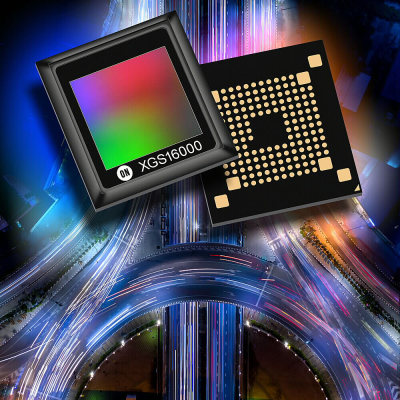
The XGS 16000 is designed to operate in a low-power state, consuming only 1W at 65 frames per second. At the same time, it supports resolution for standard 29 × 29mm industrial cameras.
The new product supports the same architecture and footprint as other XGS CMOS image sensors, allowing manufacturers to develop products with different resolutions through a single camera design. It supports various speed grades as well as both Bayer color and monochrome options.
By implementing global shutter pixels, it also resolves motion blur and distortion issues caused by rolling shutter pixels. This is critical for automation, precision inspection, and identification applications.
Toshiba Teli has adopted the XGS 16000 sensor in its latest 16-megapixel industrial camera. The DDU1607MG/MC delivers 16-megapixel color and monochrome resolution at 47 frames per second via a DUAL USB3 interface.
The new product with a 1:1 aspect ratio design maximizes the image capture area within the camera lens optical circle and ensures optimal light sensitivity. It is compatible with the 29mm² industrial standard camera format using commercially available C-mount lenses. Therefore, the field of view and sensor area can be optimized according to the actual camera size.
ON Semiconductor provides color and monochrome versions of the XGS 16000 X-Cube and X-Celerator developer kits to simplify new camera designs. Additionally, it provides examples of high-speed conversion to the MIPI interface along with reference design kits to enable faster integration into standard FPGA evaluation environments.
Comments
Related news

ON Semi Provides Base Technology and Products for Subaru ADAS System
ON Semiconductor announced that it has contributed to enhancing the ADAS-related technological capabilities of Subaru, a Japanese automotive manufacturer. Subaru's ADAS system, EyeSight, identifies road conditions through machine vision and communicates this information to the driver. Subaru designed an architecture with ON Semiconductor that ensures high-quality data flows into high-performance algorithms through ON Semiconductor's AR0231AT CMOS image sensor, and also incorporated an improved version of ON Semiconductor's LFM functionality.
2021.04.29by 명세환 기자
Samsung Electronics begins mass production of 0.64㎛ pixel image sensors.
Samsung Electronics is launching the "ISOCELL JN1," a 50-megapixel image sensor with the industry's smallest pixel size of 0.64㎛ (micrometer), thereby actively supporting slim design for high-megapixel mobile cameras.
2021.06.10by 배종인 기자
Samsung Electronics Launches Automotive Image Sensor with Enhanced Low-Light Detection
Samsung Electronics announced its launch of the ISOCELL Auto 4AC, an automotive image sensor, signaling a full-scale expansion of its image sensor product lineup from mobile to automotive applications. The ISOCELL Auto 4AC is a product equipped with 1.2 megapixels in a 1/3.7-inch optical format, and is planned to be mounted in surround-view monitors and rear-view cameras that allow drivers to view the exterior from inside the vehicle.
2021.07.15by 명세환 기자

Intel Unveils Next-Generation 'Core Ultra Series 3' and vPro Platform for Enterprise PCs
Intel has officially unveiled the "Intel Core Ultra Series 3" for next-generation enterprise PCs and the latest vPro platform, addressing a wide range of demands from enterprise notebooks to high-performance workstations.
2026.03.26by 배종인 기자
ROHM Launches ESD Protection Diode Compatible with High-Speed Interfaces of 10Gbps or Higher
Semiconductor specialist ROHM has developed the 'RESDxVx series' of ESD (electrostatic discharge) protection diodes capable of responding to next-generation high-speed data communication environments exceeding 10Gbps, simultaneously enhancing both signal quality maintenance required in high-speed interfaces and IC protection performance.
2026.03.26by 배종인 기자











