



OPC-UA and TSN to Enhance Smart Factory Connectivity
 Published2021.08.23 16:54
As the volume of data produced increases, compatibility and connectivity become important
TSN-based OPC-UA, Key to Industry 4.0 Implementation
Factory automation collects data individually as automation and optimization are carried out on a unit-by-unit basis. In contrast, smart factories can collect data integrally, allowing for data linkage. To link the data collected by countless processes and equipment within a factory, it is facilitated by utilizing a supplier-independent factory automation application communication protocol called 'OPC-UA (Open Platform Communications Unified Architecture).'
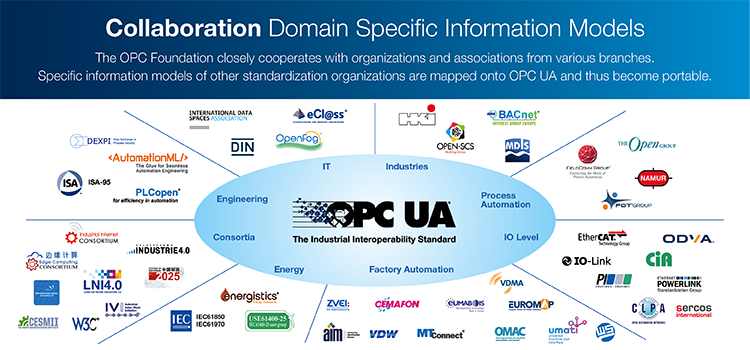
[Image = OPC-UA Foundation]
Flexible and completely independent OPC-UA bridges the gap between the IP-based world of the factory's IT domain and the production site. All production process data is transmitted within the equipment, between equipment, or between equipment and a cloud database using a single protocol.
As the size of data and the number of equipment being produced increase, a Time Sensitive Networking (TSN) standard that is at least 10 times faster than existing industrial Ethernet standards is required to maximize the potential of the OPC-UA protocol.
◇ OPC-UA, an open protocol suitable for smart factory implementation
OPC-UA originated from OPC (OLE for Process Control). As industry demand for smart factories grew, the OPC Foundation changed the definition of OPC to 'Open Platform Communication'. Currently, almost all factory automation equipment suppliers, including Siemens, Rockwell, and Mitsubishi, supply products with the OPC-UA protocol built-in.
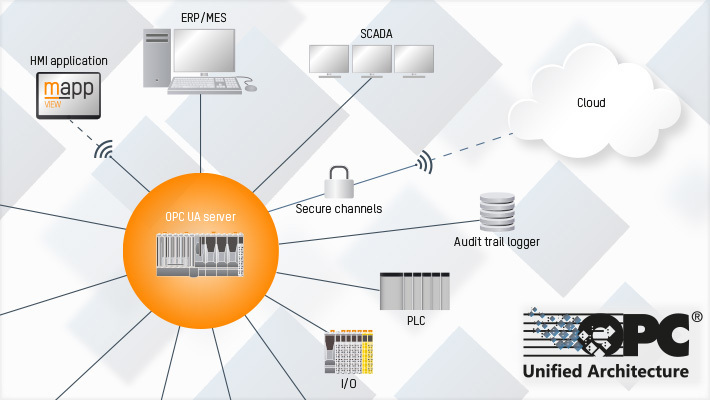
OPC-UA [Figure=B&R]
Smart factory engineers in the industry are grappling with how to integrate existing industrial fieldbus standards with the OPC-UA protocol. While this can be resolved by developing additional features internally, it creates a problem of incompatibility with products from other companies. Accordingly, the OPC-UA Foundation provides 32 information models.
This model includes industry-standards along with guidelines on how to handle events generated by each component when utilizing OPC-UA. As an open protocol, OPC-UA can be used on any enterprise's equipment and operating system (OS). In other words, it is an ideal protocol for enhancing smart factory connectivity.
◇ TSN, a next-generation standard that enhances the industrial applicability of Ethernet
Currently, industrial Ethernet operates at a speed of 100 Mbps. As the amount of data to be processed increases due to the advancement of automation facilities and the high performance of equipment, the need for Gigabit Ethernet standards has arisen, leading to the emergence of the TSN standard, a next-generation industrial Ethernet standard.
A characteristic of the TSN standard is that it possesses both real-time capability and time determinism simultaneously.
Real-time refers to the real-time connection between devices within the same network. While there may be some delay when viewed in clock units, the devices perceive this as real-time. In the field of automation, real-time refers to how often and at what frequency robot controllers, motion controllers, PLCs, and other devices communicate.
In the field of automation, time determinism refers to the ability of components to process real-time communication within a defined timeframe. High-performance communication is only possible when it operates consistently at specific intervals. This serves as a critical factor in high-speed I/O processing and synchronous control.
TSN is a standard that is continuously being refined. Automation companies are striving to convey industry opinions to the IEEE by establishing the 'IIC (Industrial Internet Consortium) TSN Interoperability Testbed.' Network switches are a representative TSN-related product. This is because it has become important to properly connect network systems that are growing massive due to gigabit speeds. Companies participating in the IIC are manufacturing numerous network switches.
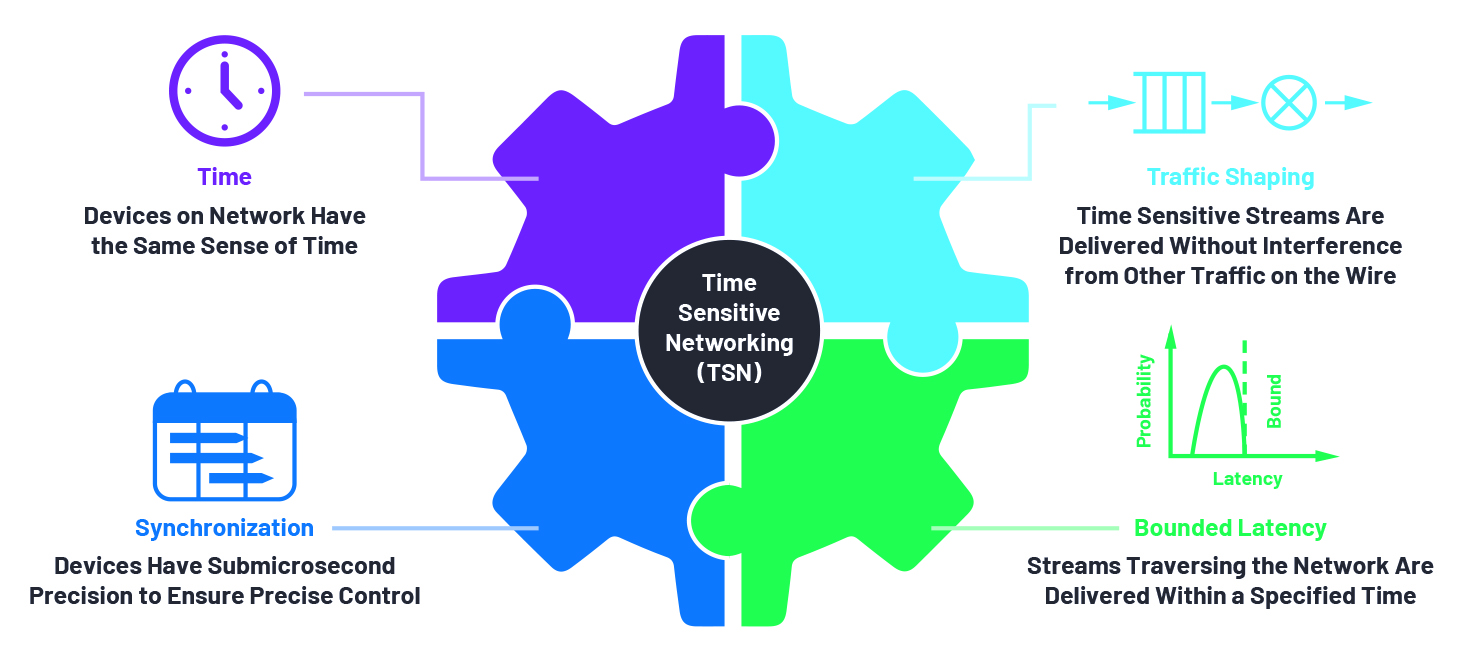
Supported TSN standards [Figure=ADI]
If TSN is a highway, OPC-UA defines the specific types of vehicles that can operate on it. Although the OPC-UA protocol is currently used in 100Mbps Ethernet, the demand for data processing in smart factories continues to increase. This means that the number of components that can be connected to the network system is increasing.
Connecting sensors at the lowest level to equipment at the highest level via a neural network (NN) is a fundamental requirement for smart factories. Without an NN, gateways or middleware are required to connect them. This slows down speeds and hinders determinism, thereby increasing production costs. Therefore, the TSN standard is an essential network technology for systems such as Cyber Physical Systems (CPS).
Comments
Related news
.jpg)
Moxa and Xilinx to Unveil TSN Technology Collaboration Results in China
Time Sensitive Networking (TSN) is a technology that introduces predictable latency capabilities to standard Ethernet, enabling the delivery of critical data at precise moments to the right locations in large-scale integrated industrial networks. Moxa stated that it is accelerating TSN technology development with Xilinx for industrial automation and mass customization production.
2020.12.10by 이수민 기자
Microchip Unveils Family of TSN IEEE Standard Ethernet Switches
Microchip has launched the SparX-5i Ethernet switch product family, which supports major TSN IEEE standards. By providing various standards on a single chip, it ensures end-to-end transmission of high-priority traffic with low latency. Additionally, it supports standard L2/L3 Ethernet with maximum bandwidth of 200G.
2021.02.05by 이수민 기자
NXP Unveils Processor Supporting CC-Link IE TSN Protocol
NXP announced a TSN solution for industrial automation supporting the CC-Link IE TSN protocol in collaboration with PORT. NXP implemented the CC-Link IE TSN Layer-2 stack on the LS1028A industrial application processor and i.MX RT1170 crossover MCU, while PORT provides the CC-Link IE TSN master station stack, remote station stack, and ICC tool for remote stack configuration to enable integration of the CC-Link IE TSN protocol into both chips.
2021.02.26by 이수민 기자
Korea Instrument, KOLAS Accredited Calibration Agency First to Simultaneously Acquire ISO/IEC 27,001·27,701
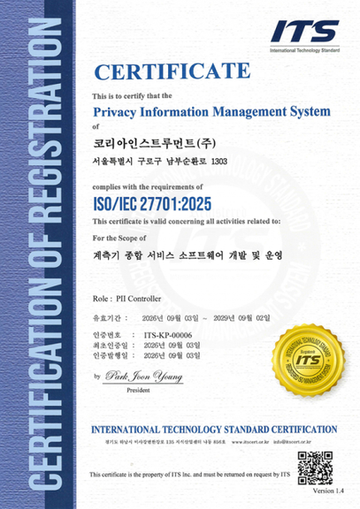
Korea Instrument has become the first among KOLAS accredited calibration agencies to simultaneously acquire ISO/IEC 27,001 and ISO/IEC 27,701 certifications. Through its proprietary platforms CWIZ Enterprise and CWIZ Partners, the company has embedded information security and personal data protection requirements across all business processes including customer information, equipment data, and calibration reports, with plans to continuously advance its management system through regular audits and security inspections.
2026.10.12by 배종인 기자
TeamViewer One, IT Incident Automation Workflow and Resolution Center Enhanced
TeamViewer has added IT incident automation capabilities and an advanced Resolution Center to its integrated digital workplace management platform 'TeamViewer ONE'. Recurrent service disruptions, configuration errors, and capacity shortages are automatically handled according to preset policies, and device status verification through script deployment can be managed in a unified interface, significantly reducing repetitive tasks for IT teams.
2026.10.12by 배종인 기자











