


The Korea Agency for Technology and Standards (KATS) has established a standard for data exchange between smart manufacturing systems.
 Published2021.09.13 11:25
Samsung SDS, Thezone BizOn, MI Cube Solutions,
Proving interoperability of standards with participation from Bitcon and others
The Ministry of Trade, Industry and Energy's National Agency for Technology and Standards established a national standard (KS X 9101) on the 9th that regulates data exchange methods between smart manufacturing systems. At the "Smart Manufacturing National Standard Conference," a side event of the "Smart Factory Expo + Automation World 2021," a demonstration verifying interoperability between manufacturing systems from different companies using the new standard was also presented.
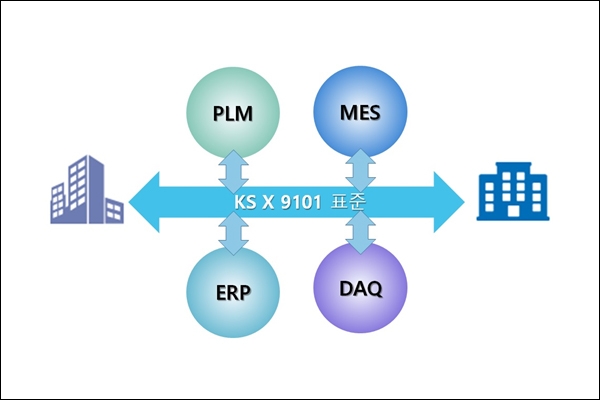
KS X 9101 Standard [Image = National Institute of Standards and Technology]
Smart manufacturing systems include enterprise business systems for executing, managing, and monitoring the entire manufacturing process, such as Enterprise Resource Planning (ERP), Manufacturing Execution System (MES), Product Life-cycle Management (PLM), and Data Acquisition System (DAQ). This standard unifies the data formats expressed differently for each smart manufacturing system, enabling data linkage between different systems.
Each system expresses "item name" differently, such as "NAME" or "NM_ITEM." When exchanging data, the standard will be defined as "ItemName," allowing both systems to recognize the data as "item name." This new standard is expected to reduce the time and cost companies have previously invested in data linking to integrate different business systems.
On this day, under the supervision of the Korea Testing Laboratory (KTL), Samsung SDS's Product Lifecycle Management (PLM), Douzone Biz On's Enterprise Resource Planning (ERP), MI Cube Solutions' Manufacturing Execution System (MES), and Bitcon's Data Acquisition System (DAQ) participated in the verification.
Interoperability involves converting data items that differ across manufacturing systems using this standard, allowing them to be recognized as identical when exchanging data. The demonstration demonstrated this approach across the entire manufacturing process, from product development and production to performance management. This demonstrated the feasibility of standards-based interoperability between systems.
From this year to 2024, KATS plans to invest 5.5 billion won in the "Development of Data Standards in the Smart Manufacturing Field and Establishment and Operation of a Verification System" project. This will apply the standards to actual manufacturing sites and verify their tangible effects. Lee Sang-hoon, President of KATS, stated, "Through smart manufacturing standardization policies, we will support the digital transformation of domestic industries."
Comments
Related news
.jpg)
Dassault Systèmes and Kyungnam University Join Hands to Cultivate Smart Manufacturing Talent
Dassault Systèmes has signed a Memorandum of Understanding (MOU) with Kyungnam University to cultivate core talent to lead the fourth industrial revolution and smart manufacturing industry, and will cooperate to develop key talent and expand recruitment opportunities for university students in the region.
2021.06.17by 명세환 기자
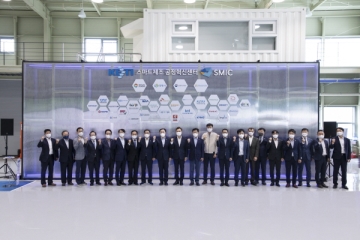
Smart Manufacturing Demonstration Plant Opens, Promoting Digital Innovation in Industrial Complexes
A smart manufacturing demo factory in Changwon, designed to support improved productivity and high-value-added manufacturing for enterprises, has opened and is drawing expectations that it will promote digital innovation in industrial complexes.
2021.07.28by 배종인 기자
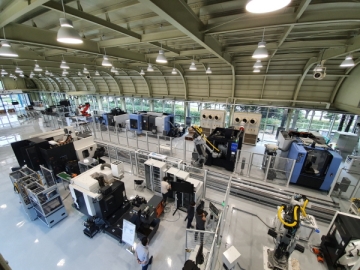
KETI Smart Manufacturing Process Innovation Center, Process Development Based on ‘Digital Twin’
Going beyond the concept of automating existing factories, a smart manufacturing demo factory that can perform proactive operational management through data by connecting factory design to unmanned automation and process development through connectivity and digital twin has begun operations in Korea, and it is expected to contribute to models for future smart factory construction and process technology development.
2021.08.24by 배종인 기자
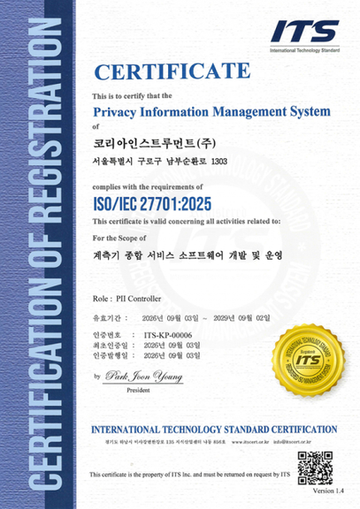
Korea Instrument, KOLAS Accredited Calibration Agency First to Simultaneously Acquire ISO/IEC 27,001·27,701
Korea Instrument has become the first among KOLAS accredited calibration agencies to simultaneously acquire ISO/IEC 27,001 and ISO/IEC 27,701 certifications. Through its proprietary platforms CWIZ Enterprise and CWIZ Partners, the company has embedded information security and personal data protection requirements across all business processes including customer information, equipment data, and calibration reports, with plans to continuously advance its management system through regular audits and security inspections.
2026.10.12by 배종인 기자
TeamViewer One, IT Incident Automation Workflow and Resolution Center Enhanced
TeamViewer has added IT incident automation capabilities and an advanced Resolution Center to its integrated digital workplace management platform 'TeamViewer ONE'. Recurrent service disruptions, configuration errors, and capacity shortages are automatically handled according to preset policies, and device status verification through script deployment can be managed in a unified interface, significantly reducing repetitive tasks for IT teams.
2026.10.12by 배종인 기자











