



ADI Unveils Wearable AFE for '4-Simultaneous Measurements' of Vital Signs
 Published2021.09.23 08:31
Electrocardiogram, heart rate, blood oxygen saturation, and respiratory rate
Suitable for wearable devices that measure everything
The medical device industry is looking to replace hospital-grade medical monitoring systems with tiny, low-power wireless devices that can be worn routinely at home or at work.
Analog Devices (ADI) announced on the 23rd that it has released a new triple-system vital sign analog front end (AFE), the 'MAX86178', that simplifies the design of remote patient monitoring (RPM) wearable devices.
.jpg)
The new product is a triple-system AFE that integrates three clinical-grade subsystems: optical, ECG, and bioimpedance. It can measure four common vital signs: electrocardiogram (ECG, EKG), heart rate (ECG, optical PPG), blood oxygen saturation (SpO2), and biopotential difference and bioimpedance (BioZ), so there is no need to use a separate device to measure each value.
The package size is 2.6mm × 2.8mm, and the simplified design enables more complex derivative vital sign monitoring, and health indicators can also be derived through optical PPG and ECG timing synchronization implementation. For ultra-low power specifications, configuration options are provided for each subsystem, and battery life can be optimized according to the usage environment.
“By integrating three medical subsystems on a single chip, ADI’s new sensor fusion AFE opens new possibilities for chronic disease management, infectious disease diagnosis, and remote monitoring,” said Andrew Burt, general manager, Industrial and Healthcare Business Unit at Maxim Integrated. “It will support the development of compact wearable devices that will reduce hospital visits, improve the quality of healthcare services, and reduce costs.”
Meanwhile, on August 27, ADI acquired Maxim Integrated, the developer of the MAX86178 AFE product, and became a company with annual sales of over $9 billion.
Comments
Related news
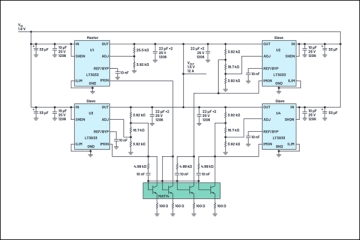
Output current can be increased by connecting LDO regulators in parallel.
Power supply designers can connect LDO regulators in parallel to increase supply current capacity even in limited space and mitigate heat dissipation. This lowers temperature rise in specific components and reduces the required size and number of cooling devices. If an LDO regulator has output current monitoring capabilities, like ADI's 'LT3033' product, balancing current distribution becomes easier as well.
2021.06.15by 이수민 기자
ST Unveils GSMA-Certified M2M-Dedicated eSIM IC 'ST4SIM'
ST announced the online launch of 'ST4SIM,' an eSIM IC for M2M applications. ST's industrial eSIM provides all services necessary to connect IoT devices to wireless networks. It is suitable for applications including equipment condition monitoring and predictive maintenance, asset tracking, energy management, and connected medical service devices.
2021.09.10by 이수민 기자

'Digitalization, Miniaturization, and Connectivity', the Foundation for Medical Innovation
Robots simplify invasive procedures in surgical operations, helping patients recover quickly, and wearable devices monitor patient medication intake and daily activities. The collected data is transmitted to physicians, who use this information to understand patient status in real time. This is a vision of the future based on advances in medical technology. With progress in wireless data transmission and component miniaturization technologies, minimally invasive surgery and telemedicine are expected to become reality soon.
2021.09.15by 이수민 기자

Intel Unveils Next-Generation 'Core Ultra Series 3' and vPro Platform for Enterprise PCs
Intel has officially unveiled the "Intel Core Ultra Series 3" for next-generation enterprise PCs and the latest vPro platform, addressing a wide range of demands from enterprise notebooks to high-performance workstations.
2026.03.26by 배종인 기자

ROHM Launches ESD Protection Diode Compatible with High-Speed Interfaces of 10Gbps or Higher
Semiconductor specialist ROHM has developed the 'RESDxVx series' of ESD (electrostatic discharge) protection diodes capable of responding to next-generation high-speed data communication environments exceeding 10Gbps, simultaneously enhancing both signal quality maintenance required in high-speed interfaces and IC protection performance.
2026.03.26by 배종인 기자











