


QLED can be folded as freely as origami.
 Published2021.09.27 16:19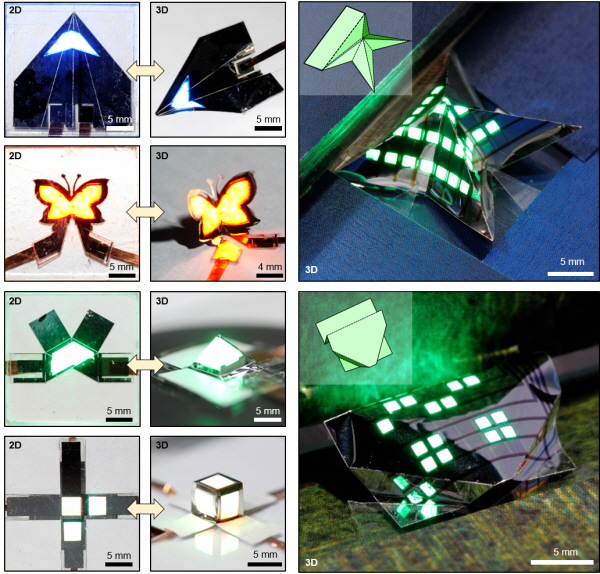
▲3D foldable QLED that can be folded freely like paper.
Expectations are high for the development of displays with customizable form factors.
As electronic devices with unique form factors, such as rollable phones, are on the verge of commercialization, a domestic research team has developed a 3D display source technology that can express information that is difficult to implement with existing flat displays.
A joint research team led by Kim Dae-hyung, deputy research director (Professor, Department of Chemical and Biological Engineering, Seoul National University) and Hyun Taek-hwan, director (Distinguished Professor, Department of Chemical and Biological Engineering, Seoul National University) of the Nanoparticle Research Group at the Institute for Basic Science (IBS, President Noh Do-young) succeeded in developing a 3D quantum dot light-emitting diode (QLED) that can be freely folded like paper.
QLED, which uses quantum dots as a light-emitting material, does not require bulky elements such as backlights, unlike conventional liquid crystal displays (LCDs), allowing for the production of displays with a much thinner thickness.
The IBS Nanoparticle Research Group also developed an ultra-thin QLED with a thickness of 3 μm, about 1/30th the thickness of a human hair, in 2015 and produced it in the form of a wearable display.
In this study, we went further and created an ultra-thin QLED that can be freely folded into any desired shape, like origami. Based on this, we succeeded in producing a 3D foldable QLED with complex structures such as a butterfly, airplane, and pyramid.
To achieve this, the research team developed a new "selective laser etching process," using a carbon dioxide laser to partially etch the epoxy film deposited on the QLED surface. The etched area is relatively thinner than the surrounding area, making it susceptible to deformation when external forces are applied.
In origami, it is about making a 'folding line'. At this time, there is a thin etch-preventing layer made of silver and aluminum alloy between the QLED and the epoxy film, which effectively prevents damage to the inside of the QLED caused by the laser.
Through this process, the research team succeeded in precisely controlling the radius of curvature of the foldable QLED, and succeeded in producing a foldable QLED with an extremely small radius of curvature of less than approximately 50 μm.
When the radius of curvature becomes smaller than several tens of μm, it appears to the naked eye as a sharp fold rather than a bend.
Additionally, all light-emitting surfaces, including the corners, operated stably even after repeated folding over 500 times.
Through this, the research team created QLEDs with complex 3D shapes such as butterflies and airplanes, and in particular, the pyramid-shaped 3D foldable QLED consisting of 64 pixels showed the possibility of developing a display that can be freely folded into the shape desired by the user as it can freely transform between 2D and 3D structures.
“Thanks to the development of a laser process utilizing an etch-preventive layer made of an alloy, we were able to create a 3D foldable QLED that can be folded freely like paper,” said Kim Dae-hyung, deputy head of the research team. “Beyond the 64-pixel display created in this study, we will be able to create QLED displays with more complex form factors in the future.”
Director Hyun Taek-hwan said, “It will be particularly useful in places that require customized small displays, such as electronic paper, newspapers, and tablets,” adding, “It is significant in that it opens up the possibility of manufacturing customized displays.”
The research results were published on September 24th in the world-renowned journal in the field of electrical and electronic engineering, Nature Electronics (IF 33.686)..
Comments
Related news
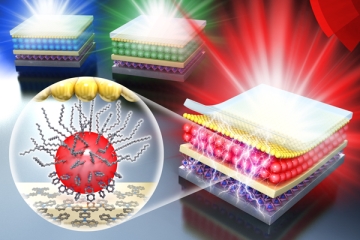
ETRI Improves QLED Efficiency with Quantum Dot Surface Substitution Technology
While OLED utilizes organic materials, QLED leverages semiconductors, specifically quantum dots, instead of organic materials. Through the development of QLED hole injection improvement technology, ETRI has developed core technology that can enhance the brightness, current, and power efficiency of QLEDs by modifying the molecular sieves that constitute the quantum dot surface. In the device that comprises a QLED display, electrons and holes injected from both electrodes meet at the quantum dots to emit light. However, while electrons move freely up and down, holes face difficulty in movement due to slower energy transfer between the electrode and quantum dots. This electron-hole imbalance problem degrades the performance of quantum dot light-emitting diodes and shortens the device lifespan, necessitating research to address this issue.
2019.04.17by 이수민 기자
.jpg)
Samsung Neo QLED 'Optimal Sound' in Any Environment
Samsung Neo QLED has become the first in the industry to receive certification from Germany's VDE (Verband Deutscher Elektrotechniker) for its 'Spatial Sound Optimization' technology, gaining recognition for its performance in providing consumers with an optimal audio environment for viewing.
2021.06.08by 명세환 기자
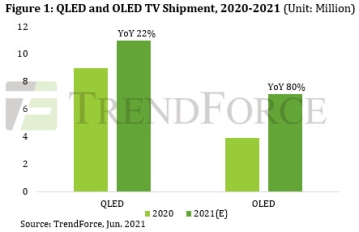
QLED and OLED TV shipments reach record highs this year.
TrendForce recently forecasted that annual QLED TV shipments in 2021 would reach 11.02 million units, representing a 22.4% increase year-over-year, and OLED TV shipments would reach 7.1 million units, representing an 80% increase year-over-year, with both product categories expected to set new records based on shipments this year.
2021.07.02by 배종인 기자
Intel Unveils Next-Generation 'Core Ultra Series 3' and vPro Platform for Enterprise PCs
Intel has officially unveiled the "Intel Core Ultra Series 3" for next-generation enterprise PCs and the latest vPro platform, addressing a wide range of demands from enterprise notebooks to high-performance workstations.
2026.03.26by 배종인 기자
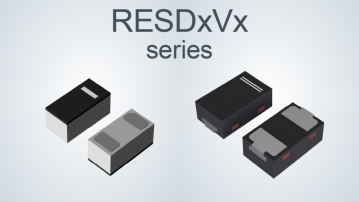
ROHM Launches ESD Protection Diode Compatible with High-Speed Interfaces of 10Gbps or Higher
Semiconductor specialist ROHM has developed the 'RESDxVx series' of ESD (electrostatic discharge) protection diodes capable of responding to next-generation high-speed data communication environments exceeding 10Gbps, simultaneously enhancing both signal quality maintenance required in high-speed interfaces and IC protection performance.
2026.03.26by 배종인 기자











