



Electronics Technology Institute Improves Metal 3D Printing Quality with Software
 Published2021.12.20 16:04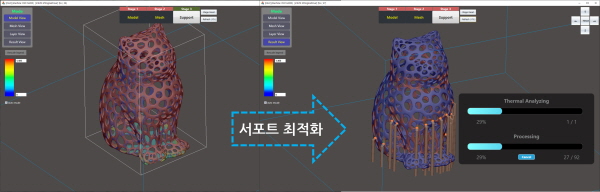
▲Before (left) and after (right) improvement of metal output quality through support optimization. The thermal energy of the output (blue) was smoothly discharged through the rod-shaped support.
The Korea Electronics Technology Institute (KETI, President Kim Young-sam) has succeeded in improving output and quality by preventing the concentration of heat energy in 3D printing results through software (SW) and enabling efficient energy discharge of support structures, which is expected to enhance the competitiveness of the domestic manufacturing industry.
KETI announced on the 20th that it has developed support generation software (SW) based on metal 3D printing layer analysis.
The SW developed by KETI this time can perform the function of creating a support structure to prevent the concentration of heat energy during the metal 3D model stacking process and to efficiently discharge energy.
Metal 3D printing involves laying out metal powder flat and selectively shooting a high-temperature laser to melt or solidify it to create the desired product. The technology to smoothly dissipate the heat generated during this process determines the quality of the product.
According to Shin Hwa-seon, a senior researcher at KETI's Intelligent Convergence SW Research Center who led the development, the SW engine is expected to improve metal 3D printing design technology and manufacturing quality, and reduce dependence on foreign countries for related technologies.
Meanwhile, metal 3D printing technology has become increasingly important across the manufacturing industry because it reduces the manufacturing cost and time of metal parts, but it cannot apply existing process know-how and requires skilled professionals. It had the disadvantage of being rare.
Furthermore, domestic companies have been highly dependent on software from advanced countries overseas to address the issue of heat dissipation that occurs during the 3D printing process, so this technology development is expected to have an import substitution effect for software led by the US and Europe.
KETI President Kim Young-sam said, “The support generation engine technology developed by KETI is expected to be utilized in various metal 3D printing manufacturing fields such as automobiles, shipbuilding, and space launch vehicles in the future.” He added, “We will do our best to ensure that small and medium-sized companies in the domestic manufacturing industry can continue to secure product design and manufacturing competitiveness based on metal 3D printing technology.”
Comments
Related news
.jpg)
KETI to invest KRW 43 billion in electronics, IT, and small and medium-sized businesses
The Korea Electronics Technology Institute (KETI, Director Kim Young-sam) is investing 43 billion won in electronics, IT, and materials/parts/equipment companies, diversifying its corporate nurturing approach beyond existing R&D and problem-solving for challenging technologies.
2021.11.12by 배종인 기자

KETI and France's Côte d'Azur University Join Hands on IoT and Smart Cities
The Korea Electronics Technology Institute (KETI, Director Kim Young-sam) has joined hands with France to cooperate on international standard technologies for IoT and smart cities.
2021.11.22by 배종인 기자
.jpg)
KETI and RF Systems Join Forces in 5G, 6G, and Satellite Communications
Korea Electronics Technology Institute (KETI, Director Kim Young-sam) and RF Systems Inc. (CEO Han Ki-woo) have joined hands in developing core components for next-generation mobile communications including 5G, 6G, and satellite communications.
2021.12.14by 배종인 기자
Korea Instrument, KOLAS Accredited Calibration Agency First to Simultaneously Acquire ISO/IEC 27,001·27,701
Korea Instrument has become the first among KOLAS accredited calibration agencies to simultaneously acquire ISO/IEC 27,001 and ISO/IEC 27,701 certifications. Through its proprietary platforms CWIZ Enterprise and CWIZ Partners, the company has embedded information security and personal data protection requirements across all business processes including customer information, equipment data, and calibration reports, with plans to continuously advance its management system through regular audits and security inspections.
2026.10.12by 배종인 기자
TeamViewer One, IT Incident Automation Workflow and Resolution Center Enhanced
TeamViewer has added IT incident automation capabilities and an advanced Resolution Center to its integrated digital workplace management platform 'TeamViewer ONE'. Recurrent service disruptions, configuration errors, and capacity shortages are automatically handled according to preset policies, and device status verification through script deployment can be managed in a unified interface, significantly reducing repetitive tasks for IT teams.
2026.10.12by 배종인 기자











