


ETRI Develops a Computing System for Accelerated Genome Analysis
 Published2021.12.26 16:54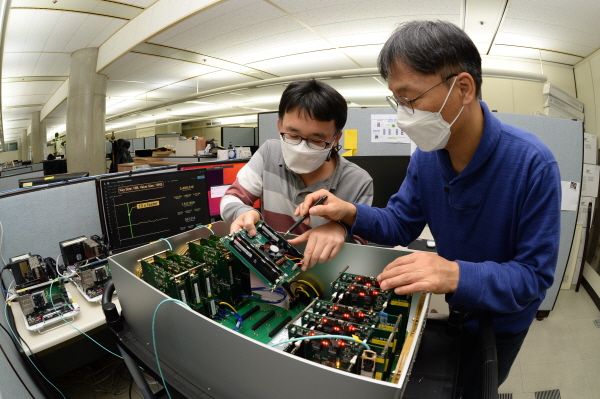
▲Discussion on the memory-centric computing hardware device developed by ETRI researchers.
A domestic research team has developed a computing system technology that can perform genome analysis even faster, improving analysis performance by 28% compared to existing processor-centric systems.
The Electronics and Telecommunications Research Institute (ETRI) announced on the 23rd that it has developed a memory-centric computing system specialized for genome analysis. This technology has achieved a 28% performance improvement over existing technologies. If the service time previously took about 10 months, this can be shortened to about 7 months.
The technology developed by ETRI is a memory-centric computing hardware and software technology specialized in next-generation sequencing (NGS) that analyzes genomes.
Until now, genome analysis has mainly used processor-centric computing technology that uses limited memory but performs many calculations. When processing large amounts of data such as genome analysis, structural bottlenecks often occur, requiring a lot of time and effort for data processing.
On the other hand, ETRI's memory-centric computing technology overcomes bottlenecks by utilizing large-scale memory.
First, the research team developed a hardware device called MOCA that enabled the system to be equipped with large-scale memory.
The key is to eliminate the need to use hard disks or SSDs during the data processing process.
Additionally, the research team developed a software that can process the base sequence alignment step, which takes the longest time during the genome analysis process, more than twice as fast by utilizing large-scale memory, thereby increasing analysis efficiency.
ETRI also verified the technology's performance in collaboration with GC Green Cross Genome.
As a result, it was shown that applying the HW developed by the research team to the existing system could increase the overall analysis performance by 16%, and applying HW and SW simultaneously could improve the performance by up to 28%.
This technology can be applied to systems that can predict cancer incidence, fetal defects, and other factors, as well as identify mutations in infectious diseases and develop treatments.
Thanks to this, it is expected that analytical institutions and pharmaceutical companies will be able to reduce service development costs and diagnosis times, and hospitals will be able to establish patient-tailored collaborative treatment systems, which will greatly contribute to improving national health and reducing social burden.
Kim Kang-ho, head of the ETRI Data-Centric Computing Systems Lab, said, “This technology is expected to serve as a new catalyst for the domestic pharmaceutical analysis market and industry, significantly activating various bio-application markets and creating employment.”
Comments
Related news
ETRI Unveils Key Research Achievements in AI, Big Data, and Cloud
The Intelligent Convergence Research Institute at the Electronics and Telecommunications Research Institute (ETRI) introduces intelligent convergence technologies for solving social problems in a 3D virtual exhibition hall, opening opportunities for disclosure and dissemination of core research outcomes and creation of new business ventures.
2021.11.15by 배종인 기자
ETRI develops AI capable of 5 quadrillion calculations per second
Domestic researchers have developed a system capable of accelerating artificial intelligence (AI) learning and inference with approximately 5,000 trillion operations per second, and it is expected to be utilized in large-scale AI services such as autonomous driving, cloud computing, and data centers.
2021.12.03by 배종인 기자
ETRI ushered in an era of real-time remote control over hundreds of kilometers.
Domestic researchers have developed technology that enables real-time remote control of smart factories (Model Factory) located hundreds of kilometers away using 5G and wired networks, generating expectations that it will contribute to strengthening the competitiveness of the domestic manufacturing industry.
2021.12.16by 배종인 기자
.jpg)
SalePoint Signs Multi-Year Partnership Agreement with AWS… Promoting Identity Security that Integrates Even AI Agents
Sailpoint has entered into a multi-year strategic partnership agreement with AWS and is moving forward with establishing an integrated governance system that manages both human and non-human identities together. The plan is to consistently manage access permissions in an environment where AI agents are increasing as work execution entities, while applying the principle of least privilege and automated policy enforcement. The two companies plan to jointly expand capabilities to manage the identities of various entities, including AI agents, within a single layer in the AWS environment. This collaboration is interpreted as a move to design security and governance together in corporate environments where AI adoption is expanding.
2026.03.26by 배종인 기자
.png)
Databricks Unveils Open AI Security Monitoring 'Lakewatch'
Databricks entered the security market on March 24 by unveiling LakeWatch, an open-source agentic SIEM. The core functionality of this product is to integrate and analyze security, IT, and business data in a single environment to support AI-based threat detection and investigation. The company explained that it reduces the limitations of existing security operations centers, which have had to forgo some data due to high cost structures, and enables large-scale data analysis and automation based on open formats and ecosystems. LakeWatch is currently offered as a private preview, with Adobe and Dropbox mentioned as early customers. Databricks also announced an expanded partnership with Anthropic as well as the acquisition of Antimatter and SiftD.ai.
2026.03.26by 배종인 기자











