


GIST Research Team Finds Clues to Create Security Keys in Nature
 Published2022.01.12 09:06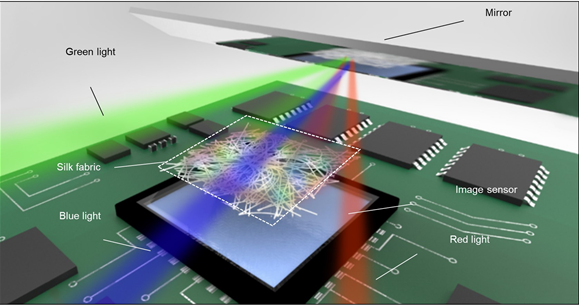
PUF miniaturization opens up possibilities for connected cars and IoT integration.
A domestic research team has found a clue in nature to create a physical security key that can prevent information leaks in the Internet of Things era.
The National Research Foundation of Korea announced on the 11th that Professor Song Young-min's research team at GIST has developed a method to create a physical security key using the micro-nano-sized hierarchical structure present in silk extracted from silkworm cocoons.
Security key technology, commonly referred to as physically unclonable elements (PUFs), was originally manufactured using complex semiconductor processes.
PUF is a technology that allows devices manufactured through the same process to generate completely different security keys, and is manufactured by taking advantage of differences in the microstructure of the semiconductor process.
The PUF produced in this study does not require a separate manufacturing process because it utilizes silk itself, which exists in nature.
The silk-based physical security key developed by the research team is expected to serve as a key to maintaining strong security for Internet of Things devices and end users, as well as for generating encryption keys for data transmission and storage.
Additionally, silk PUFs do not utilize additional optical systems.
Using optical phenomenaSince Anki can be extracted and generated, miniaturization can be expected.
Accordingly, it is expected that the effect will be greater when linked to smart grids, IoT, and connected cars.
When LED light is shined on the surface of natural silk, the light is diffracted and collected at random locations due to the disorderly distributed nano- and micro-sized hierarchical structures inside the silk.
By absorbing this light in an image sensor and converting it into an electrical signal, a security key consisting of 0s and 1s can be generated.
This security key passed the randomness test of the National Institute of Standards and Technology (NIST) and was confirmed to exhibit high reproducibility and randomness.
This study predicts the possibility of developing a PUF that is resistant to humidity and temperature by producing it using △electrospinning△3D printing technology.
Professor Song Young-min said, “This is the first case that has revealed that natural silk also has a unique encryption key like a human fingerprint.”
Meanwhile, the research results were published on the 11th in the international academic journal 'Nature Communications'.
Comments
Related news
.png)
Databricks Unveils Open AI Security Monitoring 'Lakewatch'
Databricks entered the security market on March 24 by unveiling LakeWatch, an open-source agentic SIEM. The core functionality of this product is to integrate and analyze security, IT, and business data in a single environment to support AI-based threat detection and investigation. The company explained that it reduces the limitations of existing security operations centers, which have had to forgo some data due to high cost structures, and enables large-scale data analysis and automation based on open formats and ecosystems. LakeWatch is currently offered as a private preview, with Adobe and Dropbox mentioned as early customers. Databricks also announced an expanded partnership with Anthropic as well as the acquisition of Antimatter and SiftD.ai.
2026.03.26by 배종인 기자
Kaspersky Unveils Revamped 'NEXT' Combining SOC Integrated Management and AI Analytics
As enterprises increase demand for integrated management and automation in the construction and operation of Security Operations Centers (SOC), Kaspersky has disclosed updates to its B2B security product suite 'Kaspersky Next'. This update expands EPP, EDR, XDR, and SIEM integration through a single console based on OSMP, incorporates AI capabilities such as DLL hijacking detection and suspicious account takeover behavior identification, and includes integration with generative AI assistant tool KIRA. The company stated that in large-scale deployment environments, EDR Expert can reduce resource requirements by up to 30%, and XDR Expert by up to 60%.
2026.03.25by 배종인 기자

Samsung Electronics Smart Monitor Acquires First International Certification… Expanding Application Scope Following TVs
Samsung Electronics has received Common Criteria (CC) certification for 'Samsung Knox,' a security solution applied to its 2026 smart TVs and smart monitors. The smart TV has achieved certification for 12 consecutive years, while the smart monitor obtained industry-first certification this time. The evaluation was conducted focusing on core functions including kernel integrity monitoring, phishing site blocking, and unauthorized execution prevention. The company plans to expand the scope of security certification beyond TVs to monitors, responding to growing personal information protection requirements as connected devices proliferate.
2026.03.25by 배종인 기자

Teori Selected as AI Voucher Supplier… Supplying LLM Security Solutions
Cybersecurity company Theori has been selected as a supplier for the 2026 AI Voucher Support Program. The company plans to address information leakage and regulatory compliance issues that arise during generative AI adoption through its LLM security solution 'AlphaPrism'. The solution is designed to analyze the context of prompts and source code to identify sensitive information such as personal data and authentication keys, and to continue AI utilization through masking methods rather than simple blocking. The government's AI Voucher Program supports demand enterprises with up to 200 million won per project for solution purchase costs. Based on recent application cases at POSCO DX, Theori plans to respond to expanding demand for enterprise AI security.
2026.03.24by 명세환 기자
Cisco Unveils Agentic AI Security Framework at RSAC 2026
Cisco announced security capabilities targeting the entire process of enterprise AI agent adoption at RSAC 2026 held in San Francisco, USA. The core approach involves applying identity management and the principle of least privilege to AI agents similar to humans, testing for attack vulnerabilities before deployment, and automating threat detection and response through Splunk-based security monitoring during operations. Cisco also unveiled the "AI Defense: Explorer Edition" security validation tool for developers, the open-source framework "DefenseClose," and agent-type SOC functionality. As pilot deployments are increasing but actual operational transitions remain limited, this announcement is interpreted as focusing on how enterprises can implement security frameworks during the commercialization process of AI agents.
2026.03.24by 명세환 기자











