



The Ministry of Trade, Industry and Energy will transform 1,200 parts companies into future vehicle companies.
 Published2022.01.13 14:19
Level 4+ autonomous driving technology targeted for completion by 2027
Development of unmanned, wired and wireless charging technology after parking
The Ministry of Trade, Industry and Energy plans to transform 1,200 parts companies into future vehicle companies by 2030 and promote the creation of high-value-added future vehicle service industries and strengthen their competitiveness.
The Ministry of Trade, Industry and Energy announced the "Strategy to Advance Digital Transformation to Strengthen Future Vehicle Competitiveness" at the 18th Innovation Growth Big 3 Promotion Meeting held at the Government Complex Seoul on the 13th.
The Ministry of Trade, Industry and Energy plans to accelerate the digital transformation of future vehicles through the 'Act on Promotion of Industrial Digital Transformation.'
In particular, the plan includes support measures for a fair industrial transition to ensure that no sector, such as the maintenance sector, is left out during the digital transformation of the automobile industry, including the expansion of new manufacturing and service technologies such as OTA and the expansion of electric, hydrogen, and autonomous vehicles.
The background to establishing this strategy is that acceleration is necessary across the entire value chain, including finished vehicles, parts, and services, to secure a lead in the new future automobile market.
The main contents of this strategy are: △Establishing a data-based future vehicle industry ecosystem, △Intelligent manufacturing of future vehicle parts and finished vehicles, and △Creating a high-value-added service market for future vehicles.
Building a data-driven future vehicle industry ecosystem
First, the Ministry of Trade, Industry and Energy will launch a standardization committee, create an environment for sharing and utilizing data, and open the 'Mobility Big Data Portal (www.bigdata-car.kr)' to secure 8 petabytes of data.r />
The plan also includes training specialized personnel in line with the needs of leading companies, expanding the number of personnel majoring in future automobiles, and promoting employment.
Additionally, we aim to revitalize the market by building an ecosystem for data acquisition, analysis, and trading to support companies in creating new businesses and improving operational efficiency.
■ Intelligent manufacturing of future car parts and finished vehicles
Second, we will provide support in stages to build a regionally balanced foundation for intelligent design and manufacturing, transform existing auto parts companies into future car parts companies, and complete the development of Level 4+ autonomous driving technology by 2027.
The Ministry of Trade, Industry and Energy announced that it will transform 1,200 parts companies into future vehicle companies by 2030 and secure the reliability of electrical components through a data-based lifecycle management system.
Additionally, there is content to maximize efficiency in the production sector through cooperation between the government, automakers, and parts manufacturers and smartening of production processes.
They also announced plans to develop and certify wireless automotive update technology to improve driving performance and prepare various customer service response measures.
■ Creating a high-value-added service market for future vehicles
Thirdly, we plan to pursue technology development related to service content, such as various vehicle services equipped with autonomous driving technology, digital-integrated infotainment, and expanded smartphone connectivity.
The plan is to develop and verify multi-purpose, high-value-added services, such as personal transportation services linked to autonomous driving.
△Autonomous driving service △Content platform △Service content will ensure the safety and convenience of passengers, and a data management system for parking and charging will also be established.
To improve the convenience of charging electric vehicles, we have developed unmanned, wired and wireless charging technology after parking. It also includes content to quickly resolve charging inconveniences and anxieties.
In particular, we plan to alleviate parking shortages by developing unmanned autonomous parking technology early and improving related systems to provide efficient parking space services.
Minister of Trade, Industry and Energy Moon Seung-wook said, “Based on the ‘Act on Promotion of Industrial Digital Transformation’ enacted in January, we will build a data-based future vehicle industry ecosystem through this promotion strategy,” and “We will advance the intelligent manufacturing of future finished vehicles and parts and the creation of a high value-added service market, thereby leaping forward to become a leading country in future vehicles.”
Comments
Related news
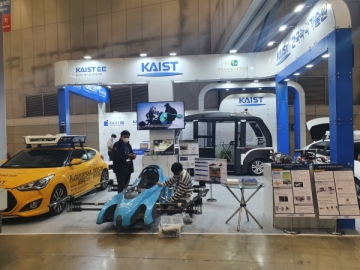
KAIST Demonstrates Advanced Autonomous Driving and Future Mobility Technologies
The Korea Advanced Institute of Science and Technology (KAIST) participated in the '2021 Seoul Mobility Show' and unveiled advanced future mobility technologies including autonomous driving and flying cars to the general public.
2021.11.26by 배종인 기자
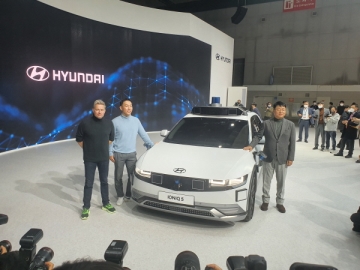
Hyundai Motor to Test Level 4 Autonomous Driving in Urban Areas Next Year
Hyundai Motor will launch a pilot service of Level 4 autonomous vehicles in Seoul's urban areas starting next year, where the vehicle's automated systems perceive and judge situations, control the vehicle, and exclude driver intervention even in emergencies.
2021.11.26by 배종인 기자
.jpg)
Intel and Nvidia Engage in Fierce Competition in Autonomous Driving Technology
Intel and NVIDIA announced latest technologies such as SoCs and expanded partnerships, signaling intense competition to seize the autonomous driving technology throne. Intel unveiled the EyeQ® Ultra system-on-chip. In response, NVIDIA announced the latest generation Drive Hyperion 8 platform.
2022.01.06by 성유창 기자

[e4ds Tech Day 2026 ⑨] Sim Sang-gyu, Autocrypt CTO: "In the Physical AI Era, Automotive Security Must Extend Beyond the Vehicle"
At e4ds Tech Day 2026, Sim Sang-gyu, CTO of Autocrypt, explained automotive cybersecurity strategies in the era of Physical AI and SDV (Software-Defined Vehicle). Automobiles are evolving as part of an ecosystem connected to AI, cloud, chargers, IoT, and robots, and he emphasized that the scope of security must expand beyond the vehicle interior to the entire connected environment. In particular, AI model tampering, adversarial attacks, OTA updates, and EV charger hacking were identified as major threats. He explained that response measures require zero trust, AI model integrity protection, intrusion detection, Security by Design and Default, and full lifecycle security management, and that proactive security system establishment beyond regulatory compliance is critical for securing future mobility competitiveness.
2026.10.12by 배종인 기자

Practical HIL Construction Strategy for Automotive and Off-Highway Controller Validation
As vehicle E/E architecture transitions to zonal structures and shifts to software-defined vehicles (SDV), the number of controllers (ECUs) requiring validation and software complexity are surging dramatically. Meanwhile, real vehicle testing cannot provide repeated verification under identical conditions and entails lead time and safety concerns. This white paper explains the principles of HIL (Hardware-in-the-Loop) validation and the structure of the NI platform composed of PXI, SLSC, and VeriStand, and through two actual implementation cases—Camera Record & Replay HIL for In-Cabin Monitoring Controller (ICMU) and Forklift Controller (VCU) HILS—describes how controller-level regression testing becomes possible. Additionally, it explicitly states application boundaries and limitations, such as lack of A2B support.
2026.10.12by 편집부











