



"The US and China Must Maintain a Strategic, Symbiotic Relationship in the Global Supply Chain."
 Published2022.01.14 11:12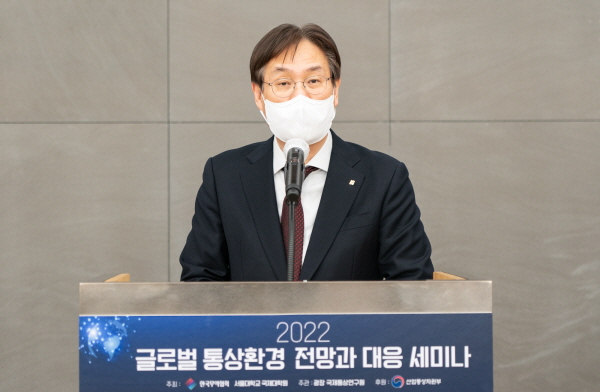
▲Lee Gwan-seop, Vice Chairman of the Korea International Trade Association. Photo credit: Korea International Trade Association.
The deepening US-China conflict is increasing uncertainty in the trade environment.
We will enter the supply chain center as a core industry.
The Korea International Trade Association, together with the Seoul National University Graduate School of International Studies and the International Trade Research Institute of Kwangjang Law Firm, held a seminar titled "2022 Global Trade Environment Outlook and Responses" at the Korea International Trade Association Conference Hall on the 12th and discussed this year's trade outlook.
In his opening remarks, Lee Gwan-seop, Vice Chairman of the Korea International Trade Association, said, “As conflicts between major countries such as the U.S. and China intensify, uncertainty in the trade environment is growing,” adding, “We will communicate more actively with companies and domestic and foreign experts in the future to examine companies’ trade risks and develop response measures.”
The first presenter, Gary Hufbauer, a senior fellow at the Peterson Institute for International Economics, said, “The Biden administration is maintaining a similar trade policy tone to the Trump administration, but is giving greater priority to agendas related to social values such as labor, environment, and human rights.”“In order to secure an advantage in competition with China, we are seeking solidarity with Asian countries through the Indo-Pacific Economic Framework (IPEF), but due to opposition within the Democratic Party, discussions on actual trade liberalization are unlikely to be active this year,” he predicted.
Next, Park Seung-chan, director of the China Management Research Institute, presented on the topic of “China’s policy changes and prospects for US-China relations in 2022,” and Yoon Seong-hyeok, director of the Industrial Policy Division at the Ministry of Trade, Industry and Energy, presented on the topic of “Global supply chain restructuring and response directions.”
Director Park said, “We anticipate a decline in consumption in China, a reduction in energy consumption due to carbon neutrality policies, and an acceleration of global supply chain diversification and technological isolation due to the US-China hegemony competition.” He added, “In the long term, China will pursue a strategic competitive system with the US while simultaneously pursuing an innovative growth policy domestically.”
He also expressed his opinion on domestic deregulation.
Director Park emphasized the need for deregulation, citing comments from third parties such as, "Korea has more referees than players, which reduces its R&D competitiveness" and "Korea has the best robot regulation in the world."
The importance of speed in applying innovative technologies to the field was emphasized to several stakeholders at the seminar.
The final presenter, Yoon Seong-hyeok, Director of the Industrial Policy Division at the Ministry of Trade, Industry and Energy, presented on 'Global Supply Chain Restructuring and Response Directions.'
Director Yoon advised, “Our companies should reorganize their management strategies from ‘short-term cost reduction’ to ‘resilience’-centered,” and added, “The government should establish an early warning system for key industrial items and a trade network to stabilize the supply chain, and strengthen supply chain management capabilities.”He stated, “We will secure ultra-gap competitiveness in key industries.”
He explained, "We must secure competitiveness in key industries of the global supply chain," and "We will enter the central axis of the supply chains of major countries."
He also said that he would implement many plans, including tax credits for R&D and facility investment, with the goal of establishing a "K-Semiconductor Belt" that would become the world's largest and most advanced semiconductor supply chain by 2030.
In the future vehicle sector, the government also announced plans to promote innovation in the ecosystem centered on future vehicles by prioritizing the conversion of 1,200 parts companies into future vehicle-related companies.
He also announced plans to establish a "Special Act on National Advanced Strategic Industries" to foster and manage key human resources while ensuring economic security and future competitiveness.
Director Park and Manager Yoon expressed the same opinion that Korea should not be forced to choose between the US and China's trade war.
He said that in the case of semiconductors, it is because American technology and the Chinese market are needed.
Director Park Seung-chan said, “A third answer sheet is needed for each issue,” and added, “We must maintain a symbiotic relationship between the ROK-US alliance and the ROK-China strategic cooperative partners.”
In a panel discussion, Cho Seong-dae, director of the Korea International Trade Association's Trade Support Center, said, "Uncertainty is a major concern for businesses," and predicted, "New regulations in major countries could pose challenges to trade."
In a panel discussion, Yeon Won-ho, a research fellow at the Korea Institute for International Economic Policy, said, “This year could be an opportunity for Korean companies,” adding, “China is holding the 20th National Assembly elections to decide on President Xi Jinping’s re-election.” He explained the reason, saying, “We are approaching the party convention, and the U.S. will also have midterm elections in November this year, so we will operate the economy stably.”
Comments
Related news
.jpg)
[China Briefing] Taiwan and the US Strengthen Their Semiconductor Honeymoon
e4ds News China Region ICT Brief - August 26, 2021 [China Briefing]: ◇Taiwan-U.S. strengthen industrial cooperation including semiconductor sector based in Arizona ◇Taiwan science and technology industrial parks achieve record-high performance despite pandemic ◇China's Ministry of Industry and Information Technology proceeds with three-year project to promote IPv6 activation ◇China's independently built first pure electric towing vessel begins full operation, etc.
2021.08.26by 이춘영 외신
[China Briefing] Amazon TV Launching in October, TCL OEM Production
Notable China ICT News Summary - September 3, 2021 [China Briefing] : ◇Amazon to begin selling its own TVs from October; TCL estimated to be the OEM ◇US-Taiwan Business Council and Taiwan Trade Development Council issue statement announcing Taiwan selected as partner for US medical, EV, and semiconductor industry development ◇Following Xi Jinping's statement to "prosper together," major Chinese enterprises begin investing in national industries; Alibaba announces investment of six months' worth of net profit, among others
2021.09.03by 이춘영 외신
Nvidia invests $5 billion in Intel
NVIDIA and Intel, leaders in global AI computing technology, are now forging ahead in providing cutting-edge solutions through NVLink-based architecture integration. NVIDIA and Intel have officially announced a strategic partnership and stated that they will jointly develop customized data center and personal computing products to accelerate diverse applications and workloads ranging from hyperscale to enterprise and consumer markets, thereby laying the foundation for the next generation computing era.
2025.09.22by 배종인 기자
.jpg)
Applied Materials Launches Environmental Protection Campaign to Mark World Cleanup Day
Applied Materials Korea (CEO Park Kwang-seon) is carrying out environmental cleanup activities with employees and their families around the Dongtan Sinricheon area on the occasion of World Cleanup Day, evolving into a company that engages with the local community beyond technological innovation.
2025.09.22by 명세환 기자
.jpg)
The combination of electrical and electronic technologies like AI, semiconductors, and electric vehicles with renewable energy will determine industrial competitiveness.
Professor Lim Chun-taek from Gwangju Institute of Science and Technology (GIST) stated in his keynote speech at the '2025 e4ds Tech Day' on the 9th, "Global energy investment is already shifting from fossil fuels to renewable energy, and the trend of electrification combined with electrical and electronic technologies is changing the industrial landscape."
2025.09.12by 배종인 기자











