



2022 ICT R&D 1.042 trillion won, 75.8% of total
 Published2022.01.26 14:59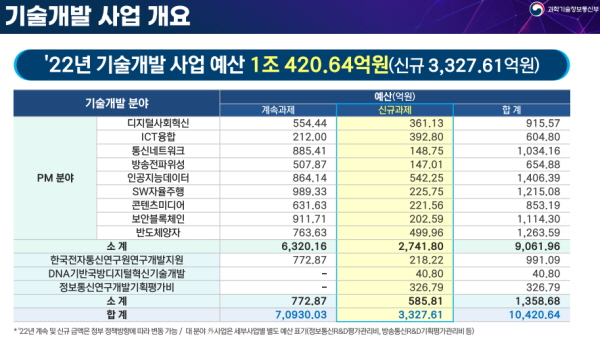
▲ 2022 Technology Development Project Budget (Photo Source: Press release from the Ministry of Science and ICT)
Total ICT R&D investment reached 1.3736 trillion won, up 13.52% from the previous year.
Budget allocated to new projects is 408.7 billion won, an increase of 16.4 billion won compared to the previous year.
The Ministry of Science and ICT and the Korea Institute of Science and Technology Planning and Evaluation held the '2022 Government R&D Project Online Joint Briefing' on the 25th and announced the details of R&D projects in the ICT sector and detailed implementation plans.
The total investment in ICT R&D in 2022 was 1,373.6 billion won, an increase of 13.52% compared to the previous year.
Of these, the budget allocated to new projects was set at 408.7 billion won, an increase of 16.4 billion won from 392.3 billion won last year.
The budget for technology development projects amounts to 1,042,064,000,000 won, which is 75.8% of the total investment, and the budget for new projects is 332,761,000,000 won.
The major areas of technology development include ICT convergence, telecommunications and networks, AI and data, software and autonomous driving, and semiconductors and quantum. />
■ ICT Convergence Project Budget: 60.48 billion won
The goal of the ICT convergence project is to integrate ICT into various industries to transform them into future high-tech industries, and to innovate the national industrial structure through the creation of new solutions, services, and markets.
The key research areas include: △advancing manufacturing innovation based on 5G and DNA and strengthening the competitiveness of smart factory suppliers; and △expanding the application of advanced ICT technologies such as 5G MEC, edge computing, and DNA.
Among ICT convergence projects, the 'Smart Manufacturing Innovation Technology Development' project was allocated the largest number of projects and budget, with 22 new projects and 31.57 billion won invested.
Support for 9 ongoing projects with 10.4 billion won will be provided to support the localization development of core components, modules, and devices required for 5G equipment (optical transmission, base stations), terminals (smartphones, wearables), etc.
■ Telecommunications and Network Business Budget: 103.416 billion won
The goal of the telecommunications and network business is to establish a foundation to lead the hyper-connected global market by advancing 5G infrastructure and securing core 6G technologies.
The key research areas are securing core source technologies for 6G, securing next-generation network equipment and component technologies, and securing core technologies for autonomous IoT.
The budget for the 6G core technology development project was allocated as 6.063 billion won for 5 new projects and 24.72 billion won for 11 continuing projects.
1.9 billion won has been allocated for the development of core technologies for autonomous IoT to support two new projects.
■ Artificial Intelligence and Data Business Budget: 140.639 billion won
The goal of the AI and data business is to expand future growth engines by advancing core technologies for next-generation AI and big data.
The key research areas are the development of new AI-converged products and services, the revitalization of the data industry ecosystem, and the induction of the transition to a digital economy.
37.125 billion won, the largest amount among AI and data projects, will be invested in the development of human-centered core source technologies for artificial intelligence to support 20 new projects.
Development of core foundational software technologies that support future computing architectures, including the cloud, will support 4 new projects with 4.2 billion won and 11 ongoing projects with 17.2 billion won.
■ SW & Autonomous Driving Business Budget: 121.508 billion won
The SW business aims to secure intelligent and convergent SW technologies that drive the Fourth Industrial Revolution and to foster small but strong companies.
The key research areas of the software business include fostering the non-face-to-face remote industry, developing core software technologies to improve the efficiency of ultra-high-speed and large-capacity data processing, conducting R&D for promising software development, and improving and enhancing existing products.
To foster a growth environment for global SW specialized companies through R&D support for SW innovation companies, 5.5 billion won will be invested in the 'Digital Transformation K-SW Technology Development' project, which supports the development of technology and business models for SW innovation companies, to support four new projects.
In addition, 20 ongoing projects will be supported with 25.925 billion won to secure core source technologies to strengthen the competitiveness of promising software and services.
The goal of the autonomous driving business is to lay the foundation for next-generation autonomous driving communication technology that aims for ultra-high speed, ultra-low latency, and high reliability.
The development of V2X communication network security and load balancing technologies is a key research focus for the autonomous driving business.
255 for the development of security evaluation technologies and test standards for autonomous vehicle V2X communication networks and the development of load balancing technologies15 ongoing projects will be supported with 96 million won, and 2 new projects with 2.85 billion won.
In addition, 5.3 billion won will be invested in the development of next-generation autonomous driving vehicle communication (5G-NR-V2X) technology to support two new projects.
■ Semiconductor and Quantum Business Budget: 126.359 billion won
The goal of this project is to secure core foundational technologies for artificial intelligence semiconductors, a national strategic industry, and core technologies for entering the ranks of the top four quantum technology powers by the 2030s.
Key research areas include the development of innovative NPU design technology, securing top-tier technology for PIM AI semiconductors, and the development of core technologies for AI semiconductors for autonomous driving.
20.412 billion won will be invested in the development of core technologies for PIM artificial intelligence semiconductors to support 14 new projects.
The goal is to secure global technological and market leadership by acquiring cutting-edge technology in new-concept PIM AI semiconductors and establishing an industrial ecosystem.
To secure global-level technological competitiveness and foster fabless companies, support will be provided for 13 continuing projects with 26.418 billion won and 3 new projects with 3.415 billion won for next-generation intelligent semiconductor technology development (design).
7.2 billion won will also be invested in the development of core source technologies for the quantum internet to support five new projects.
At the briefing session, following the explanation of the technology development project, presentations continued on technology commercialization, standardization and international collaboration, infrastructure development, and workforce training.
A budget of 76.932 billion won is allocated to technology commercialization projects, of which 40.782 billion won is invested in new projects.
With the goal of enhancing the technological competitiveness of small and medium-sized enterprises (SMEs) and venture companies, it is being pursued in a direction that strengthens their technological competitiveness and improves commercialization outcomes through support for ICT technology development and subsequent commercialization.
The standardization project is With 29.525 billion won, we will promote the strengthening of core technology standardization activity capabilities to secure ICT standard development and capabilities.
The budget for international joint research projects is 11.677 billion won, and 3.508 billion won will be provided for new projects.
It includes provisions to support strategic cooperation with technologically advanced nations such as the United States and Europe in accordance with mid-to-long-term technology acquisition plans, as well as bilateral or multilateral joint research to implement agreements such as the Joint Science and Technology Committee and the ICT Policy Forum.
The infrastructure development project will use 96.193 billion won to strengthen the R&D capabilities of small and medium-sized enterprises and enhance the competitiveness of the ICT industry.
It is being pursued in the direction of supporting the activation of ICT convergence services and strengthening the R&D capabilities of ICT SMEs.
The human resource development project aims to foster innovative talent that will lead the growth engine in the fields of the Fourth Industrial Revolution and innovative growth.
The budget for this project is 117.21 billion won, and 23 billion won will be invested in new projects.
1 billion won will be provided for the establishment and operation of the Metaverse Convergence Graduate School, and two new projects will be supported.
In addition, 1.75 billion won will be provided to a project that includes establishing customized educational courses at overseas universities and dispatching and educating domestic talent.
For detailed information and implementation schedules for each project, please refer to the website of the Korea Institute of Information & Communication Technology Planning & Evaluation.
For international joint research projects, the schedule is determined based on the results of consultations with the partner country, so you must check the IITP website frequently.
Comments
Related news
Nvidia invests $5 billion in Intel
NVIDIA and Intel, leaders in global AI computing technology, are now forging ahead in providing cutting-edge solutions through NVLink-based architecture integration. NVIDIA and Intel have officially announced a strategic partnership and stated that they will jointly develop customized data center and personal computing products to accelerate diverse applications and workloads ranging from hyperscale to enterprise and consumer markets, thereby laying the foundation for the next generation computing era.
2025.09.22by 배종인 기자
.jpg)
Applied Materials Launches Environmental Protection Campaign to Mark World Cleanup Day
Applied Materials Korea (CEO Park Kwang-seon) is carrying out environmental cleanup activities with employees and their families around the Dongtan Sinricheon area on the occasion of World Cleanup Day, evolving into a company that engages with the local community beyond technological innovation.
2025.09.22by 명세환 기자
.jpg)
The combination of electrical and electronic technologies like AI, semiconductors, and electric vehicles with renewable energy will determine industrial competitiveness.
Professor Lim Chun-taek from Gwangju Institute of Science and Technology (GIST) stated in his keynote speech at the '2025 e4ds Tech Day' on the 9th, "Global energy investment is already shifting from fossil fuels to renewable energy, and the trend of electrification combined with electrical and electronic technologies is changing the industrial landscape."
2025.09.12by 배종인 기자
.jpg)
"Data Center Power Demand Surges: Distributed Energy is the Solution"
The power demand of data centers is surging rapidly alongside the accelerating growth of artificial intelligence (AI), cloud, and electric vehicle industries. In particular, the global power supply and demand structure centered on the United States is undertaking a massive infrastructure reorganization to adapt to this change, and Korea is no exception in this trend. As an alternative to overcome the limitations of the existing centralized power system, distributed energy systems and smart grid technologies are gaining attention.
2025.09.02by 배종인 기자
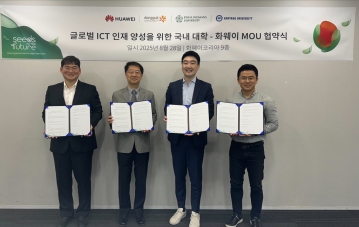
Huawei Begins Full-Scale Training of Young Korean Global ICT Leaders
Global ICT company Huawei Korea has signed a Memorandum of Understanding (MOU) with Dongguk University, Ewha Womans University, and Hanyang University, and will jointly implement a global education program to nurture next-generation ICT leaders.
2025.08.29by 배종인 기자











