



ETRI Distributes Core AI Semiconductor Software for Free
 Published2022.02.03 10:18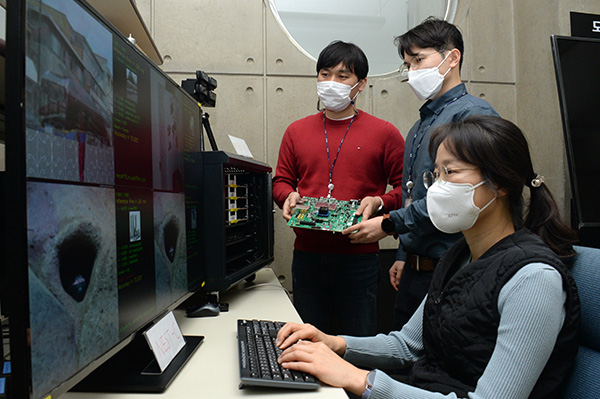
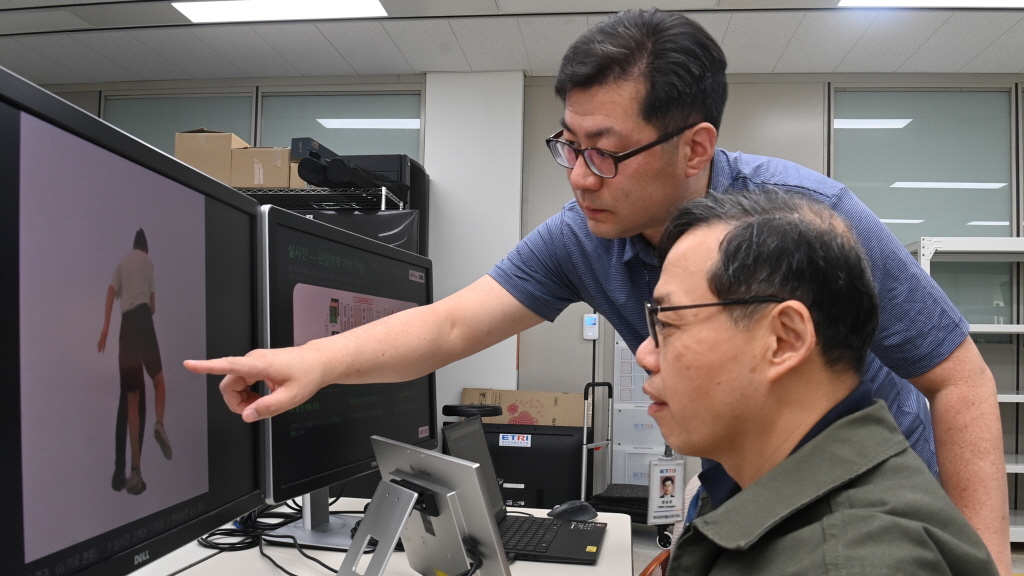
ETRI researchers on the NPU via the Nest compiler
We are demonstrating that deep learning image classification technology is in operation.
'NEST-C' Unveiled to Enhance AI Deep Learning Performance
Helps SMEs and startups reduce design and development costs
The Electronics and Telecommunications Research Institute (ETRI) took the lead in revitalizing the domestic AI semiconductor ecosystem by unveiling core technologies that reduce the time and cost of developing artificial intelligence semiconductors.
ETRI announced on the 26th that it has developed 'NEST-C,' a deep learning compiler and core AI system software. In addition, it released it on the web (Github) along with its self-developed AI semiconductor hardware so that developers can easily utilize it.
'NEST-C' has also been established as a standard by the Korea Information and Communications Technology Association (TTA), and by resolving issues of compatibility and scalability between hardware and software, it is expected to accelerate the development of AI semiconductors.
'NEST-C' is expected to shorten application development and optimization time, particularly for small and medium-sized enterprises and startups that have found it difficult to focus their capabilities on semiconductor design.
To run applications such as autonomous driving, the Internet of Things (IoT), and sensors, optimized AI semiconductors must be designed for each. Generally, manufacturers develop and sell AI semiconductors, system software, and applications together.
Previously, compilers had to be developed for each 'type of deep learning platform,' but now the Nest compiler can replace that.
In particular, this is the first time that both software and hardware for AI semiconductor development have been unveiled.
ETRI plans to expand the scope of support for deep learning compilers in collaboration with domestic companies and is also pursuing the commercialization of AI semiconductor application services through specialized software companies.
They also announced plans to contribute to the creation of new services by improving the performance and convenience required for the development of AI application services.
Kim Tae-ho, Head of the Next-Generation System Software Research Lab at ETRI, said, “The open-source release of the standard deep learning compiler is system software developed to revitalize the domestic AI semiconductor ecosystem. We are currently collaborating with various AI semiconductor companies to apply it.”
Comments
Related news
ETRI succeeds in intercontinental linkage of 5G satellite multi-connection networks.
Domestic research teams have developed infrastructure technology that can expand 5G service coverage through international joint research with the European Union (EU). Upon commercialization of this technology, uninterrupted communication services are expected to be provided even in remote and maritime areas with insufficient communication infrastructure, as well as in disaster situations.
2022.01.07by 배종인 기자
ETRI Shows Off Communication and Media Technology
ETRI will hold the '2021 ETRI Communications and Media Research Institute Achievement Presentation' to present major research results in communications and media, and will conduct live demonstrations of the deliverables.
2022.01.11by 김예지 기자

[e4ds Tech Day 2026 ⑨] Sim Sang-gyu, Autocrypt CTO: "In the Physical AI Era, Automotive Security Must Extend Beyond the Vehicle"
At e4ds Tech Day 2026, Sim Sang-gyu, CTO of Autocrypt, explained automotive cybersecurity strategies in the era of Physical AI and SDV (Software-Defined Vehicle). Automobiles are evolving as part of an ecosystem connected to AI, cloud, chargers, IoT, and robots, and he emphasized that the scope of security must expand beyond the vehicle interior to the entire connected environment. In particular, AI model tampering, adversarial attacks, OTA updates, and EV charger hacking were identified as major threats. He explained that response measures require zero trust, AI model integrity protection, intrusion detection, Security by Design and Default, and full lifecycle security management, and that proactive security system establishment beyond regulatory compliance is critical for securing future mobility competitiveness.
2026.10.12by 배종인 기자
NVIDIA to Invest $1 Billion in U.S. Science Over Next Five Years
NVIDIA has announced plans to invest $1 billion over the next five years to strengthen U.S. scientific and technological competitiveness. The company will enhance cutting-edge artificial intelligence research and development capabilities in key areas including quantum computing, healthcare, and energy security, while expanding support for higher education research institutions and cloud service providers. NVIDIA is participating as a major industry partner in the White House Office of Science and Technology Policy's Genesis Mission, and is promoting supercomputer construction in collaboration with national laboratories including Argonne and Los Alamos.
2026.10.12by 배종인 기자
ETRI Unveils 3 Next-Generation Media Technologies Including AI-Dedicated Video Compression
ETRI has unveiled three next-generation media technologies optimized for AI. These include AI-based video encoding (VCM), 3D human generation based on sparse cameras, and generative AI-based pre-visualization technology. In environments where AI directly processes video such as autonomous vehicles, robots, and drones, these technologies enable efficient compression and transmission of large-scale data, and can be applied across various industrial sectors including smart cities, video security, and sports broadcasting.
2026.10.12by 배종인 기자











