


ETRI Develops Sensor to Find People at Disaster Sites
 Published2022.02.03 16:13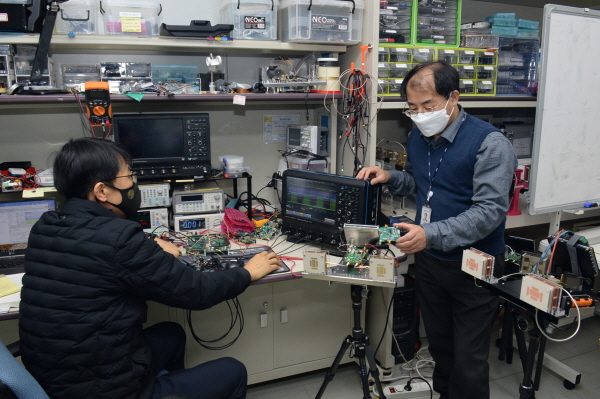
ETRI researchers measuring frequency using an IR-UWB radar sensor.
A semiconductor sensor capable of detecting vital signs of victims through walls using high-precision radar has been developed, raising expectations that it will support rapid and safe rescue operations at disaster sites.
The Electronics and Telecommunications Research Institute (ETRI) announced on the 3rd that it plans to develop a radar sensor-based human detection system and proceed with the production of a prototype for field adaptation and living lab demonstration tests.
There are two types of sensors developed by ETRI. First, the 'Impulse Radio Ultra-Wideband (IR-UWB) Radar Sensor' can detect centimeter-level movements using reflected electromagnetic waves. Therefore, it is possible to detect vital signs such as the victim's movements, breathing, and heartbeat, which are difficult to confirm with the naked eye.
In addition, 'high-precision Frequency Modulated Continuous Wave (FMCW) radar sensor technology' can detect people who are lying behind a wall or buried in collapsed debris, breathing without moving.
The current size of the system is approximately 15 cm x 20 cm, and we plan to miniaturize it in the future so that it is convenient for firefighters to carry.
Moving forward, the research team plans to make efforts to apply a sensor semiconductor-based life-saving system to disaster sites, including conducting simulated demonstrations in collaboration with fire departments.
ETRI Principal Researcher Koo Bon-tae, the project leader, stated, “Our goal is to save lives within the golden hour and ensure the safe rescue activities of firefighters in disaster environments. We will strive for rapid application to disaster sites so that this technology can contribute to the national disaster and safety management system.”
This research is being conducted until the end of this year as part of the project 'Development of Lightweight RISC-V-based Ultra-Low Power Intelligent Edge Semiconductor Technology' with support from the Ministry of Science and ICT.
Comments
Related news
ETRI succeeds in intercontinental linkage of 5G satellite multi-connection networks.
Domestic research teams have developed infrastructure technology that can expand 5G service coverage through international joint research with the European Union (EU). Upon commercialization of this technology, uninterrupted communication services are expected to be provided even in remote and maritime areas with insufficient communication infrastructure, as well as in disaster situations.
2022.01.07by 배종인 기자
ETRI Shows Off Communication and Media Technology
ETRI will hold the '2021 ETRI Communications and Media Research Institute Achievement Presentation' to present major research results in communications and media, and will conduct live demonstrations of the deliverables.
2022.01.11by 김예지 기자
ETRI Distributes Core AI Semiconductor Software for Free
ETRI has developed and disclosed core technologies to shorten the development time and reduce costs for AI semiconductor design.
2022.02.03by 김예지 기자

Intel Unveils Next-Generation 'Core Ultra Series 3' and vPro Platform for Enterprise PCs
Intel has officially unveiled the "Intel Core Ultra Series 3" for next-generation enterprise PCs and the latest vPro platform, addressing a wide range of demands from enterprise notebooks to high-performance workstations.
2026.03.26by 배종인 기자
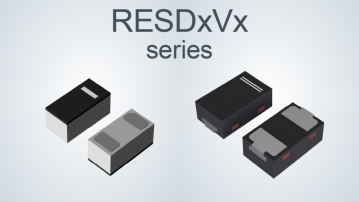
ROHM Launches ESD Protection Diode Compatible with High-Speed Interfaces of 10Gbps or Higher
Semiconductor specialist ROHM has developed the 'RESDxVx series' of ESD (electrostatic discharge) protection diodes capable of responding to next-generation high-speed data communication environments exceeding 10Gbps, simultaneously enhancing both signal quality maintenance required in high-speed interfaces and IC protection performance.
2026.03.26by 배종인 기자











