



KAIST Develops Ultra-Stable Microwave Generation Technology
 Published2022.02.04 09:36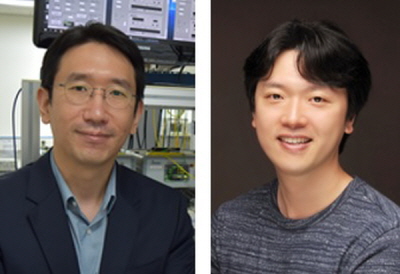
▲ (From left) KAIST Professor Kim Jung-won of the Department of Mechanical Engineering and Professor Lee Han-seok of the Department of Physics
Ultra-high-speed signal analysis using optical chips and fiber optics
Significant performance improvements expected in 5G and 6G communications
A KAIST research team has developed a technology that uses optical fibers to stabilize the characteristics of small devices, which previously struggled to maintain performance, and groundbreaking performance improvements are expected in various fields.
A joint research team led by Professor Jeongwon Kim of the Department of Mechanical Engineering and Professor Hanseok Lee of the Department of Physics at KAIST announced on the 26th that they have developed a technology to generate ultra-stable microwaves with frequency stability at the level of one-two-trillionth (5× 10⁻¹³ ) from a small, palm-sized device using optical chips and optical fibers.
This new technology enables the generation of microwaves with superior phase noise and frequency stability compared to existing microwave generation technologies from a small device the size of a mobile phone, thereby enabling groundbreaking performance improvements in various fields such as 5G and 6G communication, astronomical observation using radio telescopes, military radar, portable quantum sensors, and ultra-high-speed signal analysis technology.
Recently, microcomb technology that generates optical pulses using ultra-small microresonators is rapidly advancing.
Microcombs can increase the speed of optical pulses from tens of gigahertz (GHz, 1 billion vibrations per second) to terahertz (THz, 1 trillion vibrations per second)..
This is expected to play a key role in enhancing bandwidth and improving performance in various information and communication technology systems, as it facilitates the generation of high-frequency microwaves or millimeter waves and enables system miniaturization.
Theoretically, microcombs have a time error between pulses at the femtosecond ( 10⁻¹⁵ seconds = 1/1,000 trillionth of a second) level, but due to the characteristics of small devices, they are easily affected by the surrounding environment, making it difficult to maintain their performance for a long time.
To solve this, the microcomb can be frequency-locked to a mechanically stable device to improve stability, but until now, such a stabilization device has been very complex, sensitive to vibration, and bulky, which has prevented the utilization of the advantages of the microcomb and its application outside the laboratory.
To solve this problem, the research team developed a technology to stabilize the frequency of the microcomb using optical fibers.
A 1km-long optical fiber has excellent theoretical length stability at the level of one quadrillionth of a thermomechanical noise limit, and has the advantages of being small in volume, very light, and inexpensive.
The research team was able to implement this optical fiber-based stabilization device in a size of 108 mm × 73 mm × 54 mm.
As a result, the time error of the generated 22-gigahertz (GHz) microwave could be reduced to the level of 10 femtoseconds, which is more than six times better than that of a commercial high-performance signal generator, and the frequency stability could be reduced to the level of one-two-trillionth (5× 10⁻¹³ ).
This technology can simultaneously generate microwave and optical pulses with very high phase noise and frequency stability, and can be utilized in various cutting-edge scientific and technological fields.
As a representative example, in the case of very long baseline interferometers (VLBI) based on radio telescopes, using microwaves and optical pulses with higher frequencies and lower noise can dramatically improve measurement resolution and observation precision, which is expected to enable the exploration of new celestial phenomena, such as the event horizon of a black hole, that could not be observed previously.
Professor Jeong-Won Kim of the Department of Mechanical Engineering at KAIST stated, "We are currently conducting follow-up research to apply the newly developed ultra-stable technology to various fields such as communications, radar, data converters, and radio telescopes," while Professor Han-Seok Lee of the Department of Physics stated, "We are conducting research to improve the optical characteristics of the microresonator, a core component implemented on a silicon chip, in order to further enhance future performance."
Meanwhile, this research was conducted with support from the Korea Institute of Information & Communication Technology Planning & Evaluation's Quantum Sensor Core Source Project and the National Research Foundation of Korea's Mid-Career Researcher Program.
Comments
Related news
ETRI Selected as Lead Institution for 6G Core Technology Development Project
The Electronics and Telecommunications Research Institute (ETRI) has been selected as the lead organization for the '6G Core Technology Development Project,' which involves 37 collaborative research institutions including mobile communication service operators, Samsung Electronics, and KAIST. The research team has divided the 6G research project into five major focus areas, with institutions collectively undertaking eight strategic tasks across each field.
2021.06.24by 배종인 기자
2021 Merck Awards Select KAIST Professor Seung-Hyup Yoo
Merck Korea, the Korean subsidiary of Merck, a leading science and technology company (CEO Dr. Kim Woo-kyou), has selected Professor Yu Seung-hyup from KAIST, who has contributed to the advancement of flexible and wearable electronics technology this year, as the recipient of the Merck Award.
2021.08.25by 배종인 기자
KAIST succeeds in developing dream battery
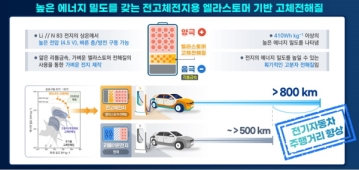
A research team from KAIST and Georgia Tech has developed the world's highest-performance all-solid-state battery, realizing the technology of the "dream battery" that enables round-trip travel between Seoul and Busan on a single charge. All-solid-state lithium-metal batteries are a future technology that replaces the volatile liquid electrolyte used in secondary batteries with a solid material, thereby preventing fires and automobile safety accidents.
2022.01.14by 성유창 기자
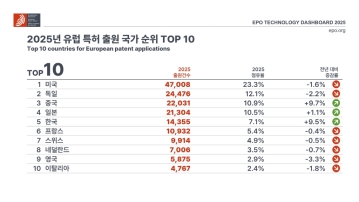
European Patent Applications Surpass 200,000 for the First Time… South Korea Maintains 5th Place, Led by Batteries and Telecommunications
According to the European Patent Office (EPO)'s 'Technology Dashboard 2025', European patent applications last year reached 201,974, surpassing 200,000 for the first time. Korean companies and inventors filed 14,355 applications, representing a 9.5% increase from the previous year and maintaining 5th place by country. Battery, digital communication, and semiconductor technologies led the growth, with Samsung ranking as the top EPO applicant for the second consecutive year and LG reaching 3rd place. The presence of major domestic cities such as Seoul, Suwon, and Yongin was also confirmed. It was also revealed that Korea's European patent strategy is expanding beyond individual technologies to span the entire industry.
2026.03.24by 명세환 기자

SK Telecom First Applies AI-Based Network Operations at Gwanghwamun K-Pop Concert
SK Telecom announced that it applied an AI-based network operation system for the first time at a large-scale K-pop concert held in the Gwanghwamun area of Seoul on March 21st, managing communication quality throughout the event. Mobile data usage during the three hours before and after the concert reached 12.15TB, approximately doubling compared to the same time slot the previous weekend. SK Telecom monitored traffic using the AI system 'A-One' in five-minute and 50-meter units to respond to potential overload situations, while also operating temporary communication facilities and on-site personnel in parallel. This case is interpreted as confirmation of the practical applicability of AI-based autonomous network operation in an environment where demand from dense events and foreign users increases simultaneously.
2026.03.23by 명세환 기자











