



Hyundai Mobis CEO Cho Sung-hwan: "Mobility is all about MECA, software, and semiconductors."
 Published2022.02.10 17:09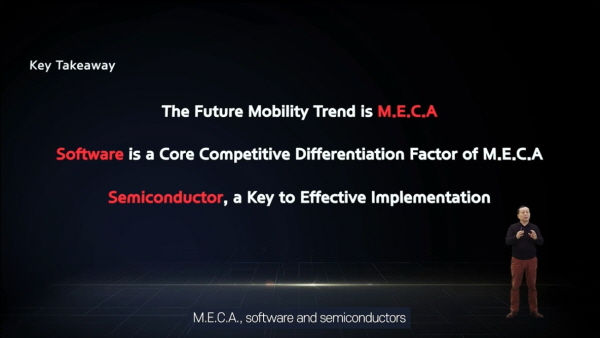
'Car safety devices' must satisfy a zero defect rate.
Downsizing technology and security will become increasingly important.
Hyundai Mobis CEO Cho Sung-hwan said that MECA, software, and semiconductors are the key factors that will define the future mobility industry, and that the automobile and semiconductor industries will experience further changes and advancements.
At 'SEMICON Korea 2022' held online, Hyundai Mobis CEO Sung-Hwan Cho delivered a keynote speech on the topic of 'Semiconductors in the Future Mobility Industry.'
CEO Cho said that automobiles and semiconductors have a close relationship.
While the COVID-19 pandemic has been cited as a major factor in the semiconductor shortage that has been occurring since the end of 2020, it was also revealed that incorrect predictions of semiconductor demand and the automobile industry were also a major reason.
Due to supply chain complexity, climate change, politics, and economics, an unprecedented decline of more than 10 million automobiles occurred last year.
This is a clear example of how semiconductors have a significant impact on the automotive industry.
CEO Cho chose MECA, software, and semiconductors as the most important keywords in the automobile and semiconductor industries.
MECA is an irreversible trend in the automotive industry created by Industry 4.0, regulatory advancements, and climate change.
/> M stands for Mobility, E for Electrification, C for Connectivity, and A for Autonomous Driving.
CEO Cho explained that the foundation of the technology that provides MECA to consumers is software, and that in the future automotive mobility industry where software and hardware are provided separately, software differentiation will be a key factor in determining the competitiveness of device operation.
In addition, securing and developing semiconductor technology that supports software development and forms the platform that enables its operation is essential.
The requirements for semiconductors in future mobility are: △optimization and high performance, △downsizing, and △security.
“Cars are safety devices,” said CEO Cho, adding that they must meet stringent quality standards.
It must operate perfectly under all conditions, including -40℃ to 150℃ and 0% to 100% relative humidity, and must be reliable enough to achieve a zero defect rate.
It must be able to satisfy all safety standards, including AEC-Q100, functional and safety standards, ISO26262, and cybersecurity standards, ISO21434.
To enter the early stages of Level 3 autonomous driving technology in the future, the performance of semiconductors must also be significantly improved.
He said that Core Performance should be improved to 450kDMIPS, which is 2.5 times higher than the current 180kDMIPS, NPU Performance should be improved to over 500TOPS, and Memory Bandwith should be improved to 410GB/s, which is 1.6 times higher than the current 256GB/s.
Downsizing technology to reduce the size of controllers and the importance of security are also expected to increase.
E/E architectureAs the architecture evolves from a distributed to a zonal architecture, the importance of security and stability increases as components and controllers are expected to be concentrated to take on higher performance and roles.
CEO Cho stated that system semiconductors will also integrate various functions and handle a lot of work in a small size, and that preparation for cybersecurity is essential.
Hyundai Mobis CEO Cho Sung-hwan said, “MECA, software, and semiconductors will continue to develop in an inseparable relationship,” adding, “This model will become the core that defines the future mobility industry.”
Comments
Related news
Hyundai Motor to Test Level 4 Autonomous Driving in Urban Areas Next Year
Hyundai Motor will launch a pilot service of Level 4 autonomous vehicles in Seoul's urban areas starting next year, where the vehicle's automated systems perceive and judge situations, control the vehicle, and exclude driver intervention even in emergencies.
2021.11.26by 배종인 기자
[Interview] Lee Kyung-soo, Manager at Infineon: "AURIX™ Automotive Security: Safe and Rapid Implementation"
Infineon Korea, a global company supplying diverse security product lines for automotive and industrial IoT applications, shared insights on automotive cybersecurity solutions through Kyung-soo Lee, Section Manager.
2022.01.24by 배종인 기자
.jpg)
“Protecting against car firmware vulnerabilities with chips”
E4ds held a webinar on the 25th featuring Microchip's Senior Director Kwak Sang-shin on "Platform Firmware Resilience for Automotive Applications." During this webinar, Kwak Sang-shin presented on vulnerabilities and protection methods that occur during the boot process and firmware updates in rapidly advancing automotive systems.
2022.01.25by 성유창 기자
[e4ds Tech Day 2026 ⑨] Sim Sang-gyu, Autocrypt CTO: "In the Physical AI Era, Automotive Security Must Extend Beyond the Vehicle"
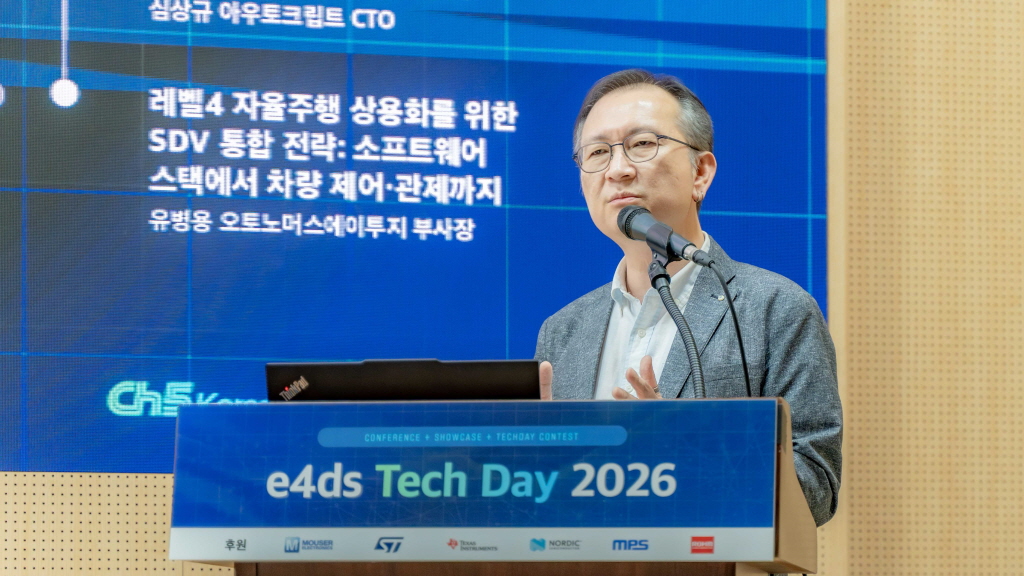
At e4ds Tech Day 2026, Sim Sang-gyu, CTO of Autocrypt, explained automotive cybersecurity strategies in the era of Physical AI and SDV (Software-Defined Vehicle). Automobiles are evolving as part of an ecosystem connected to AI, cloud, chargers, IoT, and robots, and he emphasized that the scope of security must expand beyond the vehicle interior to the entire connected environment. In particular, AI model tampering, adversarial attacks, OTA updates, and EV charger hacking were identified as major threats. He explained that response measures require zero trust, AI model integrity protection, intrusion detection, Security by Design and Default, and full lifecycle security management, and that proactive security system establishment beyond regulatory compliance is critical for securing future mobility competitiveness.
2026.10.12by 배종인 기자
Practical HIL Construction Strategy for Automotive and Off-Highway Controller Validation
As vehicle E/E architecture transitions to zonal structures and shifts to software-defined vehicles (SDV), the number of controllers (ECUs) requiring validation and software complexity are surging dramatically. Meanwhile, real vehicle testing cannot provide repeated verification under identical conditions and entails lead time and safety concerns. This white paper explains the principles of HIL (Hardware-in-the-Loop) validation and the structure of the NI platform composed of PXI, SLSC, and VeriStand, and through two actual implementation cases—Camera Record & Replay HIL for In-Cabin Monitoring Controller (ICMU) and Forklift Controller (VCU) HILS—describes how controller-level regression testing becomes possible. Additionally, it explicitly states application boundaries and limitations, such as lack of A2B support.
2026.10.12by 편집부











