



Hyundai Motors, Implementing All Connected Cars… Investing 12 Trillion Won
 Published2022.03.04 10:48
Standardization of software architecture and expansion of controller OTA updates
Genesis G90, equipped with Level 3 autonomous driving function on highways
Hyundai Motor Company announced at the '2022 CEO Investor Day' held on the 2nd that it will invest 12 trillion won by 2030 to strengthen software competitiveness, including connected cars and autonomous driving.
The plan is to provide customers with a new car-like experience through continuous vehicle updates and customized services completed by analyzing the massive data generated from connected cars.
To this end, Hyundai Motor Company is pursuing software architecture standardization and expanded application of controller OTA update functions.
Hyundai Motor Company has decided to break away from the current situation where controller configurations are fragmented by vehicle model and establish a system that can develop controllers more effectively by reducing development complexity through the introduction of a standardized software architecture and application of an integrated controller.
This will reduce the number of controllers applied to vehicles to one-third of the current level by 2030.
The controller OTA update function, which was first installed in the GV60 last year, will be installed in all new vehicles starting later this year.
Hyundai Motor Company by 2025In addition to applying the controller OTA update function to all 23 vehicle models (17 Hyundai models and 6 Genesis models) including electric vehicles, the company plans to significantly expand the controllers that can be updated with OTA.
Hyundai Motor Company is also committed to strengthening its autonomous driving technology competitiveness, including first applying the Level 3 highway autonomous driving function, 'Highway Driving Pilot (HDP),' to the Genesis G90 later this year.
In particular, if the international regulations for autonomous driving technology, which currently have a maximum speed of 60 km/h, are relaxed in the future, the driving speed will be increased and functions will be improved through OTA updates.
In addition, Hyundai Motor Company is suggesting new ways of transportation by utilizing autonomous driving technology.
Motional, a self-driving joint venture with Aptiv, plans to commercialize Ioniq 5-based robotaxis in some parts of the U.S. starting in 2023, while launching a self-driving delivery service in Santa Monica this year.
Separately, the 'Roboride' service utilizing Hyundai Motor Company's self-developed Level 4 autonomous vehicle will be introduced on a trial basis in major domestic cities in the first half of this year and gradually commercialized from 2023.
In addition, the 'Roboshuttle' based on level 4 autonomous driving technology began pilot operation in Sejong City and Hyundai Motor Group's Namyang Research Center (located in Hwaseong, Gyeonggi Province) last year, and the pilot service area will be expanded to Pangyo, Gyeonggi Province this year.
In addition to autonomous driving, Hyundai Motor Company plans to continue developing technology to provide remote autonomous parking services, including applying the Remote Smart Parking Assist 2 function through future OTA updates.
Hyundai Motor Company is also working on developing a next-generation integrated controller to support the advancement of autonomous driving and autonomous parking functions..
The second-generation integrated controller, which is an improvement on the first-generation integrated controller that was first mass-produced in 2019, will be developed and applied by 2022, and the third-generation integrated controller that will integrate and manage all autonomous driving-related controllers will begin development in 2023.
Hyundai Motor Company has decided to secure specialized capabilities and expand mid- to long-term investments to steadily strengthen its software competitiveness, which is the foundation of connectivity and autonomous driving technologies.
First, we plan to expand sales of software-related businesses such as mobility, connectivity, and data business to 30% of total sales by 2030.
In addition, we will establish software specialized organizations in Korea and overseas to secure and train human resources, while increasing specialized personnel by more than 20% every year to strengthen software capabilities in all business areas.
In addition, it was decided to invest 12 trillion won to improve software competitiveness by 2030.
This is equivalent to approximately 30% of Hyundai Motor Company’s future business investment.
Specifically, KRW 4.3 trillion will be invested in technology development related to new businesses such as connectivity and autonomous driving, KRW 4.8 trillion in strategic equity investments targeting startups and research institutes, and KRW 2.9 trillion in company-wide ICT (information and communication technology)-related investments such as the establishment of a big data center.
Comments
Related news
Hyundai Motor to Test Level 4 Autonomous Driving in Urban Areas Next Year
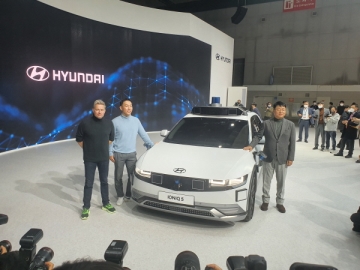
Hyundai Motor will launch a pilot service of Level 4 autonomous vehicles in Seoul's urban areas starting next year, where the vehicle's automated systems perceive and judge situations, control the vehicle, and exclude driver intervention even in emergencies.
2021.11.26by 배종인 기자

The Personal Information Protection Commission and the autonomous vehicle industry are exploring solutions to protect personal information.
The Personal Information Protection Commission visited the research and development facility of Hyundai Motor and Kia's Namyang Technical Research Institute (Hwaseong, Gyeonggi Province) on the 27th, held a discussion on the current status of personal information processing technology and protective measures, and discussed "activation measures for autonomous driving based on user trust."
2022.01.28by 성유창 기자
Hyundai Mobis CEO Cho Sung-hwan: "Mobility is all about MECA, software, and semiconductors."
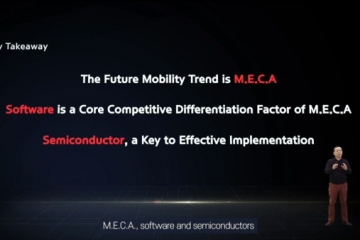
Hyundai Mobis CEO Cho Sung-hwan stated that the key to defining the future mobility industry is M.E.C.A, software, and semiconductors, adding that the automotive and semiconductor industries will achieve greater change and advancement.
2022.02.10by 성유창 기자
[e4ds Tech Day 2026 ⑨] Sim Sang-gyu, Autocrypt CTO: "In the Physical AI Era, Automotive Security Must Extend Beyond the Vehicle"
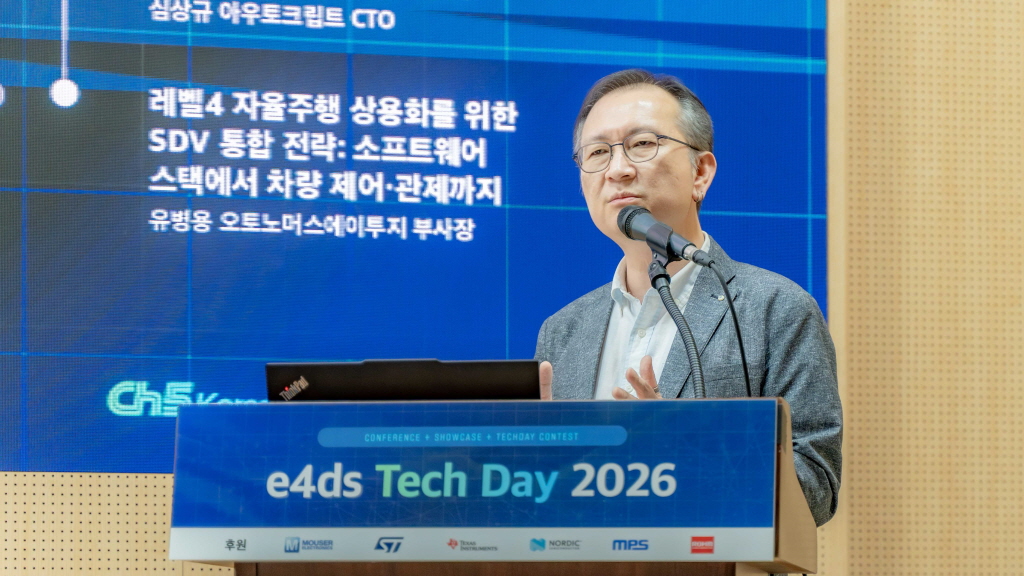
At e4ds Tech Day 2026, Sim Sang-gyu, CTO of Autocrypt, explained automotive cybersecurity strategies in the era of Physical AI and SDV (Software-Defined Vehicle). Automobiles are evolving as part of an ecosystem connected to AI, cloud, chargers, IoT, and robots, and he emphasized that the scope of security must expand beyond the vehicle interior to the entire connected environment. In particular, AI model tampering, adversarial attacks, OTA updates, and EV charger hacking were identified as major threats. He explained that response measures require zero trust, AI model integrity protection, intrusion detection, Security by Design and Default, and full lifecycle security management, and that proactive security system establishment beyond regulatory compliance is critical for securing future mobility competitiveness.
2026.10.12by 배종인 기자
Practical HIL Construction Strategy for Automotive and Off-Highway Controller Validation
As vehicle E/E architecture transitions to zonal structures and shifts to software-defined vehicles (SDV), the number of controllers (ECUs) requiring validation and software complexity are surging dramatically. Meanwhile, real vehicle testing cannot provide repeated verification under identical conditions and entails lead time and safety concerns. This white paper explains the principles of HIL (Hardware-in-the-Loop) validation and the structure of the NI platform composed of PXI, SLSC, and VeriStand, and through two actual implementation cases—Camera Record & Replay HIL for In-Cabin Monitoring Controller (ICMU) and Forklift Controller (VCU) HILS—describes how controller-level regression testing becomes possible. Additionally, it explicitly states application boundaries and limitations, such as lack of A2B support.
2026.10.12by 편집부











