


Solving the problem of medium-term carbon neutrality with smart factories
 Published2022.03.17 14:59
The government will address carbon neutrality for small and medium-sized enterprises (SMEs) by promoting smart factories, including data-driven process innovation and replacement of high-efficiency equipment.
The Korea SMEs and Startups Agency (Chairman Kim Hak-do) announced on the 16th that it is recruiting small and medium-sized enterprises (SMEs) to participate in the carbon-neutral smart factory distribution project until April 5th.
The Carbon-Neutral Smart Factory Distribution Project is a project that helps companies in high-carbon emission industries establish low-carbon management systems by supporting energy efficiency and ICT-based carbon reduction process innovation.
The industries eligible for support are the top 10 high-carbon-emitting industries among small and medium-sized enterprises, such as food manufacturing, and 14 core technology industries, such as casting and welding. The target industries have been significantly expanded from 6 last year to 24.
The main support contents include: △Energy diagnosis and design consulting that measures and analyzes energy usage by process to suggest carbon reduction strategies; △Support for energy management and process innovation solutions (FEMS, MES, etc.) and related controllers, measuring instruments, and energy efficiency facilities; △Support for replacing utility facilities such as energy-intensive and aging facilities with high-efficiency facilities that are effective in reducing energy consumption.
There are two types of application methods: assignment-based and open-ended. You can choose the method that best suits your company's circumstances.
The designated project type is a method of applying by selecting a project (137 projects) that is appropriate for the company's current status from among the projects presented through an investigation of energy-intensive processes, and the free application type is a method of applying by freely writing a plan to build a carbon-neutral smart factory that is appropriate for the company's current status and production process.
The amount of support will be divided into 50 million won for Basic and Equivalent Levels and 200 million won for Advanced Level 1, depending on the participating companies' process intelligence goals. This year's budget totals 4 billion won. For simple equipment replacements and facility investments not linked to smart production methods, up to 10 billion won per company can be provided in the form of loans, linked to the Small and Medium Business Administration's SME policy funds (e.g., the Manufacturing Site Smartization Fund).
Companies that have completed similar tasks through the General Smart Factory Promotion Project can also apply for an additional round. Companies that received SME policy financing for facility installation will also receive interest rate reductions based on performance assessments in 2023.
For more information, please visit the Korea Small and Medium Business Administration website (kosmes.or.kr) or the Smart Manufacturing Innovation Promotion Group's Smart Factory 1st Street (1st.smart-factory.kr). Applications for business participation can be made at Smart Factory 1st Street.
Choi Hak-soo, head of the Innovation Growth Division at the Korea SMEs and Startups Agency, said, “Small and medium-sized enterprises (SMEs) agree on the need for carbon neutrality, but they cite the costs of process improvement and equipment introduction as obstacles.” He added, “We expect that the carbon-neutral smart factory distribution project will play a significant role as a catalyst to promote energy efficiency improvements and the transition to low-carbon management systems for SMEs.”
Comments
Related news
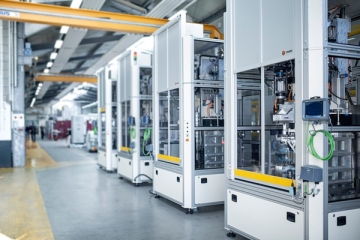
"Smart factories, the driving force behind manufacturing innovation," a qualitative shift, not a quantitative expansion, has begun.
Smart factory construction and transformation projects are being actively implemented worldwide, driving significant growth in the related market. South Korea ranks as a manufacturing powerhouse following the United States, China, Germany, Japan, and India. To go beyond maintaining its current position and achieve further growth, the country must continuously execute strategies to respond to changes in the manufacturing ecosystem, such as the widespread adoption of smart factories.
2020.11.23by 이수민 기자
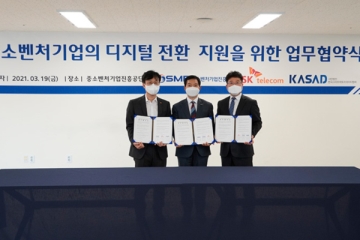
SKT, KOSBC, and KASAD to Support Digital Transformation of Manufacturing SMEs
SKT, the Korea Small Business and Startup Agency (SMBA), and KASAD have signed a Memorandum of Understanding to support the sustainable growth of small and medium-sized manufacturing enterprises facing economic difficulties due to the prolonged COVID-19 pandemic. The three institutions will establish a consultative body to support manufacturing data utilization and smart factory activation, and will join forces in providing integrated support of policy funds and AI and cloud technologies.
2021.03.19by 이수민 기자
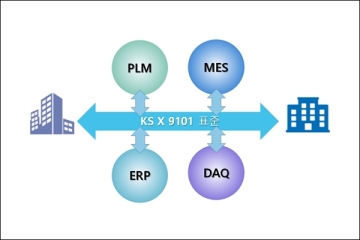
The Korea Agency for Technology and Standards (KATS) has established a standard for data exchange between smart manufacturing systems.
The National Institute of Standards and Technology under the Ministry of Industry and Trade established the national standard KS X 9101, which stipulates data exchange methods between smart manufacturing systems. Additionally, at the Smart Manufacturing National Standards Conference, a side event of Smart Factory Expo + Automation World 2021, a demonstration was presented validating interoperability between manufacturing business systems of different companies using the new standard.
2021.09.13by 이수민 기자
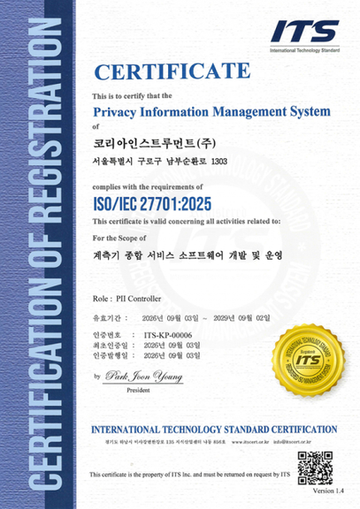
Korea Instrument, KOLAS Accredited Calibration Agency First to Simultaneously Acquire ISO/IEC 27,001·27,701
Korea Instrument has become the first among KOLAS accredited calibration agencies to simultaneously acquire ISO/IEC 27,001 and ISO/IEC 27,701 certifications. Through its proprietary platforms CWIZ Enterprise and CWIZ Partners, the company has embedded information security and personal data protection requirements across all business processes including customer information, equipment data, and calibration reports, with plans to continuously advance its management system through regular audits and security inspections.
2026.10.12by 배종인 기자
TeamViewer One, IT Incident Automation Workflow and Resolution Center Enhanced
TeamViewer has added IT incident automation capabilities and an advanced Resolution Center to its integrated digital workplace management platform 'TeamViewer ONE'. Recurrent service disruptions, configuration errors, and capacity shortages are automatically handled according to preset policies, and device status verification through script deployment can be managed in a unified interface, significantly reducing repetitive tasks for IT teams.
2026.10.12by 배종인 기자











