



[Interview] Park Han-gu, Head of the Smart Manufacturing Innovation Promotion Team: "Smart manufacturing innovation requires building a digital economy system centered on mid-sized companies." (Part 1)
 Published2022.03.29 13:42
Launched in May 2019, the goal is to build 30,000 smart factories this year.
Emphasizes technology collaboration among clusters of large, medium, and small businesses.
Cloud-based AI platform support reduces initial costs and enhances security .
[Editor's Note] Industry 4.0 aims to establish a fully automated manufacturing system, enabling information exchange between production equipment and products via the Internet of Things. To move beyond factory automation to data-driven smart manufacturing, interconnection between devices and efficient management of the data generated from this interconnection are essential. Appropriately managing exponentially growing data is crucial, and the industry is increasingly adopting the cloud to store and analyze this rapidly growing volume of industrial data. This approach is driving market expansion, fueled by its advantages of processing speed, ease of management, and cost savings. Meanwhile, we met with Park Han-gu, head of the Smart Manufacturing Innovation Promotion Team, who is in charge of the domestic smart factory distribution and expansion project, to hear about the team's future smart factory support project policies.
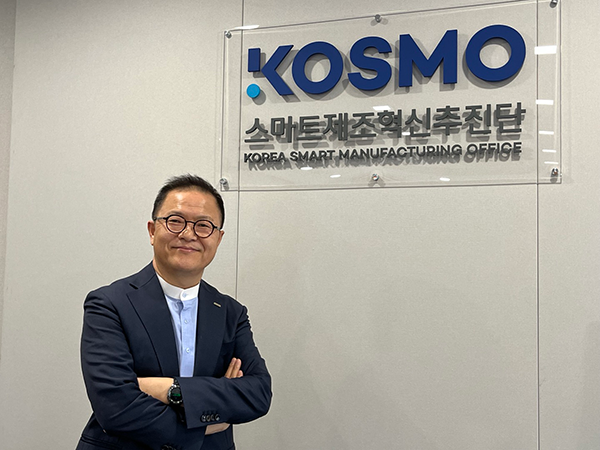
Park Han-gu, head of the Smart Manufacturing Innovation Promotion Team
■ Please introduce the Smart Manufacturing Innovation Promotion Team and tell us about its achievements since its launch.
In 2014, the Ministry of Trade, Industry and Energy established a private-sector joint smart factory promotion team, which was transferred to the Ministry of SMEs and Startups in 2018, and the Smart Manufacturing Innovation Promotion Team was launched in May 2019.
The Smart Manufacturing Innovation Promotion Team is a government-funded initiative that divides Korean companies into four stages, with each stage receiving 50% funding support to help them build smart factories.
The policy goals of the Smart Manufacturing Innovation Promotion Team are: △Achieving the establishment of 30,000 smart factories for small and medium-sized enterprises in Korea; △Reaching the advanced factory level for approximately 25% of them; and △Supporting the establishment of an AI-powered small and medium-sized venture manufacturing platform (KAMP).
The government is focusing on qualitative improvement and has been focusing on promoting the first and second stages of advancement for small and medium-sized enterprises (support of 200 million won and 400 million won, respectively) since last year.
In fact, small and medium-sized enterprises are seeing economic benefits through smart construction, such as improved productivity and quality, reduced costs, and shortened delivery times.
In addition, after the coronavirus outbreak, the working environment improved due to 3D work automation in production sites, and the employment rate of young people increased by an average of 2.6 people before and after the introduction of smart factories.all.
■ What are the government's smart factory support policies this year?
The first project we are focusing on this year is the Digital Cluster Project, which will support the intensive implementation of Stages 1-4 over a three-year period by grouping companies along the supply chain that produce completed parts and products.
The background to the launch of this project is that many manufacturing companies and companies introducing smart factories have a proactive attitude towards smart factories after COVID-19.
On the other hand, when analyzing the performance after introducing smart factories, productivity increased by 28.5%, and sales increased by 7.4%. In other words, even if productivity is high, it does not directly lead to sales.
The reason is that small and medium-sized enterprises in our country are subcontractors of companies that manufacture finished products.
The Smart Manufacturing Innovation Promotion Team will bring together companies in clusters, centered around one company in each region, from 19 techno park centers across the country to build smart factories and exchange information to enhance the value of data.
Due to the nature of our country's corporate culture, which tends to be passive in pursuing collaboration, there are some difficulties in that there are relatively few companies that support us. However, I believe that sustainable mutual growth is possible only when companies work together to create new value.
Second, we are supporting the registration of many Korean small and medium-sized enterprises in the Lighthouse Factory System, which was created as part of efforts to establish global standards for smart manufacturing innovation.
There are about 90 factories listed on the lighthouse factory list, most of which are large corporations. In Korea, there are POSCO in 2019 and LS Electric in 2021.
To support small and medium-sized enterprises, the government created the 'K-Smart Lighthouse Factory Project', selected 10 companies last year and 10 more this year, and is providing 400 million won per year, totaling 1.2 billion won over three years.
■ Please give us your opinions on the requirements, difficulties, and solutions to achieve manufacturing innovation through technological advancement.
For companies introducing smart factories to achieve success, the technological level of their suppliers must be high.
The reality is that in our country, there are still many companies that are stuck at the level of factory automation in the era of the Third Industrial Revolution.
The reason is that our country's supply companies are lacking in the ability to utilize data to create smart factories.
The government will start from 2020 to raise the level of suppliers. We are supporting 430 billion won in smart manufacturing innovation R&D projects.
Over the next five years, our R&D program will support Korean suppliers to leverage not only existing technologies but also cutting-edge technologies such as cloud computing, big data, and the metaverse, leveraging artificial intelligence to generate economic benefits for the manufacturing industry.
Our country must have an entrepreneurial spirit and a spirit of challenge that can generate economic benefits beyond those achieved through active investment, along with government support.
※ Meanwhile, e4ds news will host the ' 2022 IIoT Innovation Day ' on the topic of ' Building an Industrial Communication Network for Digital Twins ' simultaneously online and offline at COEX Hall D and e4ds.com on Friday, April 8th. This seminar will be attended by Lee Soon-yeol, CEO of I2, B&R, Codezoo, Rockwell Automation, Ericsson-LG, and others, who will introduce the latest IIoT technologies. We look forward to your participation. You can apply for participation at the e4ds news conference .
Comments
Related news
.jpg)
A place to share new technologies in industrial communication networks
e4ds news will hold the '2022 IIoT Innovation Day' event at COEX D Hall starting at 10:00 AM on April 8th.
2022.03.22by 배종인 기자
[Interview] Park Han-gu, Head of Smart Manufacturing Innovation Promotion Team - “Smart manufacturing innovation, medium-term-centered digital economic system must be established” (2)
We arranged a meeting to hear from Park Han-gu, Director of the Smart Manufacturing Innovation Promotion Group, who oversees the domestic smart factory promotion and diffusion project, and to discuss future smart factory support business policies.
2022.03.29by 김예지 기자
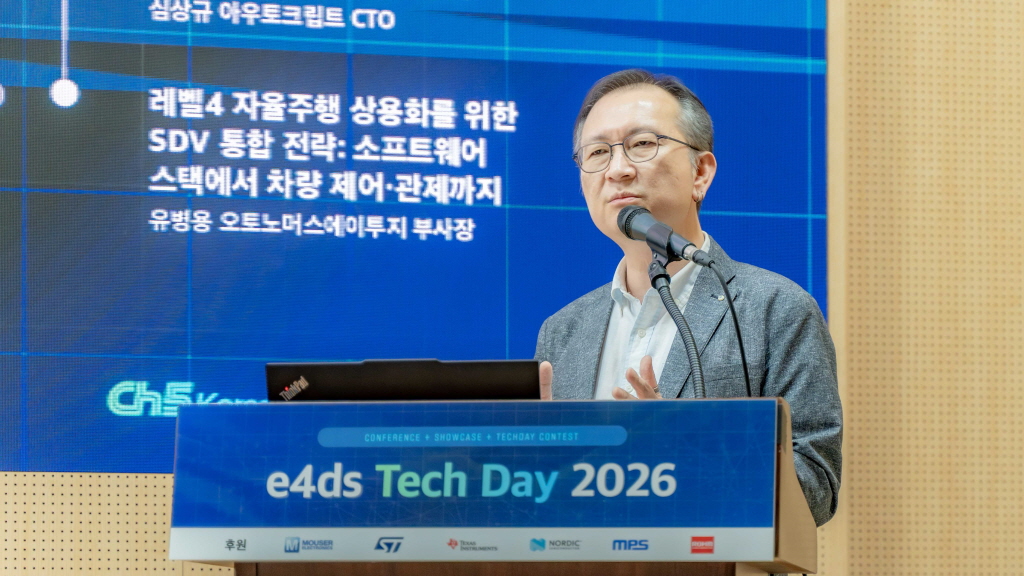
[e4ds Tech Day 2026 ⑨] Sim Sang-gyu, Autocrypt CTO: "In the Physical AI Era, Automotive Security Must Extend Beyond the Vehicle"
At e4ds Tech Day 2026, Sim Sang-gyu, CTO of Autocrypt, explained automotive cybersecurity strategies in the era of Physical AI and SDV (Software-Defined Vehicle). Automobiles are evolving as part of an ecosystem connected to AI, cloud, chargers, IoT, and robots, and he emphasized that the scope of security must expand beyond the vehicle interior to the entire connected environment. In particular, AI model tampering, adversarial attacks, OTA updates, and EV charger hacking were identified as major threats. He explained that response measures require zero trust, AI model integrity protection, intrusion detection, Security by Design and Default, and full lifecycle security management, and that proactive security system establishment beyond regulatory compliance is critical for securing future mobility competitiveness.
2026.10.12by 배종인 기자
NVIDIA to Invest $1 Billion in U.S. Science Over Next Five Years
NVIDIA has announced plans to invest $1 billion over the next five years to strengthen U.S. scientific and technological competitiveness. The company will enhance cutting-edge artificial intelligence research and development capabilities in key areas including quantum computing, healthcare, and energy security, while expanding support for higher education research institutions and cloud service providers. NVIDIA is participating as a major industry partner in the White House Office of Science and Technology Policy's Genesis Mission, and is promoting supercomputer construction in collaboration with national laboratories including Argonne and Los Alamos.
2026.10.12by 배종인 기자
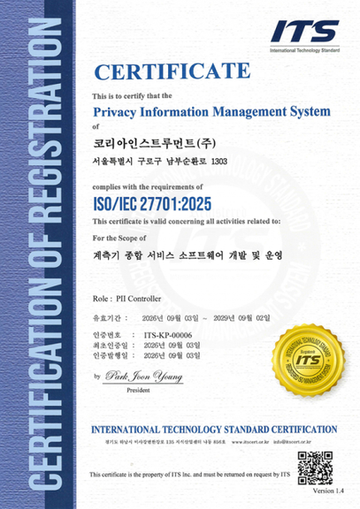
Korea Instrument, KOLAS Accredited Calibration Agency First to Simultaneously Acquire ISO/IEC 27,001·27,701
Korea Instrument has become the first among KOLAS accredited calibration agencies to simultaneously acquire ISO/IEC 27,001 and ISO/IEC 27,701 certifications. Through its proprietary platforms CWIZ Enterprise and CWIZ Partners, the company has embedded information security and personal data protection requirements across all business processes including customer information, equipment data, and calibration reports, with plans to continuously advance its management system through regular audits and security inspections.
2026.10.12by 배종인 기자











