



A venue for sharing promising patented technologies in the Science Business Belt district
 Published2022.04.01 08:54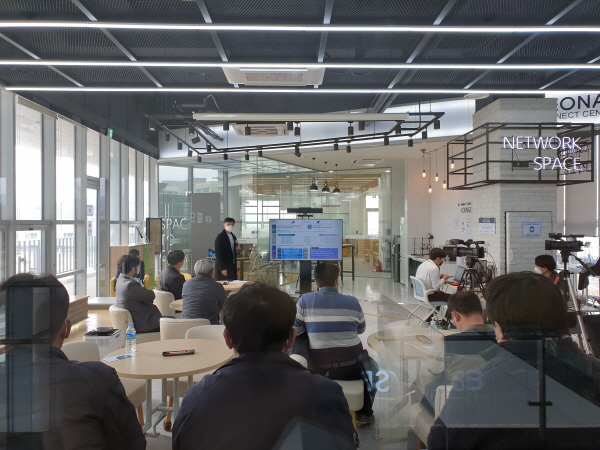
▲ A view of the Science Belt Functional and Hub District Technology Transfer Briefing held on the 30th
Promoting the transfer and commercialization of public patents within the Science Belt
Promoting technology transfer and joint research for Science Belt companies
A meeting was held to identify promising patents for transfer and commercialization in order to promote the transfer and commercialization of public patents within the Science Business Belt functional zones (Sejong, Cheongju, Cheonan) and hub zones (Daejeon-Sindong, Dungok-dong, Doryong-dong).
On the 30th, a technology transfer briefing session was held at Cheonan SB Plaza, organized by Technology & Happiness Co., Ltd., the Special Research and Development Zone Promotion Foundation, and Insight Biz Lab Co., Ltd., to promote technology transfer and joint research that can identify technical difficulties and provide solutions for companies in the Science Belt functional and hub districts.
During this briefing session, presentations were given on six commercially viable patent technologies selected as promising patents within the Science Business Belt functional and hub districts.
Patent attorney Yoo Byung-don of the Institute for Basic Science gave a presentation on "Targeted Crystallization of Nanoparticles for Inducing Cancer Cell Death." It was evaluated as being useful for medical and pharmaceutical applications, such as the prevention and treatment of solid tumors, blood cancers, and tumors, as it does not exhibit toxicity to the human body or normal cells. Because it exhibits a cancer cell-specific killing effect, it is expected to overcome the limitations of medical applications caused by the non-specific cytotoxicity of existing cationic nanoparticles.
Dr. Park Hyung-ki of the Korea Institute of Industrial Technology introduced a 'multi-point temperature measuring device.' It can significantly reduce the time required for temperature measurement when there are multiple objects to be measured, such as in product quality inspections, and can lower the risk of operation even when the target tube is at a high temperature. In addition, the accuracy of the measurement value can be improved by ensuring that the measuring terminals of the thermocouples, which are arranged along the surface where the joint is joined to the target tube, make good contact with the target tube.
Professor Lee Byeong-ui of Soonchunhyang University presented on the "Method for Manufacturing Batch for Winter Cultivation of Button Mushrooms." The technology concerns a method for manufacturing a cultivation medium for button mushrooms during the winter, which includes a step of outdoor fermenting of a mixture intended for the production of the cultivation medium. Professor Lee stated that when comparing the efficiency of outdoor fermentation and composting of the mixture for producing the cultivation medium, the outdoor fermentation efficiency of the mixture was superior.
Professor Lee Seong-ah of Soonchunhyang University introduced "a device and method for enhancing cognitive ability." This technology relates to a device and method designed to improve cognitive ability by having a user draw a shape, combine it with a corresponding word, and then expose either the shape or the combined word to the user to receive input from the corresponding shape or word. It is evaluated as effective in improving fine motor skills in an era of aging populations and a rising number of stroke patients.
Professor Lee Na-hyun of Dankook University introduced the 'Sr-nanocement' technology effective for osteoporosis. This is a nanocement that promotes bone formation and inhibits osteoclastosis. Significant bone recovery was confirmed in animal experiments involving osteoporosis induction, utilizing an effective non-drug nanotherapeutic implantable biomaterial platform technology for treating osteoporotic bone defects that possesses fracture inhibition and bone formation stimulation effects. Through these experiments, bone volume, spongy water, and thickness were higher compared to the control group, and the degree of bone detachment was lower, proving that osteoporosis can be prevented.
Following this, Professor Jin Seong-gyu of Dankook University presented a "topical transparent film-forming gel for herpes treatment." It is a topical transparent film-forming gel containing acyclovir that can be applied to treat herpes. Acyclovir is an antiviral drug used to treat herpes simplex virus and varicella-zoster virus infections, and it is also used to prevent viral infections in patients with compromised immune function. This technology exists as a topical gel formulation before application to the skin, but it rapidly forms a film upon application, allowing for flexible application even to curved areas.
Comments
Related news
2021 International Science Business Belt Functional Zone Technology Transfer Briefing Session
The '2021 International Science Business Belt Functional District Technology Transfer Briefing Session' will be held on November 24 at 1:30 PM at the Cheonan SB Plaza within Chungnam Technopark.
2021.11.16by 배종인 기자
The Science Belt: A Unified Platform for Technology Transfer, Diffusion, and Commercialization
A venue was established for demand discovery from companies in the Science Belt and for technology transfer, dissemination, and commercialization of research results, enabling optimal technology matching from technology discovery through post-technology transfer commercialization linkage.
2021.11.24by 배종인 기자

Nvidia invests $5 billion in Intel
NVIDIA and Intel, leaders in global AI computing technology, are now forging ahead in providing cutting-edge solutions through NVLink-based architecture integration. NVIDIA and Intel have officially announced a strategic partnership and stated that they will jointly develop customized data center and personal computing products to accelerate diverse applications and workloads ranging from hyperscale to enterprise and consumer markets, thereby laying the foundation for the next generation computing era.
2025.09.22by 배종인 기자
.jpg)
Applied Materials Launches Environmental Protection Campaign to Mark World Cleanup Day
Applied Materials Korea (CEO Park Kwang-seon) is carrying out environmental cleanup activities with employees and their families around the Dongtan Sinricheon area on the occasion of World Cleanup Day, evolving into a company that engages with the local community beyond technological innovation.
2025.09.22by 명세환 기자
.jpg)
The combination of electrical and electronic technologies like AI, semiconductors, and electric vehicles with renewable energy will determine industrial competitiveness.
Professor Lim Chun-taek from Gwangju Institute of Science and Technology (GIST) stated in his keynote speech at the '2025 e4ds Tech Day' on the 9th, "Global energy investment is already shifting from fossil fuels to renewable energy, and the trend of electrification combined with electrical and electronic technologies is changing the industrial landscape."
2025.09.12by 배종인 기자











