


Cyber threats require two-factor authentication and access security policies.
 Published2022.04.07 12:00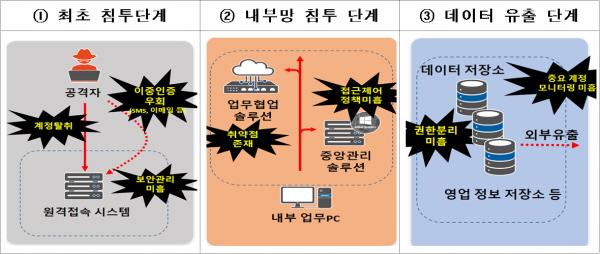
▲Key supplementary requirements by stage
Request for abnormal behavior inspection system check
The Ministry of Science and ICT, in collaboration with the Korea Internet & Security Agency, analyzed recent cyber threat trends and announced response measures for domestic companies on the 7th to enable Korean companies to systematically and preemptively respond to changes in the work environment, such as remote work becoming routine in the wake of COVID-19, and to cyber threats that are becoming increasingly sophisticated and organized.
Accordingly, it was revealed that in the initial infiltration stage, two-factor authentication such as highly secure biometric authentication must be introduced, and when accessing the remote work system, a security policy that allows access only through pre-approval and designated terminals and IPs must be applied.
He also mentioned the need to apply policies such as tracking employee account activity history and monitoring for abnormal signs by utilizing AI and big data-based technologies.
In the internal network penetration stage, it was revealed that two-factor authentication such as designating an administrator terminal for access to important servers and biometric authentication must be applied, monitoring for abnormal use such as accessing the server with an account different from the initial access account must be strengthened, and inspections must be strengthened for malicious code execution and log deletion behaviors that are mainly used in internal network attacks.
In the data leak stage, it was mentioned that access rights, export policies, and usage policies should be managed differentially by user, data, and usage behavior, and an AI-based continuous monitoring system should be introduced to monitor and block accounts with large volumes and repetitive exports, and to manage access history, such as abnormal behavior attempting to access data or servers without prior approval.
In addition, as cyberattacks are rapidly evolving due to rapid digital transformation, it is a time when meticulous security management at the corporate level is very necessary. He said that it is important to join 'C-TAS 2.0', which allows real-time sharing of cyber threat information, to quickly check threat information and take measures in advance, and to regularly check security vulnerability information such as SW through the 'Vulnerability Information Portal' and supplement the system.
Kim Jeong-sam, Director General of Information Protection Network Policy at the Ministry of Science and ICT, said, “As cyber threat techniques are rapidly becoming more sophisticated and intelligent, targeting vulnerabilities in the recent spread of non-face-to-face interactions and rapid digital transformation, it is time for companies to conduct meticulous security activities, such as regular checks at the manager level, to prevent security breaches from occurring due to insufficient basic security management.” He added, “In addition, we urge companies to actively utilize various information security services, such as C-TAS 2.0 subscription, My Server Caretaker, and cyber crisis response simulation training, to protect their valuable information assets from cyber threats that are becoming more intelligent and sophisticated by the day.”
Comments
Related news
Top 5 Expected Cybersecurity Threats in 2020
AhnLab has forecasted cybersecurity threats expected in 2020 in response to accelerating digital transformation. The five major anticipated threats include the full-scale launch of targeted ransomware attacks, emerging cloud security threats, increased threats to specialized systems and OT security, sophistication of information gathering and theft attacks, and diversification of mobile cyber attack methods.
2020.01.03by 최인영 기자

[Interview] Yoo Chang-hoon, CEO of Sensestone - “We will become the global cybersecurity leader”
We recently met with Yoo Chang-hoon, CEO of Senstone, who won six awards at an international security awards ceremony, to discuss Senstone's key technologies and the latest trends in authentication security.
2022.03.24by 배종인 기자
.jpg)
Ministry of Science and ICT Strengthens Cybersecurity for SMEs
The Ministry of Science and Technology will launch the 'My Server Care' service together with KISA, which remotely inspects security vulnerabilities in corporate servers of small and medium-sized enterprises, starting from the KISA Boho-Nara website (boho.or.kr).
2022.04.01by 김예지 기자
.png)
Databricks Unveils Open AI Security Monitoring 'Lakewatch'
Databricks entered the security market on March 24 by unveiling LakeWatch, an open-source agentic SIEM. The core functionality of this product is to integrate and analyze security, IT, and business data in a single environment to support AI-based threat detection and investigation. The company explained that it reduces the limitations of existing security operations centers, which have had to forgo some data due to high cost structures, and enables large-scale data analysis and automation based on open formats and ecosystems. LakeWatch is currently offered as a private preview, with Adobe and Dropbox mentioned as early customers. Databricks also announced an expanded partnership with Anthropic as well as the acquisition of Antimatter and SiftD.ai.
2026.03.26by 배종인 기자
Kaspersky Unveils Revamped 'NEXT' Combining SOC Integrated Management and AI Analytics
As enterprises increase demand for integrated management and automation in the construction and operation of Security Operations Centers (SOC), Kaspersky has disclosed updates to its B2B security product suite 'Kaspersky Next'. This update expands EPP, EDR, XDR, and SIEM integration through a single console based on OSMP, incorporates AI capabilities such as DLL hijacking detection and suspicious account takeover behavior identification, and includes integration with generative AI assistant tool KIRA. The company stated that in large-scale deployment environments, EDR Expert can reduce resource requirements by up to 30%, and XDR Expert by up to 60%.
2026.03.25by 배종인 기자











