


US to eliminate steering wheel and pedals from cars
 Published2022.04.11 14:45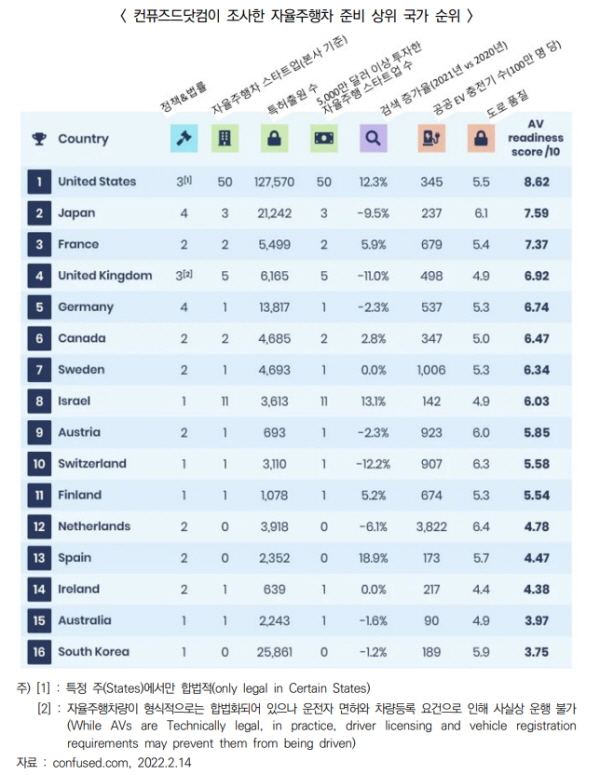
▲ Ranking of countries with the highest level of readiness for autonomous vehicles (Source: Ministry of Science and ICT, Data: confused.com)
Fully autonomous vehicles allowed on roads
The US ranks first in supporting and preparing for the era of autonomous driving
According to the Ministry of Science and ICT's Science and Technology & ICT Trends No. 211, the United States allowed autonomous vehicles equipped with Automated Driving Systems (ADS) that operate without a driver based on cutting-edge technologies such as artificial intelligence and do not have steering wheels, pedals, or driver's seats to drive on the road in March.
The difference between ADAS (Advanced Driver Assistance Systems) and ADS is the presence or absence of a manual control device. ADS is the stage where the vehicle goes beyond the stage of 'supporting' the driver for safety and convenience and makes all decisions and drives on its own.
It's been six years since NHTSA allowed testing of self-driving cars without steering wheels or pedals.
However, it includes a provision that it must be able to guarantee the same level of passenger safety as vehicles currently in operation, and each state and county government will need to work on revising detailed rules before it can be implemented nationwide.
Following the approval of Waymo and GM Cruise for paid autonomous taxi business on February 28, this is considered significant in that it has laid the foundation for an era of fully autonomous vehicles, and it is interpreted that the U.S. government's will to establish strong safety standards for autonomous vehicles stands out.
The United States ranked first by a landslide among the top 30 countries that are most supportive and prepared for the era of autonomous vehicles, announced by Confused.com in February. The evaluation criteria are a combination of scores for △related policies and laws △technology and innovation △consumer acceptance △infrastructure. The United States ranked first with 8.62 points, followed by Japan in second with 7.59 points, and European countries such as France, the United Kingdom, and Germany followed. Korea ranked 16th with 3.75 points.
The United States not only has the largest number of startups related to autonomous driving, but also has an overwhelming number of patent applications. There are 50 autonomous vehicle startups in the United States (second place: Israel with 11), and the number of patent applications is 127,670 (second place: Korea with 5,861).
Comments
Related news
US Strengthens Fuel Efficiency Regulations for Vehicles… Significant Increase in Fines
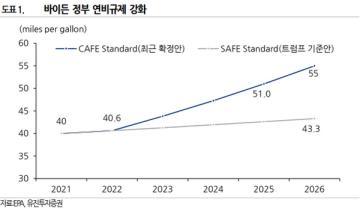
The U.S. National Highway Traffic Safety Administration (NHTSA) has raised the fuel economy improvement target from the significantly reduced average of 1.5% per year under the Trump administration back up to an average of 8%, and substantially increased penalties for failing to meet Corporate Average Fuel Economy (CAFE) standards from $5.5 per mpg to $14 per mpg.
2022.04.04by 성유창 기자
.jpg)
Autonomous Driving Commercialization, Sensor Problems Must Be Solved
While expectations for the commercialization of autonomous vehicles are growing, it appears that automakers have yet to find a definitive answer on which image sensor combination is optimal for driving and safety.
2022.04.04by 성유창 기자
Ministry of Science and ICT Summary of Policy Recommendations for Level 4 Autonomous Driving
A publication has been released that compiles the results of discussions between experts and citizens regarding the impact that Level 4 or higher autonomous driving technology will have on the economy, society, and culture.
2022.04.06by 성유창 기자

[e4ds Tech Day 2026 ⑨] Sim Sang-gyu, Autocrypt CTO: "In the Physical AI Era, Automotive Security Must Extend Beyond the Vehicle"
At e4ds Tech Day 2026, Sim Sang-gyu, CTO of Autocrypt, explained automotive cybersecurity strategies in the era of Physical AI and SDV (Software-Defined Vehicle). Automobiles are evolving as part of an ecosystem connected to AI, cloud, chargers, IoT, and robots, and he emphasized that the scope of security must expand beyond the vehicle interior to the entire connected environment. In particular, AI model tampering, adversarial attacks, OTA updates, and EV charger hacking were identified as major threats. He explained that response measures require zero trust, AI model integrity protection, intrusion detection, Security by Design and Default, and full lifecycle security management, and that proactive security system establishment beyond regulatory compliance is critical for securing future mobility competitiveness.
2026.10.12by 배종인 기자

Practical HIL Construction Strategy for Automotive and Off-Highway Controller Validation
As vehicle E/E architecture transitions to zonal structures and shifts to software-defined vehicles (SDV), the number of controllers (ECUs) requiring validation and software complexity are surging dramatically. Meanwhile, real vehicle testing cannot provide repeated verification under identical conditions and entails lead time and safety concerns. This white paper explains the principles of HIL (Hardware-in-the-Loop) validation and the structure of the NI platform composed of PXI, SLSC, and VeriStand, and through two actual implementation cases—Camera Record & Replay HIL for In-Cabin Monitoring Controller (ICMU) and Forklift Controller (VCU) HILS—describes how controller-level regression testing becomes possible. Additionally, it explicitly states application boundaries and limitations, such as lack of A2B support.
2026.10.12by 편집부











