


KIMM Develops Korea's First Robotic Catheter for Cardiac Intervention
 Published2022.04.19 11:05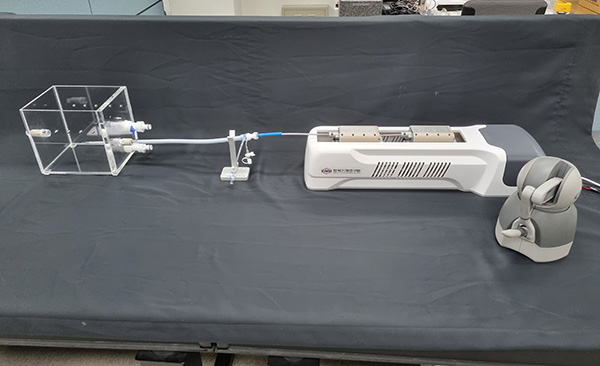
▲Robot catheter system
Flexible, flexible shape for insertion into internal organs and easy manipulation
Application of 'Variable Stiffness Control' technology… High stiffness facilitates easy procedures
The Korea Institute of Machinery and Materials (KIMM), under the Ministry of Science and ICT, is developing a robotic catheter system for interventional procedures involving the heart, lungs, and bladder, and is taking the lead in follow-up research for cooperation with various institutions and commercialization.
The Korea Institute of Machinery and Materials announced that it has developed a robotic catheter system for use in interventional procedures on the heart, lungs, bladder, and other organs of domestic patients.
This is the first robotic catheter system capable of being inserted into an organ in Korea.
The newly developed robotic catheter is a flexible guiding catheter that guides the catheter to the target location for deep insertion without damaging organ tissue.
It can be bent in two directions, making it easy to move to the desired position and simple to operate. In addition, it consists of two guiding catheters, with the outer catheter acting as a fixation to prevent shaking, while the inner catheter allows for flexible movement.
The research team announced that they implemented tension control in the robotic catheter using 'variable stiffness control' technology.
Variable stiffness control technology was developed to operate by connecting a motor to each strand of the drive wire on a one-to-one basis, and it works by measuring the tension of the drive wire and transmitting it to the connected motor.
When inserting the robotic catheter, it is inserted gently with low rigidity to protect organ tissues from damage, and during the procedure, the robotic catheter acts as a support with high rigidity, making the procedure easier.
The Korea Institute of Machinery and Materials stated that, unlike existing foreign products that use springs, the newly developed robotic catheter is more flexible in the form of a soft tube, resulting in less tissue damage.
In addition, they stated that safety has been ensured because the same materials and heat treatment methods used for manual catheters currently employed in major human organs are utilized, and since it operates as a robotic system, it can reduce radiation exposure for medical personnel during the arrhythmia diagnosis process.
Kim Ki-young, a senior researcher at the Korea Institute of Machinery and Materials, said, “This achievement is significant as it involves the development of a robotic catheter system capable of reducing radiation exposure using domestic technology, and it utilizes robotic technology to simplify the operation of the catheter and control its rigidity.” He added, “We will continue to help patients with heart, lung, and bladder diseases through follow-up research for commercialization and cooperation with various institutions, including companies and hospitals.”
Comments
Related news
KIMM Lays Foundation for Localization of LNG and Cryogenic Equipment
The Korea Institute of Machinery and Materials (KIMM, Director Park Sang-jin) under the Ministry of Science and ICT has established Korea's first comprehensive research foundation for the localization of LNG and cryogenic equipment. A green light has been turned on for the localization of LNG and cryogenic-related equipment.
2022.03.28by 배종인 기자
.jpg)
[Personnel] Korea Institute of Machinery and Materials
The Korea Institute of Machinery and Materials will conduct personnel changes effective April 1, 2022.
2022.03.29by 명세환 기자
Korea Institute of Machinery and Materials (KIMM) establishes AI Robot Research Center.
The Korea Institute of Machinery and Materials (KIMM; Director Park Sang-jin) under the Ministry of Science and ICT will foster specialized research organizations to achieve carbon neutrality and strengthen R&D capabilities to secure nationally essential strategic technologies.
2022.03.29by 배종인 기자

[e4ds Tech Day 2026 ⑨] Sim Sang-gyu, Autocrypt CTO: "In the Physical AI Era, Automotive Security Must Extend Beyond the Vehicle"
At e4ds Tech Day 2026, Sim Sang-gyu, CTO of Autocrypt, explained automotive cybersecurity strategies in the era of Physical AI and SDV (Software-Defined Vehicle). Automobiles are evolving as part of an ecosystem connected to AI, cloud, chargers, IoT, and robots, and he emphasized that the scope of security must expand beyond the vehicle interior to the entire connected environment. In particular, AI model tampering, adversarial attacks, OTA updates, and EV charger hacking were identified as major threats. He explained that response measures require zero trust, AI model integrity protection, intrusion detection, Security by Design and Default, and full lifecycle security management, and that proactive security system establishment beyond regulatory compliance is critical for securing future mobility competitiveness.
2026.10.12by 배종인 기자

NVIDIA to Invest $1 Billion in U.S. Science Over Next Five Years
NVIDIA has announced plans to invest $1 billion over the next five years to strengthen U.S. scientific and technological competitiveness. The company will enhance cutting-edge artificial intelligence research and development capabilities in key areas including quantum computing, healthcare, and energy security, while expanding support for higher education research institutions and cloud service providers. NVIDIA is participating as a major industry partner in the White House Office of Science and Technology Policy's Genesis Mission, and is promoting supercomputer construction in collaboration with national laboratories including Argonne and Los Alamos.
2026.10.12by 배종인 기자











