


A policy briefing session on the hydrogen fusion human resource development project was held to strengthen the nation's hydrogen competitiveness.
 Published2022.04.27 09:16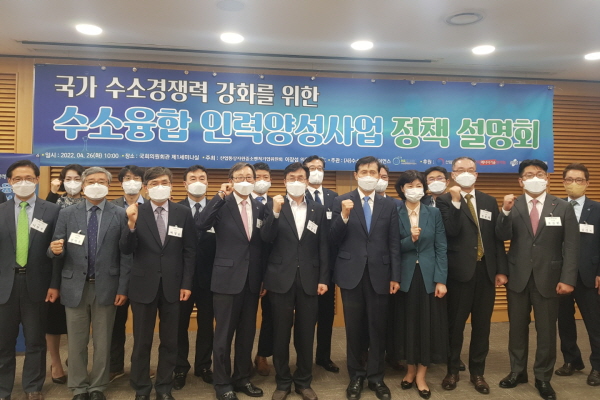
▲Participants in the hydrogen human resources development policy briefing are taking a commemorative photo.
H2KOREA develops human resource development roadmap and promotes training programs.
On the 26th, Rep. Lee Jang-seop of the National Assembly's Industry, Trade, Energy, SMEs and Startups Committee held a policy briefing session on the "Hydrogen Convergence Human Resources Development Project to Strengthen National Hydrogen Competitiveness" in the first seminar room of the National Assembly Members' Hall.
This briefing session was hosted by the Hydrogen Convergence Alliance (hereinafter referred to as H2KOREA) and sponsored by the Ministry of Trade, Industry and Energy, the Korea Institute of Energy Technology Evaluation and Planning, and the Korean Society for Hydrogen and New Energy. Approximately 20 people from the National Assembly, government, specialized organizations, and industry, academia, and research attended the session, including Rep. Lee Jang-seop, Chairman of the Trade, Industry, Energy, Small and Medium Venture Business Committee Lee Hak-young, Rep. Yang Jeong-sook, Chairman of H2KOREA Moon Jae-do, President of the Korean Society for Hydrogen and New Energy Nam Seok-woo, Professor Baek Young-soon of Suwon University, and Vice President Oh Seung-hwan of SK Ecoplant.
In November of last year, the government announced a plan to cultivate specialized personnel in the hydrogen sector through the 'First Basic Plan for Hydrogen Economy Implementation'.
We will cultivate top-level talents with accumulated knowledge and research experience in the entire hydrogen cycle through the establishment of a Hydrogen Convergence Graduate School and a Hydrogen Innovation Research Center, and we will also foster specialized industries and local companies in each hydrogen cluster to cultivate field-specific human resources.t;The plan is to establish a hydrogen practical training base centered on local universities to meet the research institute's human resource needs.
In his opening remarks, Rep. Lee Jang-seop of the National Assembly, who hosted the briefing session, said, “The government is expanding policies starting with the hydrogen economy roadmap with the goal of achieving carbon neutrality by 2050, and the National Assembly is also working to foster the hydrogen industry, such as enacting the world’s first hydrogen law. Companies are also supporting the hydrogen economy by deciding to invest approximately 43 trillion won by 2030.” He continued, “However, while support measures for technological development and infrastructure expansion to create a hydrogen industry ecosystem are extensive, support for training human resources who will drive the future hydrogen economy has been insufficient.”
He continued, “This briefing session was organized to achieve the government’s goal of creating approximately 600,000 jobs by 2050 through the Basic Plan for the Transition to a Hydrogen Economy and to support young Koreans to showcase their skills in the international community.”
In his welcoming address, H2KOREA Chairman Moon Jae-do emphasized, “As the legislation of the Hydrogen Act amendment, which includes the clean hydrogen certification system and mandatory clean hydrogen power generation currently proposed to the National Assembly, is delayed, uncertainty in the hydrogen industry to achieve carbon neutrality is increasing.” He added, “If clear industrial growth is not achieved, it will be impossible to realize the agenda of today’s briefing session, which is to cultivate future talent who will lead and survive in the hydrogen economy era. “The swift enactment of the revised Hydrogen Act will provide a clear milestone for private investment, and based on this, the national hydrogen industry will develop and future talent will be nurtured, allowing Korea to lead the global market as a hydrogen powerhouse,” he said.
At the briefing session held that day, presentations were given on the following topics: △Hydrogen industry trends and human resource development (Nam Seok-woo, President of the Hydrogen Society), △Hydrogen Convergence Education Center, human resource development roadmap and education projects (Park Seon-young, Senior Researcher at H2KOREA), and △Global green hydrogen industry trends and human resource development (Oh Seung-hwan, Vice President of SK Ecoplant).
In particular, Park Seon-young, a senior researcher at H2KOREA, said, “H2KOREA has established a roadmap for fostering hydrogen economy human resources to improve the efficiency of fostering innovative talents and to establish a mid- to long-term systematic human resources training system based on an analysis of the human resources demand in the hydrogen industry.” She added, “Based on the roadmap for fostering human resources, we are planning to establish a hydrogen convergence education center to prepare for the future industrial transition and promote the development of the hydrogen industry by operating educational programs for current employees, retirees, those changing jobs, college students, and job seekers in the hydrogen industry.”
Comments
Related news
Materials Research Institute Develops Ultra-thin Coating Water Electrolysis Catalyst Technology
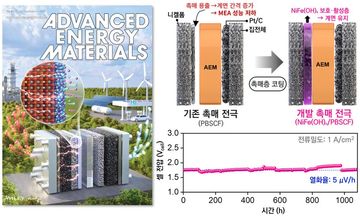
The Korea Institute of Materials Science has simultaneously resolved the performance and durability trade-off problem in water electrolysis catalysts by applying ultra-thin surface coating technology. Achieving 1.9 times higher performance compared to conventional catalysts while demonstrating 1,000-hour long-term stability, the institute has developed technology scalable to industrial water electrolysis systems through a simple process.
2026.10.07by 배종인 기자
Gigaphoton Develops Neon Gas Recycling System for ArF Excimer Lasers...Achieves 50% Recycling Rate
Gigaphoton announced that it has developed a gas recycling system for ArF excimer lasers and achieved a 50% neon gas recycling rate.
2026.10.02by 배종인 기자
UNIST suppresses vaporization losses while maintaining 97% of liquefied hydrogen storage capacity
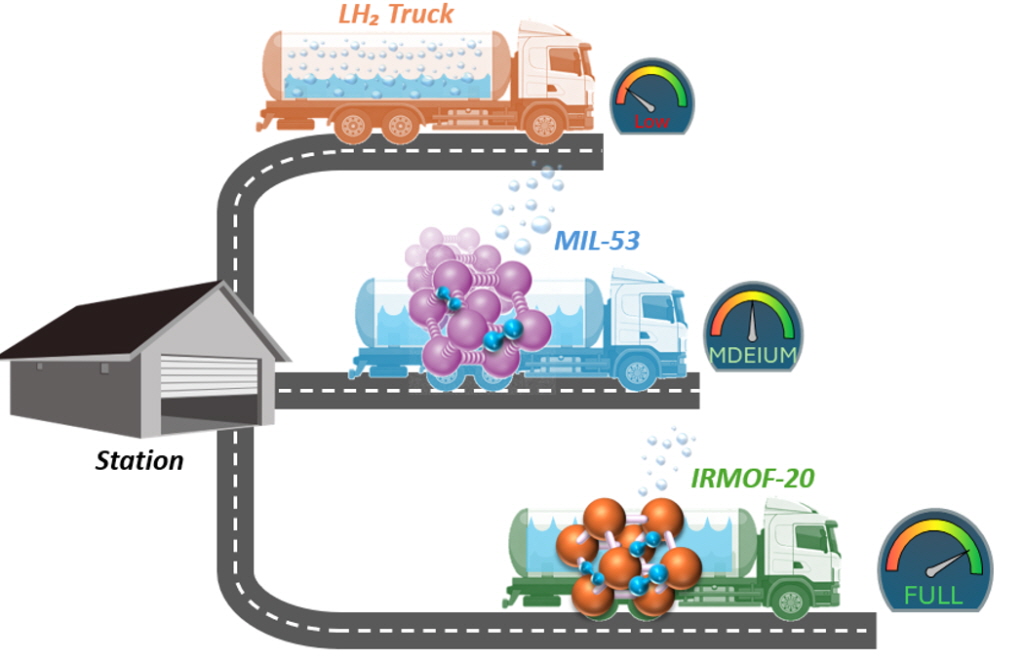
A research team led by Professor Oh Hyun-cheol from the Department of Chemistry at UNIST, in collaboration with Professor Moon Hoe-ri from Ewha Womans University and researchers from the Technical University of Munich in Germany, has verified technology that reduces boil-off loss occurring during liquefied hydrogen transportation and storage by utilizing metal-organic frameworks (MOF).
2026.09.30by 배종인 기자
LG Chem Expands Semiconductor Cleaning Materials Business…Collaborates with China's Jianghua Wei on Ultra-high Purity IPA
LG Chem is moving to expand its ultra-high purity IPA (isopropyl alcohol) business, a core material for semiconductor processes. The company is building a local supply system in collaboration with a Chinese precision chemical company and strengthening its market strategy for AI semiconductors and advanced memory.
2026.09.14by 배종인 기자
Korea Institute of Materials Science Begins Development of Anhydrous Ammonia SCC Integrated Evaluation Platform
The Korea Institute of Materials Science has begun developing an integrated evaluation platform for stress corrosion cracking (SCC) of high-strength steel for ammonia propulsion and transport vessels. By establishing a system to verify the safety of steel in anhydrous ammonia environments using domestic technology, the institute will strengthen the international competitiveness of the shipbuilding and steel industries and lay the foundation for reflecting domestic technology in regulatory and standard revisions by the International Maritime Organization (IMO) and other bodies.
2026.08.05by 배종인 기자











