


Hyundai Motor and SOS Lab Jointly Develop LiDAR for Mobile Robots
 Published2022.05.18 09:15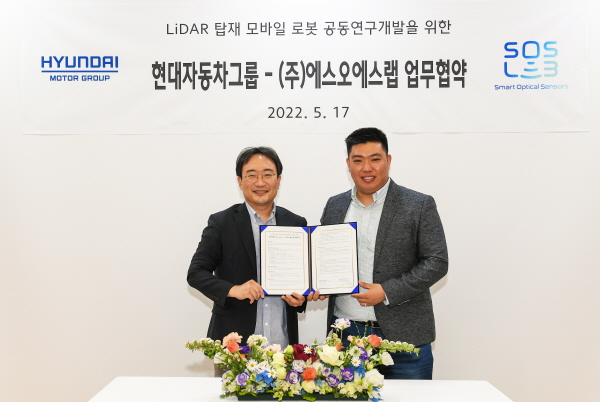
Collaboration planned for the development of 3D lidar for robots
Sensor miniaturization and expansion of short-range object recognition range
Hyundai Motor Group announced on the 17th that it signed a memorandum of understanding (MOU) with SOS Lab at its Uiwang Research Institute for the joint development of lidar for mobile robots.
SOS Lab (Smart Optical Sensors Lab) is a company that develops fixed lidar sensors for industrial and automotive use. SOS Lab's lidar sensors have advantages in the following areas: size, weight, power consumption, price, and durability compared to existing mechanical lidars. Currently, it is selling high-resolution 2D/3D lidar to industrial robots, port security, etc., and is evaluated as a leading lidar development company in Korea.
This joint development agreement aims to develop a dedicated high-resolution 3D lidar to optimize the autonomous driving performance of Hyundai Motor Group's mobile robots, including 'MobED', a small mobility platform unveiled by Hyundai Motor Group in December of last year, and the two companies plan to collaborate over the course of two years.
For this joint development of LiDAR for mobile robots, Hyundai Motor Group will support mobile robot hardware design technology and algorithms, while SOS Lab will provide cutting-edge 3D high-resolution LiDAR design technology and software know-how.
Through this collaboration, Hyundai Motor Group plans to develop a mobile autonomous driving robot that can move more reliably on irregular road surfaces and between obstacles by miniaturizing the lidar sensor while dramatically expanding its short-range object recognition range.
“By equipping Hyundai Motor Group’s mobile robots with a 3D lidar optimized for autonomous driving, we are one step closer to commercializing a compact mobility platform that can autonomously navigate complex indoor and outdoor spaces,” said Hyun Dong-jin, managing director of Hyundai Motor Group’s Robotics Lab. “Through this, we will be able to introduce various businesses and services such as courier/delivery and single-person mobility.”
“The robotics field is an industry that will bring innovation to the mobility market and ultimately create a better life. We will supply safe, accurate, high-resolution 3D lidar sensors optimized for robotics,” said Jeong Ji-seong, CEO of SOS Lab.
Meanwhile, Hyundai Motor Company unveiled its vision for future robotics at CES 2022, declaring that it would implement a new 'Mobility of Things (MoT)' ecosystem using robots.At the '2022 CEO Investor Day', Kia announced that it plans to focus its capabilities on launching robotics, the next-generation business of Hyundai Motor Group.
Comments
Related news

Hyundai Motor, Q1 sales mix improvement and favorable exchange rate effects
Hyundai Motor's operating profit increased year-on-year despite lower sales volume, as improved sales mix centered on Genesis and SUVs, combined with favorable exchange rate effects from improved regional mix focused on developed countries, offset the volume decline.
2022.04.26by 성유창 기자
Hyundai Motor, Kia, and Domestic Universities Join Hands for Joint Research on Intelligent Control
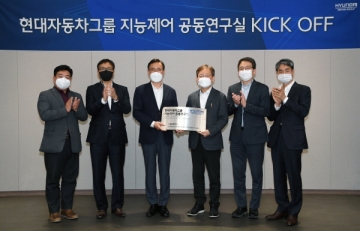
Hyundai Motor and Kia held a ceremony on the 27th at Seoul National University's Faculty Club to commemorate the establishment of the "Intelligent Control Joint Research Laboratory," attended by officials from Seoul National University, Yonsei University, Kwangwoon University, and the research and development divisions of Hyundai Motor and Kia.
2022.04.29by 성유창 기자
Hyundai Autoever Receives Automotive Cybersecurity Technology Certification
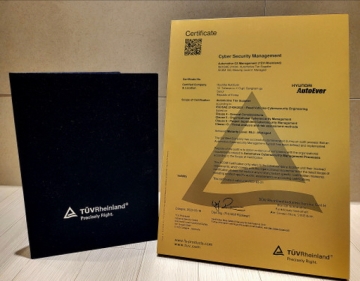
Hyundai Autoever demonstrated an internationally-level vehicle cybersecurity software development process through obtaining vehicle cybersecurity technology certification.
2022.05.17by 배종인 기자
[e4ds Tech Day 2026 ⑨] Sim Sang-gyu, Autocrypt CTO: "In the Physical AI Era, Automotive Security Must Extend Beyond the Vehicle"
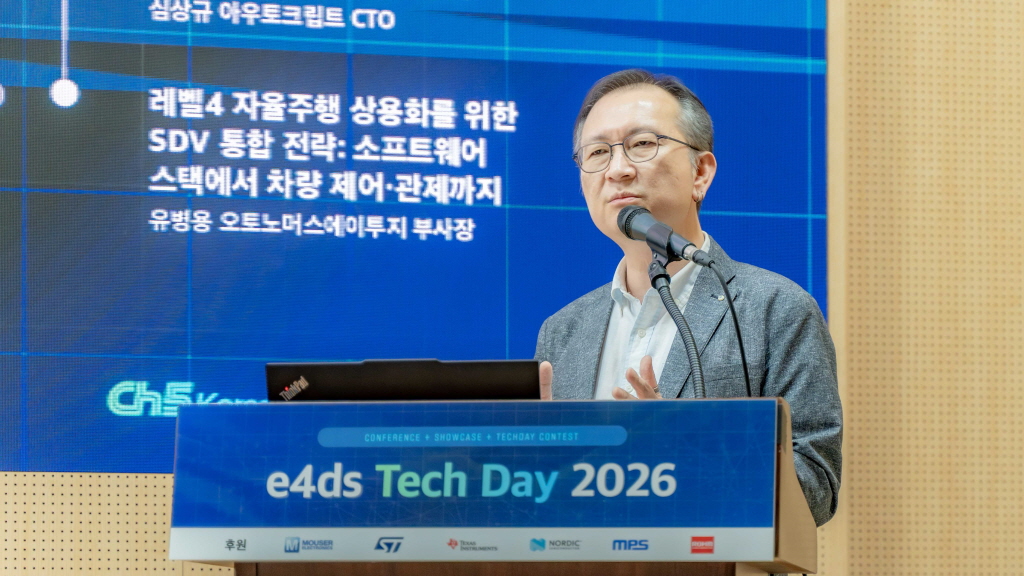
At e4ds Tech Day 2026, Sim Sang-gyu, CTO of Autocrypt, explained automotive cybersecurity strategies in the era of Physical AI and SDV (Software-Defined Vehicle). Automobiles are evolving as part of an ecosystem connected to AI, cloud, chargers, IoT, and robots, and he emphasized that the scope of security must expand beyond the vehicle interior to the entire connected environment. In particular, AI model tampering, adversarial attacks, OTA updates, and EV charger hacking were identified as major threats. He explained that response measures require zero trust, AI model integrity protection, intrusion detection, Security by Design and Default, and full lifecycle security management, and that proactive security system establishment beyond regulatory compliance is critical for securing future mobility competitiveness.
2026.10.12by 배종인 기자

Practical HIL Construction Strategy for Automotive and Off-Highway Controller Validation
As vehicle E/E architecture transitions to zonal structures and shifts to software-defined vehicles (SDV), the number of controllers (ECUs) requiring validation and software complexity are surging dramatically. Meanwhile, real vehicle testing cannot provide repeated verification under identical conditions and entails lead time and safety concerns. This white paper explains the principles of HIL (Hardware-in-the-Loop) validation and the structure of the NI platform composed of PXI, SLSC, and VeriStand, and through two actual implementation cases—Camera Record & Replay HIL for In-Cabin Monitoring Controller (ICMU) and Forklift Controller (VCU) HILS—describes how controller-level regression testing becomes possible. Additionally, it explicitly states application boundaries and limitations, such as lack of A2B support.
2026.10.12by 편집부











