



The new administration aims to commercialize fully autonomous vehicles within its term.
 Published2022.05.18 15:20
Minister of Land, Infrastructure and Transport Won Hee-ryong: "A paradigm shift toward user-centered 'mobility' policy."
Minister of Land, Infrastructure and Transport Won Hee-ryong said at his inauguration ceremony on the 16th, “By 2027, we will enter an era where ordinary citizens will be able to ride in fully autonomous vehicles (Level 4).” He added, “The Ministry of Land, Infrastructure and Transport will also redesign its organizational structure from one centered on internal combustion engines to one centered on mobility, and prepare for the future through innovation in space and movement.”
Minister Won then emphasized the need for a policy paradigm shift from supplier-centered 'transportation' to demand-centered 'mobility'.
He stated that the convenience and satisfaction of citizens, who are the users, will be important criteria and values in the mobility business, and that he will prioritize the construction of smart cities, C-ITS, and digital twin national territory, which are the basic infrastructure of the mobility revolution, and will pay attention to innovations such as UAM and personal mobility as well as autonomous driving.
He said that immediately after taking office, he will meet with young people who will be responsible for the future of land, infrastructure and transportation, including mobility, and hear stories about regulations and support.
The Yoon Seok-yeol administration's '20 promises to the people' and '110 major national tasks'The development of fully autonomous vehicle technology was also included.
Among the 110 major national tasks posted on the website of the Office for Government Policy Coordination, the 28th, “Full-fledged opening of the mobility era and future strategic industrialization of the land, infrastructure and transportation industry,” clearly states that the Yoon administration will virtually complete the commercialization of fully autonomous vehicles within its term.
There is a lot of debate regarding laws and regulations. At the "Seminar on Laws and Regulations for Safe Autonomous Vehicle Operation: Autonomous Vehicle Technology Law and Regulations" held in April, experts, including Park Jun-hwan, a researcher at the National Assembly Research Service, expressed their opinions on various aspects, including safety measures for autonomous vehicle accidents and current regulations.
When faced with a crossroads where the public interest and the owner's life must be chosen in the event of an accident, the philosophical aspect must also be taken into consideration, as the owner may face death that is not his or her choice.
Global automakers, including Hyundai Motor Company, have also predicted that fully autonomous vehicles will be commercialized by 2024 at the earliest and by 2027 at the latest.
At the '2022 CEO Investor Day,' Hyundai Motor Company announced that it is committed to strengthening its autonomous driving technology competitiveness, including the first application of the Level 3 highway autonomous driving function, 'Highway Driving Pilot (HDP),' to the Genesis G90 later this year. Its autonomous driving-related business is also actively underway. Motional, a joint venture between Hyundai Motor Group and US autonomous driving specialist Aptiv, announced on the 17th that it has begun autonomous delivery in partnership with ride-sharing company Uber. The significance lies in the fact that autonomous vehicles can now handle not only passenger transport but also food and goods delivery.
Furthermore, Hyundai Motor Company plans to introduce a 'Roboride' service utilizing its own Level 4 autonomous vehicles on a trial basis in major domestic cities in the first half of this year, with commercialization expected to begin gradually in 2023.
In 2022, Gwangju successfully established a C-ITS, and autonomous driving demonstration projects are underway in various places, including Sangam, Seoul, and Daegu Technopolis, indicating the emergence of autonomous driving-related projects and policies.
Son Jun-woo, chairman of Sonnet and president of the Autonomous Transportation Service Association, predicted the future of transportation, saying, “From a service perspective, when autonomous driving above Level 4 becomes commercialized, shuttle-style Level 4 autonomous vehicles that run on designated routes will begin around 2025.” He added, “You will be able to easily travel anywhere without owning a car.”
SUM, which has been issued a limited license for paid transportation of autonomous vehicles and operates a bus-type self-driving car (Solati) in Sangam-dong, Seoul, is pursuing its business with the goal of providing a premium self-driving taxi service as well as autonomous mobility for transportation and logistics, with a business model that includes design, manufacturing, and sales suitable for autonomous driving section services.
Despite significant investment and effort from local governments, small and medium-sized enterprises, and large corporations, several obstacles remain to the commercialization of fully autonomous vehicles. Optimizing sensors responsible for passenger safety and automotive cybersecurity are prime examples.
Tesla and Waymo, leaders in autonomous driving technology, are also suffering from problems such as accidents caused by sensor recognition errors and phantom braking. Tesla is working hard to solve the problem by using pseudo-LiDAR, while Waymo and Hyundai Motors are using HD Maps.
According to an e4ds webinar, vehicle theft and internal control system theft accounted for 28.4% of cybersecurity attacks in 2021, second only to data breaches (30%). Internal control system theft is a serious issue, as it can cause malfunctions, potentially injuring not only the driver but also others.
Professor Yeom Heung-ryeol of Soonchunhyang University emphasized, “Various privacy infringement issues are being raised regarding autonomous vehicles,” and “It is necessary to strengthen the security functions of autonomous vehicles by referring to international security standards.”
As such, autonomous driving requires a multitude of supporting factors, including laws, systems, security, international standards, technology, and infrastructure. With the government, businesses, and academia all expecting autonomous driving to be commercialized by 2030, attention is focused on whether Korea can establish itself as a global leader in autonomous driving.
Comments
Related news

SUM, autonomous driving competition in full swing… Sangam runs
SUM announced that it has obtained a limited commercial transportation license enabling paid autonomous vehicle transport services, and is operating a bus-type autonomous shuttle vehicle (Solati) in Sangam-dong, Seoul.
2022.05.10by 성유창 기자
HUD, Enjoying Its Heyday Until Full Autonomous Driving
With the development of in-vehicle infotainment, the value of HUD in preventing information overload for drivers is becoming increasingly prominent, and HUD is expected to continue developing as a differentiated technology for safety until the era of full autonomous driving arrives.
2022.05.16by 성유창 기자

Launch of the Private-Led Autonomous Robot Alliance
A privately-led 'Autonomous Mobile Robot Alliance' has been launched, with related industries and associations taking the lead to revitalize the domestic autonomous mobile robot industry.
2022.05.18by 성유창 기자
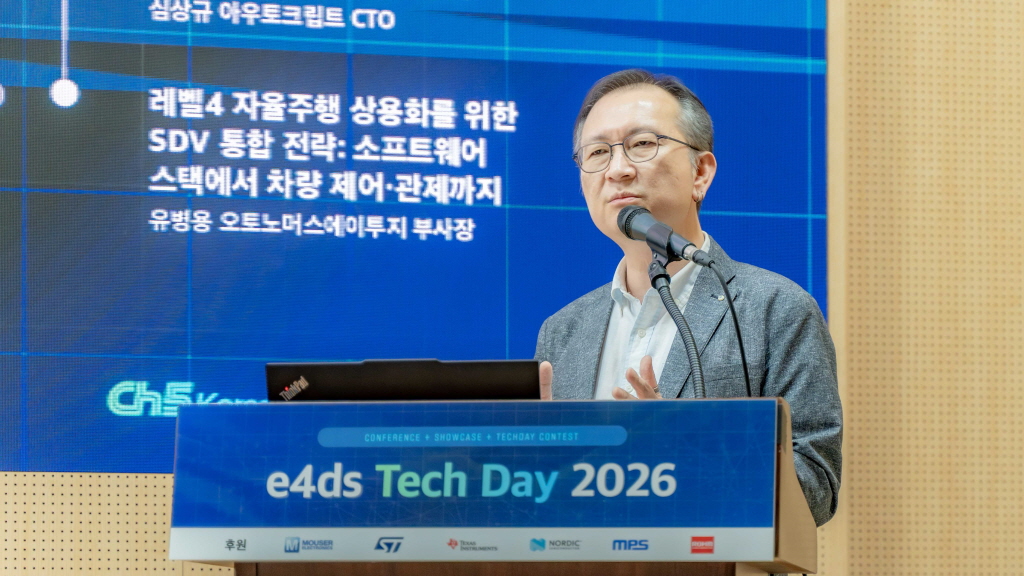
[e4ds Tech Day 2026 ⑨] Sim Sang-gyu, Autocrypt CTO: "In the Physical AI Era, Automotive Security Must Extend Beyond the Vehicle"
At e4ds Tech Day 2026, Sim Sang-gyu, CTO of Autocrypt, explained automotive cybersecurity strategies in the era of Physical AI and SDV (Software-Defined Vehicle). Automobiles are evolving as part of an ecosystem connected to AI, cloud, chargers, IoT, and robots, and he emphasized that the scope of security must expand beyond the vehicle interior to the entire connected environment. In particular, AI model tampering, adversarial attacks, OTA updates, and EV charger hacking were identified as major threats. He explained that response measures require zero trust, AI model integrity protection, intrusion detection, Security by Design and Default, and full lifecycle security management, and that proactive security system establishment beyond regulatory compliance is critical for securing future mobility competitiveness.
2026.10.12by 배종인 기자

Practical HIL Construction Strategy for Automotive and Off-Highway Controller Validation
As vehicle E/E architecture transitions to zonal structures and shifts to software-defined vehicles (SDV), the number of controllers (ECUs) requiring validation and software complexity are surging dramatically. Meanwhile, real vehicle testing cannot provide repeated verification under identical conditions and entails lead time and safety concerns. This white paper explains the principles of HIL (Hardware-in-the-Loop) validation and the structure of the NI platform composed of PXI, SLSC, and VeriStand, and through two actual implementation cases—Camera Record & Replay HIL for In-Cabin Monitoring Controller (ICMU) and Forklift Controller (VCU) HILS—describes how controller-level regression testing becomes possible. Additionally, it explicitly states application boundaries and limitations, such as lack of A2B support.
2026.10.12by 편집부











