


Development of core technology for 1,200 km/h hyperloop communication
 Published2022.05.18 16:08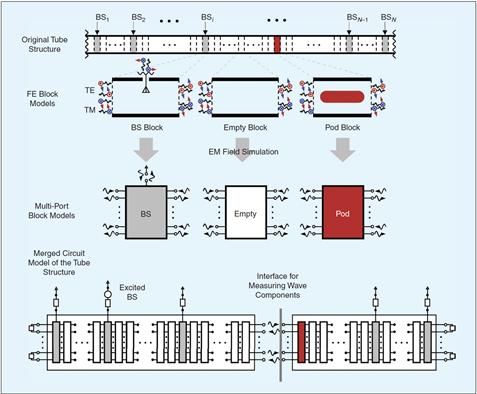
▲Model of the developed hyperloop tube communication environment analysis technique
Technology has been developed to enable communication within a hyperloop running at a high speed of 1,200 km/h, and expectations are high that this will become the basis for wireless communication design in future high-speed transportation.
UNIST (President Yong-Hoon Lee) announced on the 18th that Professor Hyoil Kim's team from the Department of Electrical and Electronic Engineering developed a technique to analyze wireless communication waves (communication channels) within a hyperloop.
It is expected to become the foundation technology for designing wireless communication systems to monitor the safety of high-speed passenger cars and provide Internet services.
Hyperloop is a next-generation transportation system that accelerates passenger cars called 'pods' one at a time inside a near-vacuum tube called a 'tube' to travel at speeds of up to 1,200 km/h.
When designing a wireless communication system for Hyperloop, communication channel analysis, which predicts how radio waves propagate in three-dimensional space, is essential to determine antenna design, carrier frequency, bandwidth, etc.
On the other hand, in the case of Hyperloop, there were limitations in analysis using existing electromagnetic wave simulators.
The tube resembles a waveguide that can trap radio waves and is very long, hundreds of kilometers long, so radio waves can pass through it normally. Because it spreads far beyond space.
The scope of objects (such as base stations) to be included in the simulation has been significantly expanded. The impact of pods traveling at high speeds within the tube is another variable.
To address this, the research team developed a new technique that simulates each of the three representative sections and mathematically connects them to model the entire tube.
This method involves dividing the electromagnetic wave simulation into a single base station section, a single pod section, and an empty tube section without a base station or pod, and then connecting them using the 'network parameter modeling' technique.
Analysis results showed that various signal distortion phenomena, such as signal transmission and reflection, were occurring in each pod. A representative example is the reception of multiple interference signals that occur when some of the interference signals transmitted by other base stations penetrate multiple pod sections.
Based on these analysis results, the research team identified the most suitable frequency band, maximum possible bandwidth, and optimal electromagnetic mode for wireless communication within the Hyperloop.
Additionally, it was possible to accurately predict the reception strength of communication signals depending on the driving position of the pod.
Professor Kim Hyo-il said, “The analysis technique is flexible, so it has the advantage of being easily applicable even if the specifications of the Hyperloop change,” and expressed his expectation that “it can serve as a source technology in related fields such as antenna design optimized for the Hyperloop environment, development of communication techniques, and pod design considering communication performance.”
Meanwhile, this study was conducted in collaboration with Professor Ki-Jin Han of Dongguk University (joint corresponding author), and Researcher Jeong-Tak Kim (Combined Master's and Doctoral Program in Electrical and Electronic Engineering, UNIST) participated as the first author.
The research results were published in IEEE Vehicular Technology Magazine, an authoritative journal in the field of mobility.
Comments
Related news

UNIST Challenges Development of 35% Efficiency Super Solar Cells
UNIST challenges the development of a super solar cell achieving 35% efficiency over five years, contributing to carbon neutrality and the advancement of Korea's photovoltaic industry.
2021.12.22by 배종인 기자
UNIST on the verge of commercializing 6G devices
A UNIST research team has proposed communication device technology capable of rapidly identifying OAM signals by utilizing self-designed metasurfaces, and is drawing expectations that this will accelerate the commercialization of 6G communications.
2022.03.22by 배종인 기자
UNIST develops artificial skin that can hear sound
An interface technology for controlling robots using artificial skin capable of hearing sound has been developed, and it is expected to be applied to avatar robots and other virtual reality, augmented reality, and Internet of Things applications in the future.
2022.03.28by 배종인 기자
European Patent Applications Surpass 200,000 for the First Time… South Korea Maintains 5th Place, Led by Batteries and Telecommunications
According to the European Patent Office (EPO)'s 'Technology Dashboard 2025', European patent applications last year reached 201,974, surpassing 200,000 for the first time. Korean companies and inventors filed 14,355 applications, representing a 9.5% increase from the previous year and maintaining 5th place by country. Battery, digital communication, and semiconductor technologies led the growth, with Samsung ranking as the top EPO applicant for the second consecutive year and LG reaching 3rd place. The presence of major domestic cities such as Seoul, Suwon, and Yongin was also confirmed. It was also revealed that Korea's European patent strategy is expanding beyond individual technologies to span the entire industry.
2026.03.24by 명세환 기자

SK Telecom First Applies AI-Based Network Operations at Gwanghwamun K-Pop Concert
SK Telecom announced that it applied an AI-based network operation system for the first time at a large-scale K-pop concert held in the Gwanghwamun area of Seoul on March 21st, managing communication quality throughout the event. Mobile data usage during the three hours before and after the concert reached 12.15TB, approximately doubling compared to the same time slot the previous weekend. SK Telecom monitored traffic using the AI system 'A-One' in five-minute and 50-meter units to respond to potential overload situations, while also operating temporary communication facilities and on-site personnel in parallel. This case is interpreted as confirmation of the practical applicability of AI-based autonomous network operation in an environment where demand from dense events and foreign users increases simultaneously.
2026.03.23by 명세환 기자











