


From Jeju Airport to Jungmun by self-driving car
 Published2022.05.24 09:25
Autonomous vehicle production and infrastructure construction to begin in June, with mobility services to be launched in the second half of the year.
The Ministry of Land, Infrastructure and Transport announced on the 24th that it had selected a consortium led by Autonomous A2Z and IT Telecom as the final operators for the 'Autonomous Driving Mobility Service Project'.
This public offering project provides subsidies of 8 billion won (4 billion won each in the first and second years) over two years to private sector autonomous vehicle-based mobility projects.
Its significance lies in the fact that ordinary citizens can experience it, and it also provides startups and small and medium-sized enterprises with a practical opportunity to demonstrate it.
A total of seven consortia participated in this second round of competition.
The Ministry of Land, Infrastructure and Transport announced that it had selected two final operators after evaluating the business plans based on various indicators, including the innovativeness of the business model, the feasibility of the technology applied to the service, and the effectiveness of increasing public acceptance of autonomous vehicle services.
The first consortium is Autonomous A2Z. It consists of Kakao Mobility, KT, Hyundai Autoever, Newbility, and Korea Automobile Research Institute.
Autonomous A2Z plans to establish a vehicle platform and related communication infrastructure that can provide integrated passenger (demand-responsive) and logistics (delivery services) services in Daegu Technopolis and national industrial complexes.
The IT Telecom Consortium is comprised of Rideflux, Gwangmyeong D&C, KAIST, and Jeju Research Institute.
IT Telecom provides a circular autonomous tourist shuttle service connecting major tourist destinations near Jeju Airport, a carrier delivery service between the airport and Jungmun Hotel, and a public transportation shuttle bus service.
The organization selected as the business operator will manufacture autonomous vehicles through subsidies and operate the business by building autonomous driving infrastructure in the service area.
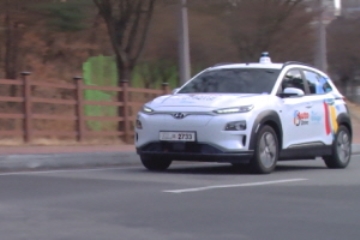
During the project period, a total of 11 Level 3 autonomous vehicles (Ioniq, Solati, etc.) are expected to be manufactured and operated.
Basically, it provides autonomous driving service, but it operates with professional safety personnel on board to prepare for unexpected situations.
The autonomous vehicles produced during the project will be recovered by the government upon completion of the project and used to provide continuous mobility services, such as by lending them to industries, academia, and research institutions for various purposes such as test runs and data collection.
A detailed business plan agreement will be signed between the Ministry of Land, Infrastructure and Transport and the consortium this month, and the project will begin in earnest, with autonomous vehicle production and infrastructure construction starting in June.
We plan to proceed with the project without a hitch so that we can fully launch autonomous mobility services in the second half of 2022.
Park Ji-hong, Director General of the Ministry of Land, Infrastructure and Transport's Automobile Policy Bureau, said, "Through this project, the public will experience a more stable autonomous vehicle mobility service, thereby contributing to the autonomous vehicle industry." “You will be able to feel that the era of commercialization is fast approaching before our eyes,” he said. “The Ministry of Land, Infrastructure and Transport plans to spare no effort in providing policy support, such as improving legal and institutional regulations, advancing infrastructure, and supporting technological development, so that autonomous driving technology can be commercialized and the era of autonomous driving can be brought forward.”
Comments
Related news

SUM, autonomous driving competition in full swing… Sangam runs
SUM announced that it has obtained a limited commercial transportation license enabling paid autonomous vehicle transport services, and is operating a bus-type autonomous shuttle vehicle (Solati) in Sangam-dong, Seoul.
2022.05.10by 성유창 기자
The new administration aims to commercialize fully autonomous vehicles within its term.
The new administration has established the commercialization of fully autonomous vehicles during its term as a national policy task, and the new Minister of Land, Infrastructure and Transport has emphasized a paradigm shift in policy toward customer-centric "mobility." Against this backdrop, the domestic autonomous driving industry appears to be gaining momentum, and attention is focused on whether related systems and issues can be resolved.
2022.05.18by 성유창 기자

[e4ds Tech Day 2026 ⑨] Sim Sang-gyu, Autocrypt CTO: "In the Physical AI Era, Automotive Security Must Extend Beyond the Vehicle"
At e4ds Tech Day 2026, Sim Sang-gyu, CTO of Autocrypt, explained automotive cybersecurity strategies in the era of Physical AI and SDV (Software-Defined Vehicle). Automobiles are evolving as part of an ecosystem connected to AI, cloud, chargers, IoT, and robots, and he emphasized that the scope of security must expand beyond the vehicle interior to the entire connected environment. In particular, AI model tampering, adversarial attacks, OTA updates, and EV charger hacking were identified as major threats. He explained that response measures require zero trust, AI model integrity protection, intrusion detection, Security by Design and Default, and full lifecycle security management, and that proactive security system establishment beyond regulatory compliance is critical for securing future mobility competitiveness.
2026.10.12by 배종인 기자

Practical HIL Construction Strategy for Automotive and Off-Highway Controller Validation
As vehicle E/E architecture transitions to zonal structures and shifts to software-defined vehicles (SDV), the number of controllers (ECUs) requiring validation and software complexity are surging dramatically. Meanwhile, real vehicle testing cannot provide repeated verification under identical conditions and entails lead time and safety concerns. This white paper explains the principles of HIL (Hardware-in-the-Loop) validation and the structure of the NI platform composed of PXI, SLSC, and VeriStand, and through two actual implementation cases—Camera Record & Replay HIL for In-Cabin Monitoring Controller (ICMU) and Forklift Controller (VCU) HILS—describes how controller-level regression testing becomes possible. Additionally, it explicitly states application boundaries and limitations, such as lack of A2B support.
2026.10.12by 편집부
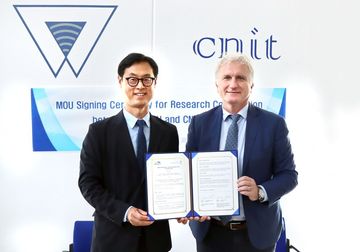
Korea Automotive Research Institute Signs MOU with Italy National Institute for Wireless Communications
The Korea Automotive Research Institute will sign an MOU with Italy's National Institute for Wireless Communications and launch joint research on next-generation mobility technologies based on 6G, V2X, and connected vehicles. The two organizations will conduct research to apply advanced wireless communication technologies to vehicles and discover international joint projects to advance next-generation connected vehicle technology development.
2026.10.12by 배종인 기자











