


The Ukraine War Shifts the Security Paradigm
 Published2022.05.26 09:24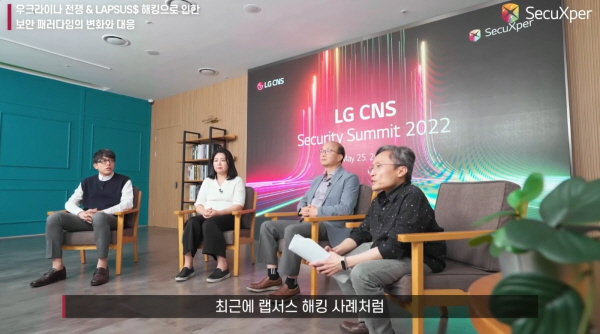
▲At LG CNS Summit 2022, information on shifting security paradigms and responses was shared. (Photo: LG CNS Summit 2022 capture)
Control and Infrastructure Industries See a Surge in Hacking Attacks
Deepfakes will become a significant threat within five years.
At the LG CNS Summit 2022 held on the 25th, experts, including Professor Jeong Su-hwan of the Department of Electronic and Information Engineering at Soongsil University, shared information on the changing security paradigm and responses under the theme of "AI and OT: Examining the Latest Global Security Trends."
This discussion was attended by Gwak Gyu-bok, a specialist in the LG CNS Security Technology Strategy Team, Jeong Su-hwan, a professor in the Department of Electronic and Information Engineering at Soongsil University, Lee Hyang-jin, team leader of the KISA Infrastructure Protection Team, and Kim Chang-hee, team leader of the AhnLab Product Planning Team.
Expert Commissioner Kwak Gyu-bok said, “Cyberwarfare has emerged as the biggest issue both domestically and internationally. “The war in Ukraine is changing the security paradigm,” he said. “With the expansion of cyber warfare, attacks aimed at destroying systems between countries are rapidly increasing, and Korea is also strengthening its response system at the government level.”
Team Leader Kim Chang-hee reported that, according to AhnLab's monitoring results, the industry with the highest attack rate compared to general industries in the global market was control facilities and infrastructure, accounting for 24.4%. The domestic situation is similar, with the average industry experiencing a 12-17% increase in attacks, while attacks on control and infrastructure increased by 29.5%.
When asked about attacks on industrial infrastructure, Team Leader Lee Hyang-jin responded, "There have been no official announcements of attacks on major information and communications infrastructure in Korea." He continued, "The most recent major incident overseas was the ransomware attack on Colonial Pipeline, a US pipeline company, which raised alarms." He went on to explain that while damage incidents are occurring at small and medium-sized smart factories in Korea, some are not disclosed for business reasons.
Team Leader Kim Chang-hee stated, "These threats have significantly increased the number of measures companies must take to address them." With remote work becoming the norm due to COVID-19, external contact points have increased, diversifying attack vectors. Furthermore, many industries are using outdated operating systems with outdated security support, increasing the risk of hacking due to weak perimeter security. He emphasized the need to maintain fundamental perimeter security and consistently implement measures to address permissions and network connections.
Professor Jeong Su-hwan cited deepfakes as one of the latest security threat trends. During the Ukrainian War, a video appeared to show President Zelensky surrendering, and this was also created using deepfake technology. Successful cases of voice phishing using deepfake technology have also been confirmed. Professor Jeong predicted that deepfake would become a significant threat within five years.
Professor Jeong, regarding the application of new AI security technologies, stated that AI is essential to security. Security event data continues to grow, and analyzing it all manually is impossible. For this reason, AI is being used for security control and malware and network traffic attack detection.
He then cited updating AI systems to prepare for new attack patterns, unlike those seen in the past, as a key consideration when applying AI to security technologies. He expressed the opinion that, given the relatively recent adoption of AI in the security field, building a mature AI system is a priority.
Team Leader Kim Chang-hee stated that in real-world industrial settings, mishandling a system can impact availability, making it difficult for non-experts to access equipment systems. He continued that OT security requires significant time, as it requires research and collaboration with manufacturers. However, he added that in areas like smart factories for small and medium-sized enterprises (SMEs), the diverse environments and numerous constraints make it difficult to access.
The new paradigm of information security has shifted the IT environment of businesses and organizations in the wake of COVID-19. While traditional security relied on authentication and access control, distinguishing between internal and external environments, the current cloud and other technologies make it difficult to distinguish between internal and external environments.
In this trend, Professor Jeong said that the paradigm is shifting to a 'zero trust'-based approach that allows access through thorough verification. To achieve 'zero trust', security mechanisms must be automated because a huge amount of data must be verified.
Taking advantage of this, hackers have begun exploiting vulnerabilities in AI itself. Cases have been reported where AI training data and decision-making data were corrupted, preventing accurate decisions from being made. Such attacks could have devastating consequences for smart cars and smart factories.
Professor Jeong predicted that countermeasures against dysfunction arising from AI-based security automation and improving the reliability of AI systems themselves will become important issues in the future.
Comments
Related news
System-destroying hacking on the rise, 'customized integrated security service' essential
As the work environment shifts toward hybrid models and large-scale hacking attacks aimed at system disruption occur, the need for "customized integrated security services" is emerging.
2022.05.25by 성유창 기자
.png)
Databricks Unveils Open AI Security Monitoring 'Lakewatch'
Databricks entered the security market on March 24 by unveiling LakeWatch, an open-source agentic SIEM. The core functionality of this product is to integrate and analyze security, IT, and business data in a single environment to support AI-based threat detection and investigation. The company explained that it reduces the limitations of existing security operations centers, which have had to forgo some data due to high cost structures, and enables large-scale data analysis and automation based on open formats and ecosystems. LakeWatch is currently offered as a private preview, with Adobe and Dropbox mentioned as early customers. Databricks also announced an expanded partnership with Anthropic as well as the acquisition of Antimatter and SiftD.ai.
2026.03.26by 배종인 기자
Kaspersky Unveils Revamped 'NEXT' Combining SOC Integrated Management and AI Analytics
As enterprises increase demand for integrated management and automation in the construction and operation of Security Operations Centers (SOC), Kaspersky has disclosed updates to its B2B security product suite 'Kaspersky Next'. This update expands EPP, EDR, XDR, and SIEM integration through a single console based on OSMP, incorporates AI capabilities such as DLL hijacking detection and suspicious account takeover behavior identification, and includes integration with generative AI assistant tool KIRA. The company stated that in large-scale deployment environments, EDR Expert can reduce resource requirements by up to 30%, and XDR Expert by up to 60%.
2026.03.25by 배종인 기자
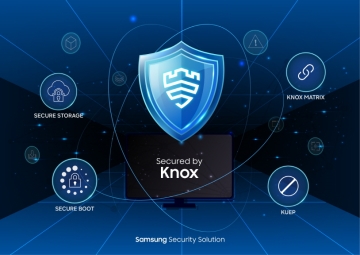
Samsung Electronics Smart Monitor Acquires First International Certification… Expanding Application Scope Following TVs
Samsung Electronics has received Common Criteria (CC) certification for 'Samsung Knox,' a security solution applied to its 2026 smart TVs and smart monitors. The smart TV has achieved certification for 12 consecutive years, while the smart monitor obtained industry-first certification this time. The evaluation was conducted focusing on core functions including kernel integrity monitoring, phishing site blocking, and unauthorized execution prevention. The company plans to expand the scope of security certification beyond TVs to monitors, responding to growing personal information protection requirements as connected devices proliferate.
2026.03.25by 배종인 기자
Teori Selected as AI Voucher Supplier… Supplying LLM Security Solutions
Cybersecurity company Theori has been selected as a supplier for the 2026 AI Voucher Support Program. The company plans to address information leakage and regulatory compliance issues that arise during generative AI adoption through its LLM security solution 'AlphaPrism'. The solution is designed to analyze the context of prompts and source code to identify sensitive information such as personal data and authentication keys, and to continue AI utilization through masking methods rather than simple blocking. The government's AI Voucher Program supports demand enterprises with up to 200 million won per project for solution purchase costs. Based on recent application cases at POSCO DX, Theori plans to respond to expanding demand for enterprise AI security.
2026.03.24by 명세환 기자











