



UNIST Develops Low-Power, Ultra-High-Speed 6G Semiconductor Devices
 Published2022.06.07 16:46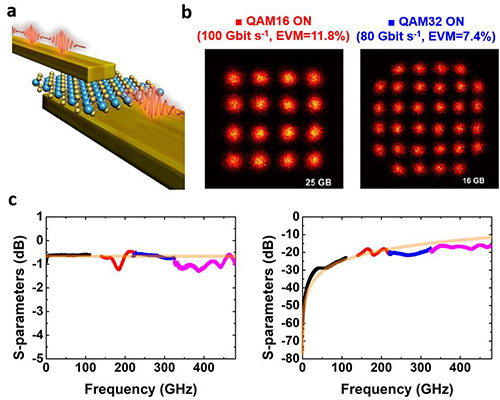
▲Non-volatile 6G switch based on two-dimensional materials
Professor Myung-Soo Kim and his research team at UNIST have developed a two-dimensional semiconductor-based analog switch.
Zero standby power, high energy efficiency… Potential for next-generation 6G systems
A semiconductor device for 6G communication that is highly electrically efficient and can process signals quickly and accurately has been developed, contributing to the commercialization of 6G communication.
Professor Myung-Soo Kim of the Department of Electrical and Electronic Engineering at UNIST announced that he has developed a low-power, ultra-high-speed analog switch in collaboration with researchers from the United States, France, and Israel.
The results of this study were introduced on the 31st in the 'Research Briefing' section of Nature Electronics, a sister journal of Nature and an authoritative journal in electrical and electronic engineering, as "the first case with a high possibility of commercialization among electronic devices made of two-dimensional semiconductor materials."
Analog switches are semiconductor devices used to select and transmit or block radio waves. They have been widely used in data communication and hyper-connected systems to switch between various frequency bands and to transmit and block signals between antennas and reconfigurable wireless communication systems.
In order to support wireless environments such as autonomous driving, AR, and VR through 6G communication, it is necessary to solve the problem of standby power consumption when existing diode or transistor-based analog switches are not in operation.
Professor Kim's research team announced that they have developed an analog switch with zero standby power consumption using molybdenum disulfide (MoS2), a two-dimensional semiconductor material.
This switch △operates in the terahertz high frequency range to meet the data transmission speed of 100 Gbit/s, which is the data transmission speed required for IEEE 6G communication, and △can also support complex signal modulation technology for implementing uninterrupted AR/VR △Satisfies the maximum transmission speed of 100 Gbit/s in various modulation technologies, and can process it with a low error rate and high signal-to-noise ratio.
Professor Myung-soo Kim explained, “Communication devices for 6G technology must be able to support complex modulation technologies while satisfying the data transmission speed of 100 Gbit/s and the operating frequency conditions in the terahertz (THz) range,” and added, “This research will contribute to the commercialization of 6G communication systems by developing low-power communication devices that can reduce battery usage while satisfying ultra-high-speed communication conditions.”
Comments
Related news
UNIST on the verge of commercializing 6G devices
A UNIST research team has proposed communication device technology capable of rapidly identifying OAM signals by utilizing self-designed metasurfaces, and is drawing expectations that this will accelerate the commercialization of 6G communications.
2022.03.22by 배종인 기자
UNIST develops artificial skin that can hear sound
An interface technology for controlling robots using artificial skin capable of hearing sound has been developed, and it is expected to be applied to avatar robots and other virtual reality, augmented reality, and Internet of Things applications in the future.
2022.03.28by 배종인 기자
UNIST Develops Next-Generation Semiconductor Materials to Overcome Moore's Law Limits
UNIST has developed next-generation semiconductor materials capable of overcoming the physical limitations of Moore's Law, and expectations are mounting that this will drive innovation not only in two-dimensional semiconductors but also in encapsulation layers, membranes, next-generation secondary battery electrode materials, and quantum light sources.
2022.06.03by 배종인 기자
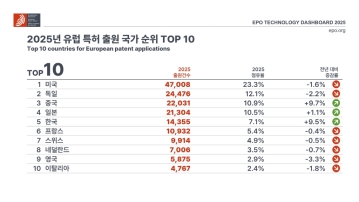
European Patent Applications Surpass 200,000 for the First Time… South Korea Maintains 5th Place, Led by Batteries and Telecommunications
According to the European Patent Office (EPO)'s 'Technology Dashboard 2025', European patent applications last year reached 201,974, surpassing 200,000 for the first time. Korean companies and inventors filed 14,355 applications, representing a 9.5% increase from the previous year and maintaining 5th place by country. Battery, digital communication, and semiconductor technologies led the growth, with Samsung ranking as the top EPO applicant for the second consecutive year and LG reaching 3rd place. The presence of major domestic cities such as Seoul, Suwon, and Yongin was also confirmed. It was also revealed that Korea's European patent strategy is expanding beyond individual technologies to span the entire industry.
2026.03.24by 명세환 기자

SK Telecom First Applies AI-Based Network Operations at Gwanghwamun K-Pop Concert
SK Telecom announced that it applied an AI-based network operation system for the first time at a large-scale K-pop concert held in the Gwanghwamun area of Seoul on March 21st, managing communication quality throughout the event. Mobile data usage during the three hours before and after the concert reached 12.15TB, approximately doubling compared to the same time slot the previous weekend. SK Telecom monitored traffic using the AI system 'A-One' in five-minute and 50-meter units to respond to potential overload situations, while also operating temporary communication facilities and on-site personnel in parallel. This case is interpreted as confirmation of the practical applicability of AI-based autonomous network operation in an environment where demand from dense events and foreign users increases simultaneously.
2026.03.23by 명세환 기자











