



NVIDIA Accelerates AI, Digital Twins, Quantum Computing, Edge Computing, and HPC
 Published2022.06.08 11:28
.jpg)
▲NVIDIA announced acceleration solutions for various industries at ISC 2022 on the 7th.
ISC 2022 Strengthens Supercomputers, Devices, and the Scalable Quantum Computing Ecosystem
NVIDIA (CEO Jensen Huang) accelerates AI, digital twins, quantum computing, edge, and HPC.
NVIDIA announced acceleration solutions for various industries at ISC 2022 on the 7th.
“Researchers are pushing high-performance computing (HPC) to the cutting edge by using highly sensitive equipment or accelerating simulations of hybrid quantum systems,” said Ian Buck, vice president of accelerated computing at NVIDIA, in a special address at the ISC.
■ CPU acceleration up to 3x with super chips
The Venado supercomputer at Los Alamos National Laboratory delivers 10 exaflops of AI performance for work in areas such as materials science and renewable energy.
Benado said the NVIDIA Grace Hopper superchip can run workloads up to three times faster than previous GPUs and double the performance per watt of traditional CPUs in non-accelerated applications.
■ BlueField-2
Texas firstThe single computing center said it is adding BlueField-2 DPUs to Lonestar6's NVIDIA Quantum InfiniBand network.
It is expected to be a development platform for cloud-native supercomputing that safely isolates workloads and hosts multiple users and applications with bare-metal performance, he said.
■ Expanding the Exascale Computing Deployment Ecosystem
NVIDIA and SiPearl announced a collaboration to expand the developer ecosystem building exascale computing on Arm.
Nvidia's accelerated computing and networking technologies could port applications to systems using Cypher's Rhea and future Arm-based CPUs, he added.
■Project progress with heterogeneous 3D applications
Ian Buck demonstrated a virtual fusion power plant being built in NVIDIA Omniverse by researchers at the UK Atomic Energy Agency and the University of Manchester.
NVIDIA Omniverse is a 3D design collaboration and world simulation platform that allows remote researchers to collaborate on projects in real time using different 3D applications.
■ MONAI, an AI framework
Ian Buck explains how researchers created a library of 100,000 synthetic images of the human brain on NVIDIA's Cambridge-1, a supercomputer dedicated to advancing healthcare with AI.
King's College London said it has used MONAI, an AI framework for medical imaging, to generate lifelike images that could help researchers study diseases like Parkinson's.br />
■ Clara Holoscan
At Lawrence Berkeley National Laboratory, we're using NVIDIA Clara Holoscan to see in real time, down to the nanometer, what would take days on a CPU.
NVIDIA is developing HPC Holoscan, a highly scalable version of its imaging software, to bring supercomputing to the edge.
■ Accelerating Quantum Simulation
Ian Buck said the NVIDIA cuQuantum software development kit, which integrates with major quantum software frameworks, allows users to access GPU acceleration without any additional coding.
“Quantum computing has enormous potential, and simulating quantum computers on GPU supercomputers is essential to getting us closer to meaningful quantum computing,” said Ian Buck. “We’re really excited to be at the forefront of this work.”
Comments
Related news
NVIDIA Handles RTX GPUs' Challenging Workflows
Nvidia (CEO Jensen Huang), a leader in AI computing technology, has unveiled its latest RTX GPUs that support demanding workflows and hybrid work.
2022.04.04by 배종인 기자
NVIDIA Unveils 'Drive Map', a Self-Driving Assistance Platform
Nvidia announced NVIDIA DRIVE Map, a multimodal mapping platform with stability and autonomy, during the GTC 2022 keynote.
2022.04.04by 성유창 기자
NVIDIA Announces Launch of Grace CPU Superchip in First Half of 2023
NVIDIA's presence has been notable at Computex 2022, the international ICT trade show held in Taiwan. In its keynote address, NVIDIA positioned itself as the "engine of AI" and focused on presenting new solutions in data centers, high-performance computing, AI, and cloud graphics.
2022.05.25by 명세환 기자
NVIDIA Launches Water-Cooled GPU for Sustainable Computing Support
Regulations establishing energy efficiency standards are pending in Asia, Europe, and the United States. This is motivating banks and other large data center operators to evaluate liquid cooling solutions. Additionally, liquid cooling is not limited to data centers alone, and its necessity is increasingly growing for cooling high-performance systems embedded in confined spaces such as automobiles and other systems.
2022.05.25by 명세환 기자
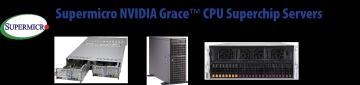
Supermicro Adds NVIDIA Grace CPU Superchip-Based Servers
The data center market is experiencing rapid growth. It is supporting high-efficiency servers for cloud gaming, data analytics, and high-performance computing, and total IT solutions accompanied by energy-efficient solutions are being provided in accordance with ESG principles.
2022.05.26by 명세환 기자











