



"Korea is definitely not a leading autonomous driving powerhouse"... Deregulation is essential.
 Published2022.06.28 16:26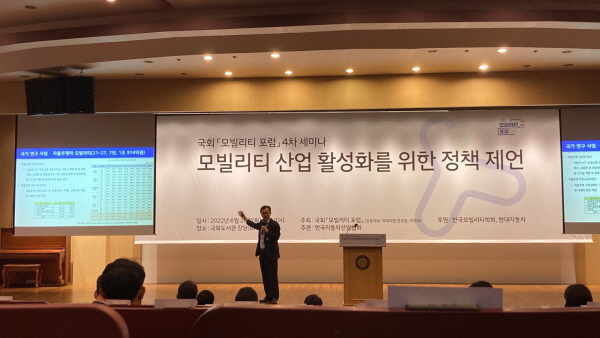
▲ Professor Lee Kyung-soo of Seoul National University is giving a presentation at the 4th seminar of the National Assembly's 'Mobility Forum.'
Excessive labor and environmental regulations weaken global crisis response capabilities.
R&D business planning is required to support collaborative research between automakers, small and medium-sized enterprises, and universities.
The National Assembly's 'Mobility Forum', co-chaired by Representatives Kwon Seong-dong and Lee Won-wook, held its 4th seminar on the topic of 'Policy Suggestions for Revitalizing the Mobility Industry' at the National Assembly Library auditorium on the 28th.
Co-CEO Kwon said in his opening remarks, “As the core policy direction of the Yoon administration is ‘deregulation,’ we will work to ease regulations in preparation for the future mobility era through cooperation between the ruling and opposition parties.”
The co-representative said, “Transferring regulatory issues to the Office of the President will not only solve the problem, but also help create jobs,” and added, “I hope this seminar will serve as an opportunity to clearly present the future direction of the mobility industry.”
Kim Yong-won, head of the Environment and Safety Division of the Korea Automobile Manufacturers Association, who then gave a presentation, said that there were 275 related regulations (enforcement decrees, enforcement rules, public notices, etc.) for regulatory implementation, which was 2.4 times more than the number of legal regulations (114 cases). He presented the basis for the need for deregulation, saying there were many.
Chief Kim cited the following as major factors hindering the automobile industry: the entrenched high-cost, low-efficiency production structure; rapid climate change response and environmental regulations that do not take the industrial base into account; and lack of support for R&D and technological innovation. He added that it is urgent to seek solutions from a legislative perspective to address these factors.
While the average annual wage per person rose by 26.6% in 2019 compared to 2010, added value only increased by 1.6%, and it is assessed that the rigid labor market due to excessive regulations and excessive union power have lowered production efficiency.
There are also concerns that rapid climate change response and environmental regulations, which do not consider the industrial foundation, could undermine it. Given the lack of systematic preparation and support for the transition to electrification, the rapid industrial transition could exacerbate the crisis faced by mid-sized automakers and struggling parts suppliers.
Director Kim argues that excessive government intervention, such as excessive regulations on labor and the environment and legally regulating wages amid a series of adverse events, including COVID-19 and the war in Ukraine, could weaken the government's ability to respond to crises.
As improvements in the automotive industry, he mentioned the imposition of voluntary recall fines and the relaxation of regulations on the use of in-house contract workers.
Under current law, even if a manufacturer discovers and repairs (corrects) a vehicle that does not meet safety standards, it is subject to fines. Director Kim asserted that even recalls for reasons not directly related to safety could result in fines of up to 10 billion won. To protect consumers, we have proposed an improvement plan that exempts fines in cases where manufacturers voluntarily recall products as quickly as possible.
Director Kim reported that the Ministry of Labor and the Ministry of Employment and Labor's interpretation that the relaxation of regulations on the use of in-house contract workers was not a violation of the Dispatch Workers Act was recently overturned, and there have been cases where labor authorities and prosecutors have determined that it is illegal.
The suspension of foreign representatives from leaving the country and the incurring of over 50 billion won in legal fees have placed a heavy burden on the industry. Conflicting interpretations by government agencies have also undermined trust, leading to negative impacts such as a decline in foreign investment. He urged government agencies to respond cautiously to prevent reversals of their interpretations and suggested the necessity of introducing flexible labor regulations to actively attract foreign-invested companies.
Professor Lee Kyung-soo of Seoul National University's Department of Mechanical Engineering agreed, saying, "Korea is a manufacturing powerhouse," but added, "It is absolutely not a powerhouse in autonomous driving."
He said, “The government is working really hard to establish laws, systems, and infrastructure. However, he criticized, “It is absurd to say that China is a powerhouse in autonomous driving,” and “China’s companies and research institutes are much more advanced and larger than those in Korea.”
Some have questioned Korea's 7th place ranking in the 2020 Autonomous Vehicle Readiness Index released by KPMG Global, despite the country lacking an autonomous vehicle platform, a shortage of sensor companies, and no globally promising startups.
The professor criticized the fact that the budget of 1.1 trillion won will be invested in R&D projects related to autonomous driving mobility by 2027, saying that this is insufficient, and he also criticized the fact that projects are being carried out in the seven newly designated autonomous driving pilot operation zones, saying that the scale is small and the level of preparation is weak.
While autonomous driving pilot projects have been actively pursued by local governments since 2020, they are being implemented on a small scale, with annual budgets allocated. Professor Lee emphasized that these projects should be pursued through mid- to long-term planning, in collaboration with capable specialized companies, university research centers, and automakers.
He emphasized the need for a national government R&D plan as part of a national strategy for autonomous smart mobility. He argued that a national R&D project should be planned to support collaborative research among automakers, small and medium-sized enterprises, and universities.
He also emphasized that long-term planning and collaborative research with excellent university research institutes and laboratories is important because the autonomous driving mobility industry has a very broad technological base, encompassing machinery, electrical information, software, and AI.
Comments
Related news

The Ministry of Land, Infrastructure and Transport is expanding autonomous driving pilot operation zones.
The Ministry of Land, Infrastructure and Transport will expand pilot operation zones from the existing areas to 14 zones, double the previous number, to enable private autonomous driving companies to conduct autonomous driving service demonstrations in urban areas, tourist destinations, and parks starting in the second half of the year.
2022.06.23by 성유창 기자
SKT Expands Self-Driving Vehicle Pilot Area in Sangam
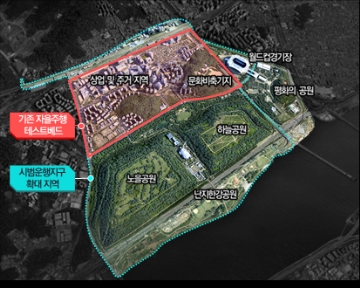
SKT has expanded the construction of an autonomous vehicle pilot operation zone in the Sangam area of Seoul as part of its demonstration project for 'C-ITS,' an intelligent transportation system based on 5G.
2022.06.27by 김예지 기자
[e4ds Tech Day 2026 ⑨] Sim Sang-gyu, Autocrypt CTO: "In the Physical AI Era, Automotive Security Must Extend Beyond the Vehicle"
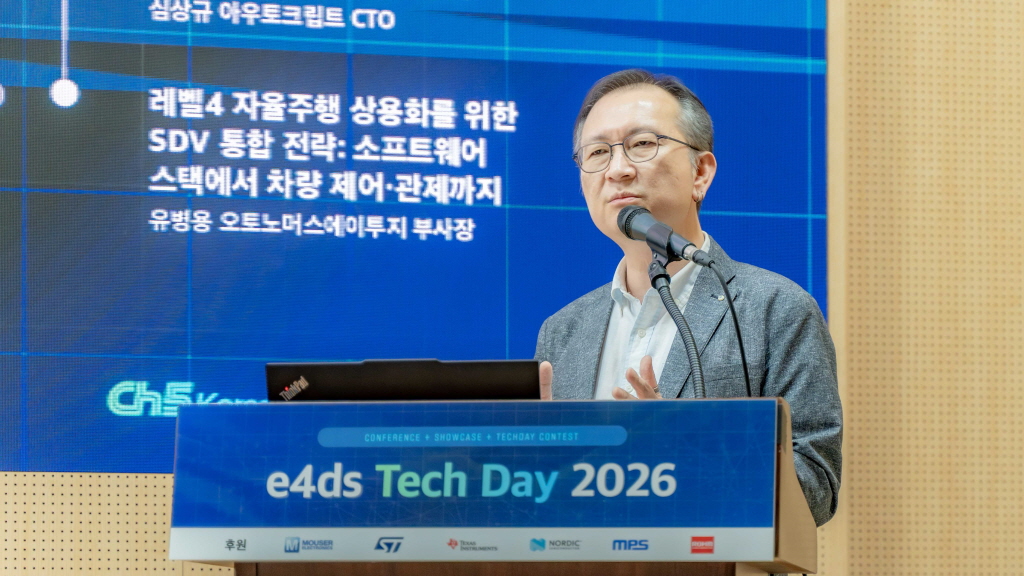
At e4ds Tech Day 2026, Sim Sang-gyu, CTO of Autocrypt, explained automotive cybersecurity strategies in the era of Physical AI and SDV (Software-Defined Vehicle). Automobiles are evolving as part of an ecosystem connected to AI, cloud, chargers, IoT, and robots, and he emphasized that the scope of security must expand beyond the vehicle interior to the entire connected environment. In particular, AI model tampering, adversarial attacks, OTA updates, and EV charger hacking were identified as major threats. He explained that response measures require zero trust, AI model integrity protection, intrusion detection, Security by Design and Default, and full lifecycle security management, and that proactive security system establishment beyond regulatory compliance is critical for securing future mobility competitiveness.
2026.10.12by 배종인 기자

Practical HIL Construction Strategy for Automotive and Off-Highway Controller Validation
As vehicle E/E architecture transitions to zonal structures and shifts to software-defined vehicles (SDV), the number of controllers (ECUs) requiring validation and software complexity are surging dramatically. Meanwhile, real vehicle testing cannot provide repeated verification under identical conditions and entails lead time and safety concerns. This white paper explains the principles of HIL (Hardware-in-the-Loop) validation and the structure of the NI platform composed of PXI, SLSC, and VeriStand, and through two actual implementation cases—Camera Record & Replay HIL for In-Cabin Monitoring Controller (ICMU) and Forklift Controller (VCU) HILS—describes how controller-level regression testing becomes possible. Additionally, it explicitly states application boundaries and limitations, such as lack of A2B support.
2026.10.12by 편집부
Korea Automotive Research Institute Signs MOU with Italy National Institute for Wireless Communications
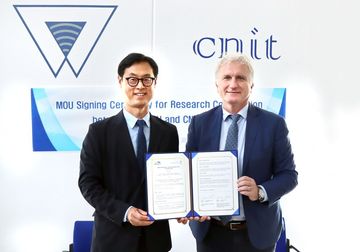
The Korea Automotive Research Institute will sign an MOU with Italy's National Institute for Wireless Communications and launch joint research on next-generation mobility technologies based on 6G, V2X, and connected vehicles. The two organizations will conduct research to apply advanced wireless communication technologies to vehicles and discover international joint projects to advance next-generation connected vehicle technology development.
2026.10.12by 배종인 기자











