


ETRI Leading International Standardization of Medical 3D Printing and 3D Scanning
 Published2022.06.29 14:14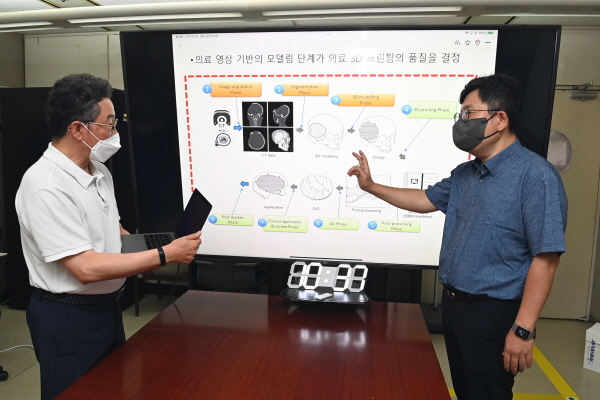
▲ ETRI specialist Lee Byung-nam (left) and principal researcher Jeon Jong-heung (right) discussing the medical 3D printing standard process.
Domestic researchers are taking the lead in developing international standards for medical 3D printing and 3D scanning, which are essential for manufacturing patient-customized medical devices. When these standards are developed, they are expected to not only promote public health but also contribute significantly to revitalizing the related medical equipment industry and facilitating the spread of digital twin and metaverse technologies.
The Electronics and Telecommunications Research Institute (ETRI) announced on the 29th that three newly proposed international standard development projects regarding "medical imaging-based medical 3D printing modeling" have been approved, and a working group for 3D scanning standard development has also been newly established.
The three newly adopted standardization items include △standard evaluation process for assessing precision and accuracy in the process of manufacturing medical 3D printed prosthetics based on standard CT images △methodology for evaluating precision and accuracy errors in the human tissue segmentation and 3D modeling stages △standard operating procedures for creating datasets.
The research team anticipates that once the standard is completed, precision and accuracy of medical 3D printing modeling software can be evaluated through standardized procedures and methods, which is expected to be very helpful in licensing medical 3D printing software domestically and internationally.
Design time can also be shortened from 24 hours to approximately 3 hours. Comprehensive quality management also becomes easier.
Most importantly, upon commercialization, it is expected to contribute to establishing a new medical paradigm by predicting treatment efficacy through virtual simulations based on individual health data and prescribing optimal medications.
Since experts from organizations such as the U.S. FDA, RSNA, and DICOM will also participate in this standardization work, it is expected to have significant ripple effects on the medical and related industries.
Since 2019, the research team has been developing standards for surgical 3D printing modeling and AI-based automation, and is preparing to establish two standards by the end of this year.
The three newly proposed items contain additional key evaluation systems and methodologies for precision and accuracy.
Additionally, ETRI has newly established a working group (AHG-3) for 3D scanning standard development and held its first meeting on the 16th.
The working group will discover future international standardization issues linking 3D scanning and 3D printing, and will proceed with developing technical reports and establishing international standardization roadmaps.
Kim Hyung-joon, director of ETRI's Intelligent Convergence Research Institute, stated, "It is highly significant that we are developing five or more medical 3D printing standards essential for patient-customized medicine under Korean leadership, establishing a 3D scanning group, and leading core international standards that can extend to digital twin and metaverse technologies."
Comments
Related news
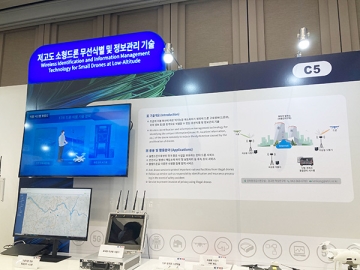
[ETRI Conference] Illegal Drones Caught with Remote Wireless Identification Technology
At the ETRI Conference 2022 held on the 24th-25th, 'Low-Altitude Small Drone Wireless Identification and Information Management Technology' was introduced.
2022.05.27by 김예지 기자
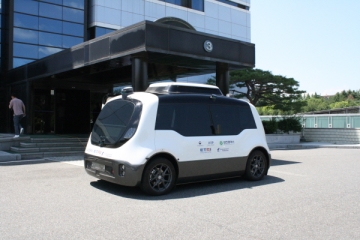
ETRI Accelerates Research on Safe Driving on Irregular Roads and Adverse Weather Conditions
The Electronics and Telecommunications Research Institute (hereinafter ETRI) unveiled "AutoVi" last year, completing preparations for a truly Level 4 autonomous vehicle era without a driver's seat. In 2022, efforts continue to showcase more advanced technology.
2022.05.31by 성유창 기자
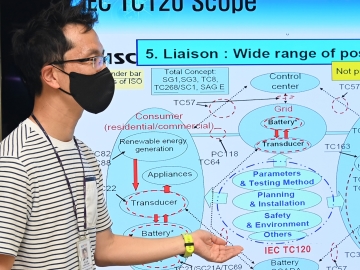
ETRI Develops Domestic Microgrid for International Standard Approval
The Electronics and Telecommunications Research Institute (ETRI) announced on the 15th that international standards for two technologies—energy storage systems (ESS) and demand response (DR), which are core components of microgrid systems—have been approved by the technical committee of the International Electrotechnical Commission (IEC).
2022.06.17by 김예지 기자
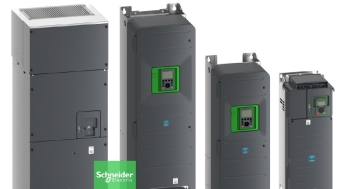
Schneider Aims for Building Energy Savings and Operational Stability with Next-Generation HVAC Drives
Schneider Electric has unveiled its next-generation HVAC drive product line 'Altivar HVAC'. The new product line's key features center on enhanced energy savings, system operational stability, and building management system integration. The products are divided into 'ATH200' for OEM and small equipment applications, and 'ATH600' for environments requiring continuous operation and advanced control. The company plans to expand the application scope from commercial buildings to facilities where HVAC system stability is critical, such as hospitals, airports, and data centers. The announcement includes over 30% energy savings, operation from -10°C to +60°C, Modbus and BACnet support, and compatibility with low global warming potential refrigerants.
2026.03.26by 명세환 기자
Ecolab Expands AI Data Center Cooling Business Through Acquisition of CoolIT
Ecolab has agreed to acquire CoolIT Systems, a liquid cooling company for AI data centers, for approximately $4.75 billion. The transaction is expected to close by Q3 2026, subject to regulatory approvals. CoolIT has been supplying direct-to-chip cooling-based coolant distribution units, cold plates, and manifolds, serving hyperscale data centers and colocation operators as customers. This acquisition is a measure to address the high-heat and high-density server environments created by AI proliferation. Ecolab plans to combine its water management and digital monitoring capabilities with CoolIT's hardware technology to expand its data center cooling business.
2026.03.26by 명세환 기자











