


Pangyo Autonomous Vehicle Pilot Operation Zone Route → Area Expansion
 Published2022.07.01 08:54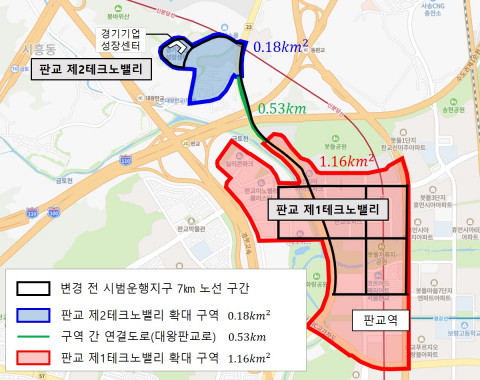
▲ Status of Designated Pangyo Autonomous Vehicle Pilot Operation Zone (Source: Convergence Institute)
Providing demand-responsive services is expected to become easier.
Demonstrations of autonomous driving services in transportation, passenger transport, and logistics will be conducted.
The Gyeonggi Autonomous Driving Center of the Institute of Advanced Convergence Technology (hereinafter referred to as the Institute) announced on the 30th of last month that it has expanded the designation of the Pangyo autonomous vehicle pilot operation zone from a route form to a zone form.
An autonomous vehicle pilot operation zone is an area where special regulatory provisions are applied to promote the research and pilot operation of autonomous vehicles in accordance with Article 7 of the Act on the Promotion and Support of Commercialization of Autonomous Vehicles.
On June 24, the Ministry of Land, Infrastructure and Transport held the 'Autonomous Vehicle Pilot Operation District Committee' and deliberated and approved the expansion of the Pangyo Autonomous Vehicle Pilot Operation District in Seongnam, Gyeonggi-do into a zone, and finalized the change.
The Gyeonggi Autonomous Driving Center at the Convergence Institute has been operating a Zero Shuttle autonomous driving demonstration project that circulates from the Gyeonggi Enterprise Growth Center to Pangyo Avenue France within the existing 7km route of the Pangyo Autonomous Vehicle Pilot Operation Zone.
The Pangyo autonomous vehicle pilot operation zone will be changed and expanded from the existing route to a 1.34㎢, 0.53km area from the 1st Techno Valley to the 2nd Techno Valley.
The expanded area was designated after reviewing the demand of public transportation users, along with Pangyo workers and residents.
As the pilot operation zone expands from a fixed route to a specific area, it is expected to facilitate the provision of demand-responsive services that allow passengers to call for autonomous driving services from their desired location, regardless of the route. Furthermore, based on this expanded scope, active demonstrations of autonomous driving services are anticipated to take place across various fields, including transportation, passenger transport, and logistics.
The Pangyo Autonomous Vehicle Pilot Zone of the Gyeonggi Autonomous Driving Center, which Gyeonggi Province has been developing since 2016 and the Convergence Institute has been operating since 2019, is the first in Korea to conduct research such as operating an autonomous vehicle pilot zone based on actual roads, establishing an autonomous driving control center, and operating autonomous vehicles and collecting data. With this expansion of the zone, there are plans to gradually expand the construction of autonomous driving infrastructure.
Meanwhile, according to our coverage, an official stated that the company responsible for paid autonomous transportation in the Pangyo Autonomous Driving Zone has not yet been determined.
While the pilot operation zones are being expanded, it remains uncertain when autonomous driving-based services will be available.
Comments
Related news

The Ministry of Land, Infrastructure and Transport is expanding autonomous driving pilot operation zones.
The Ministry of Land, Infrastructure and Transport will expand pilot operation zones from the existing areas to 14 zones, double the previous number, to enable private autonomous driving companies to conduct autonomous driving service demonstrations in urban areas, tourist destinations, and parks starting in the second half of the year.
2022.06.23by 성유창 기자
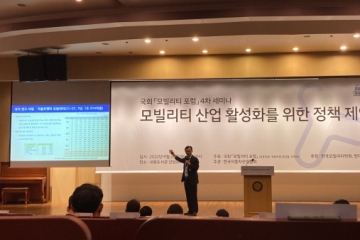
"Korea is definitely not a leading autonomous driving powerhouse"... Deregulation is essential.
Experts have raised the argument that regulatory relaxation is essential in preparing for the future mobility era, including autonomous driving, urban air mobility (UAM), and mobility-as-a-service (MaaS).
2022.06.28by 성유창 기자
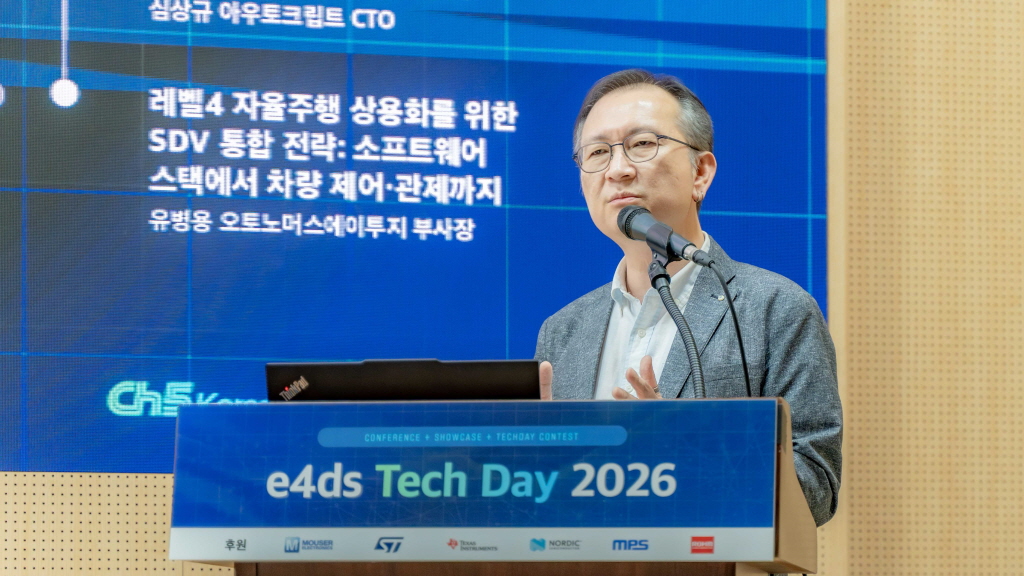
[e4ds Tech Day 2026 ⑨] Sim Sang-gyu, Autocrypt CTO: "In the Physical AI Era, Automotive Security Must Extend Beyond the Vehicle"
At e4ds Tech Day 2026, Sim Sang-gyu, CTO of Autocrypt, explained automotive cybersecurity strategies in the era of Physical AI and SDV (Software-Defined Vehicle). Automobiles are evolving as part of an ecosystem connected to AI, cloud, chargers, IoT, and robots, and he emphasized that the scope of security must expand beyond the vehicle interior to the entire connected environment. In particular, AI model tampering, adversarial attacks, OTA updates, and EV charger hacking were identified as major threats. He explained that response measures require zero trust, AI model integrity protection, intrusion detection, Security by Design and Default, and full lifecycle security management, and that proactive security system establishment beyond regulatory compliance is critical for securing future mobility competitiveness.
2026.10.12by 배종인 기자

Practical HIL Construction Strategy for Automotive and Off-Highway Controller Validation
As vehicle E/E architecture transitions to zonal structures and shifts to software-defined vehicles (SDV), the number of controllers (ECUs) requiring validation and software complexity are surging dramatically. Meanwhile, real vehicle testing cannot provide repeated verification under identical conditions and entails lead time and safety concerns. This white paper explains the principles of HIL (Hardware-in-the-Loop) validation and the structure of the NI platform composed of PXI, SLSC, and VeriStand, and through two actual implementation cases—Camera Record & Replay HIL for In-Cabin Monitoring Controller (ICMU) and Forklift Controller (VCU) HILS—describes how controller-level regression testing becomes possible. Additionally, it explicitly states application boundaries and limitations, such as lack of A2B support.
2026.10.12by 편집부
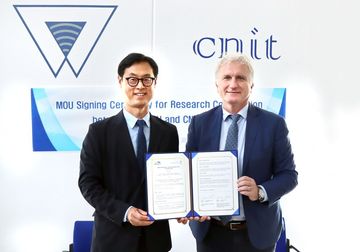
Korea Automotive Research Institute Signs MOU with Italy National Institute for Wireless Communications
The Korea Automotive Research Institute will sign an MOU with Italy's National Institute for Wireless Communications and launch joint research on next-generation mobility technologies based on 6G, V2X, and connected vehicles. The two organizations will conduct research to apply advanced wireless communication technologies to vehicles and discover international joint projects to advance next-generation connected vehicle technology development.
2026.10.12by 배종인 기자











