


The Road Traffic Act, now over 60 years old, needs regulatory reform.
 Published2022.07.04 14:28
OTA 등 하위법령 개정으로 개선 가능 과제 신속 주문
상의는 그동안 민간 규제샌드박스 지원센터와 대한상의 소통플랫폼을 통해 발굴한 규제혁신과제를 비롯해 회원기업과 72개 지방상의를 통해 접수한 과제들이 포함된 ‘기업이 바라는 규제혁신과제’를 정부에 전달했다고 4일 밝혔다.
이번 건의는 최근 정부가 발표한 ‘경제 규제혁신TF’의 핵심분야를 고려해 △신산업 △현장애로 △환경 △입지 △보건 의료 △경영일반 6대 분야에 대해 100개 과제를 선정했으며, 정부가 과감한 규제혁신을 예고한 만큼 기업이 바라는 규제혁신 과제에 대한 속도감 있는 검토와 개선을 요청했다.
대한상의는 “규제는 기업들에게 ‘없으면 좋은’ 정도가 아닌 ‘당장 목을 옥죄고 있는 ‘올가미’ 같은 존재로 인식되고 있다”며 “규제로 인해 어려움을 겪는 기업의 절박한 상황을 정부에 전달하고, 기업들의 숨통을 틔워줄 수 있는 규제혁신을 추진해달라는 의미”라고 이번 건의배경을 설명했다.
건의서에는 △AI 로봇 △드론 △친환경신기술 △수소경제 △공유경제 △모빌리티 등 신산업 신기술 관련 규제혁신 과제 26건이 포함됐다.
이 중에는 규제샌드박스를 통해 승인받은 과제 중 사회 경제적 파급효과가 크거나 안정성이 어느 정도 검증된 과제 등 선제적인 후속 법령정비가 필요한 과제들도 담겼다.
신산업 규제는 낡은 법제도가 그대로 남아있고, 관련규제가 여러 부처에 얽혀있는 경우가 많다.
대표적으로 자율주행로봇은 미국, 영국 등 선진국을 필두로 활성화돼 세계 시장규모 2조원(2021년)을 돌파했지만 국내에선 자유롭게 달릴 수 없다.
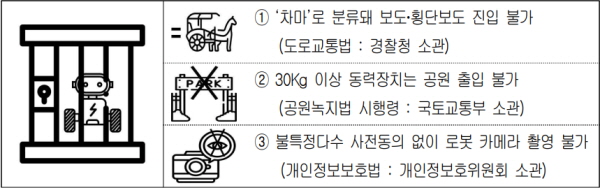
▲자율주행로봇 규제 (그림출처: 대한상공회의소)
60년대에 제정된 도로교통법상 ‘차마’로 분류돼 보도 횡단보도에 진입할 수 없고, 공원녹지법상 공원출입도 제한되며, 개인정보보호법상 AI학습, 충돌방지를 위한 로봇 카메라 영상촬영도 제한되기 때문이다.
마찬가지로 전파를 활용한 전기차 무선충전기술도 전파법, 전기생활용품안전법, 자동차관리법상 관련기준이 없어 상용화할 수 없는 상황이다.
이에 두 가지 기술 모두 규제샌드박스를 통해 시범사업으로만 운영되고 있다.
상의는 기업들이 혁신산업에 뛰어들지 못해서 글로벌 경쟁에서 낙오되지 않으려면 범부처 차원의 노력으로 새로운 기술 서비스의 변화를 반영하지 못하는 ‘규제루프홀(규제사각)’을 메워야 한다고 설명했다.
OTA 등 하위법령 개정으로 개선 가능한 과제도 신속하게 해결할 것을 주문했다.
대한상의는 특히 “국회의 협력이 필요한 법 제 개정 사항과 달리 시행령 시행규칙 등 하위법령 개정으로 개선 가능한 과제는 신속하게 해결해야 한다”라며 즉시 개선 가능한 과제를 별도로 구분해 가시적인 규제혁신 성과를 내 줄 것을 주문했다.
대표적으로 국가전략기술 인정범위 확대를 건의했다. 현재 국가전략기술은 반도체, 이차전지, 백신에 제한돼 있으나, 최신기술 트렌드를 반영해 D.N.A(Data, Network, AI) 등의 분야로 대상을 확대하고 세제지원을 강화해 관련산업을 전략적으로 육성해야 된다는 것이다.
또한 기존 반도체에 연산기능을 더한 지능형반도체를 국가전략기술 중 하나인 차세대 메모리 반도체로 인정해 줄 것도 건의했다.
그 외에도 OTA, 온실가스배출권거래제 상쇄배출권 확대, 폐플라스틱 열분해유 제품 규격 현실화 등의 과제를 즉시 개선할 수 있는 과제로 선정했다고 밝혔다.
Comments
Related news
SKT Expands Self-Driving Vehicle Pilot Area in Sangam
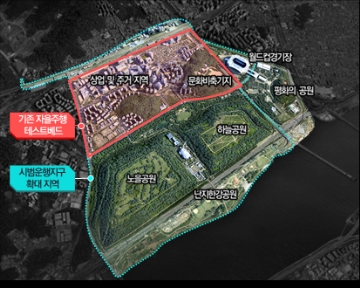
SKT has expanded the construction of an autonomous vehicle pilot operation zone in the Sangam area of Seoul as part of its demonstration project for 'C-ITS,' an intelligent transportation system based on 5G.
2022.06.27by 김예지 기자
"Korea is definitely not a leading autonomous driving powerhouse"... Deregulation is essential.
Experts have raised the argument that regulatory relaxation is essential in preparing for the future mobility era, including autonomous driving, urban air mobility (UAM), and mobility-as-a-service (MaaS).
2022.06.28by 성유창 기자
.jpg)
Pangyo Autonomous Vehicle Pilot Operation Zone Route → Area Expansion
As the Pangyo autonomous vehicle pilot operation zone expands from a designated route to a broader area, it is expected that various autonomous driving-based transportation services will become available.
2022.07.01by 성유창 기자
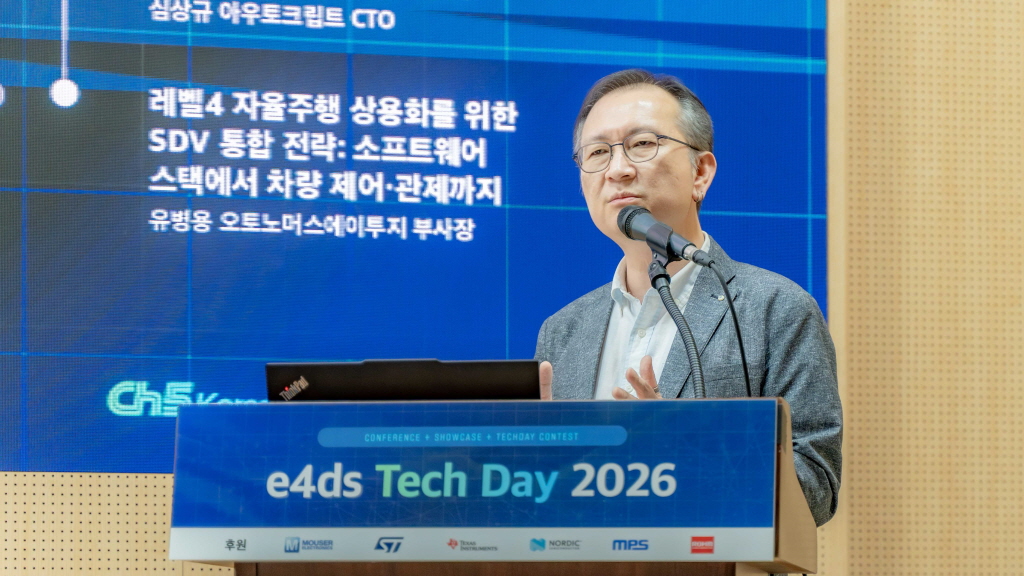
[e4ds Tech Day 2026 ⑨] Sim Sang-gyu, Autocrypt CTO: "In the Physical AI Era, Automotive Security Must Extend Beyond the Vehicle"
At e4ds Tech Day 2026, Sim Sang-gyu, CTO of Autocrypt, explained automotive cybersecurity strategies in the era of Physical AI and SDV (Software-Defined Vehicle). Automobiles are evolving as part of an ecosystem connected to AI, cloud, chargers, IoT, and robots, and he emphasized that the scope of security must expand beyond the vehicle interior to the entire connected environment. In particular, AI model tampering, adversarial attacks, OTA updates, and EV charger hacking were identified as major threats. He explained that response measures require zero trust, AI model integrity protection, intrusion detection, Security by Design and Default, and full lifecycle security management, and that proactive security system establishment beyond regulatory compliance is critical for securing future mobility competitiveness.
2026.10.12by 배종인 기자

Practical HIL Construction Strategy for Automotive and Off-Highway Controller Validation
As vehicle E/E architecture transitions to zonal structures and shifts to software-defined vehicles (SDV), the number of controllers (ECUs) requiring validation and software complexity are surging dramatically. Meanwhile, real vehicle testing cannot provide repeated verification under identical conditions and entails lead time and safety concerns. This white paper explains the principles of HIL (Hardware-in-the-Loop) validation and the structure of the NI platform composed of PXI, SLSC, and VeriStand, and through two actual implementation cases—Camera Record & Replay HIL for In-Cabin Monitoring Controller (ICMU) and Forklift Controller (VCU) HILS—describes how controller-level regression testing becomes possible. Additionally, it explicitly states application boundaries and limitations, such as lack of A2B support.
2026.10.12by 편집부











