


[Interview] ETRI Director Min Kyung-wook: "We will reduce the technology gap with leading autonomous driving countries within five years."
 Published2022.07.05 15:46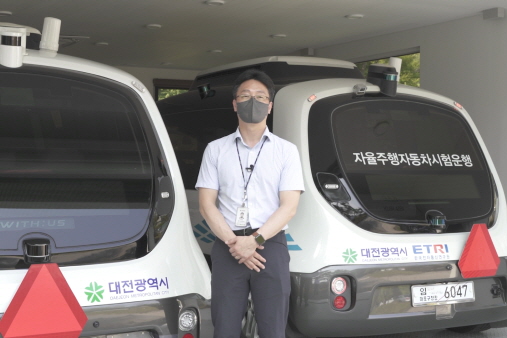
▲Min Kyung-wook, Director of ETRI
"Narrowing the technological gap with advanced autonomous driving countries within five years."
"Korea lags the US by five years in the cognitive, judgment, and control software technologies essential for autonomous driving."
■ What are Otobi's core technologies or differentiating ideas?
The core technology of Autobee is the application of autonomous driving AI technology by integrating camera and lidar sensors. Autobee processes the information received from the camera and lidar in real time using AI algorithms applied to Autobee, recognizing the surrounding environment and objects and creating an autonomous driving path.
A distinctive idea is that, from a service perspective, the absence of a driver's seat allows the general public to experience autonomous driving more deeply. Finally, the vehicle is equipped with features such as voice recognition and VR displays in addition to autonomous driving, providing convenience while traveling.
I heard you're researching autonomous driving on irregular roads. Is there a difference between this technology and driving on regular roads?
Atypical environments are those where lanes and road markings are unclear. This includes unpaved environments like country roads and back roads where the road and sidewalk are not clearly defined and pedestrians and illegally parked vehicles are constantly present. These environments present challenges in implementing autonomous driving location recognition technology and in creating driving paths. In this environment, we are conducting advanced research focusing on artificial intelligence technology that can effectively perform autonomous driving.
■ Please explain the sensors installed in the autobi.
The Autovi vehicle is equipped with two cameras in the front and two lidars each in the front, side, and rear. Equipped with six lidars, it eliminates blind spots and enhances safety. The camera sensors detect road markings, such as lane markings, and traffic lights, and recognize whether the taillights of a stationary vehicle are hazard lights or reverse lights. The lidar is used to recognize dynamic objects (people, vehicles, etc.) in 3D using artificial intelligence.
The reason for the lack of radar is that Autobees don't drive at high speeds, and radar can't clearly distinguish between cars and people. Current law stipulates a maximum speed of 25 km/h for driverless autonomous vehicles for safety reasons, meaning they must maintain this speed even on public roads. Therefore, radar is unnecessary.
■ When the evasive command was issued, the vehicle was observed crossing the center line. While I understand it's designed to strictly adhere to road traffic laws, can this be interpreted as including flexibility depending on the situation?
Crossing the center line is generally illegal. However, in campus environments, back roads, and two-lane roads, it is implicitly permitted, and drivers are encouraged to avoid crossing the center line in these situations. Although it is technically possible to flexibly respond to each situation and environment by distinguishing between them, it is avoided on major roads because of the constant risk and strong legal sanctions.
■ As AI technology becomes central, we often hear talk of training data. What exactly does training data mean?
For example, AI learning is performed to better recognize objects ahead while driving, whether they are people, cars, buses, or trucks. Furthermore, to better detect not only the type of object but also its three-dimensional size, speed, and direction, a large amount of data must be built and trained to achieve safe autonomous driving technology.
Research and standardization efforts in autonomous driving technology are actively underway around the world. Where does Korea stand and what are our thoughts on the direction we should take?
The scope of autonomous driving technology is so broad that it's difficult to quantify the technological gap in a single word. However, the most crucial technology in autonomous driving is the perception/judgment/control software that enables safe vehicle operation. Artificial intelligence software is particularly crucial. I believe Korea is approximately five years behind the advanced US in this area of perception/judgment/control software technology. This gap is expected to narrow significantly by 2027, when the current Autonomous Driving Technology Development Innovation Project (2021-2027) concludes.
■ Were there any difficulties during research and development?
Since there is no accelerator, steering wheel or brake, functional testing is several times more difficult. While standard autonomous vehicles can simply apply the brakes in an emergency, the lack of brakes in Autobees makes them slower to respond to dangerous situations, a major challenge during research and development. Furthermore, the lack of a driver's seat also necessitates manual steering, requiring a joystick for maneuvering, which presents significant inconvenience.
■ A word to the readers
Self-driving services that citizens can experience are still a story of the future. Currently, some local governments are conducting pilot services for self-driving shuttle services, and in the medium to long term, I believe that many industries will be revitalized, such as robotaxis that citizens can experience, self-driving services linked to public transportation, and self-driving services in transportation-deprived areas. I ask for your continued encouragement and support.
Comments
Related news

[e4ds Tech Day 2026 ⑨] Sim Sang-gyu, Autocrypt CTO: "In the Physical AI Era, Automotive Security Must Extend Beyond the Vehicle"
At e4ds Tech Day 2026, Sim Sang-gyu, CTO of Autocrypt, explained automotive cybersecurity strategies in the era of Physical AI and SDV (Software-Defined Vehicle). Automobiles are evolving as part of an ecosystem connected to AI, cloud, chargers, IoT, and robots, and he emphasized that the scope of security must expand beyond the vehicle interior to the entire connected environment. In particular, AI model tampering, adversarial attacks, OTA updates, and EV charger hacking were identified as major threats. He explained that response measures require zero trust, AI model integrity protection, intrusion detection, Security by Design and Default, and full lifecycle security management, and that proactive security system establishment beyond regulatory compliance is critical for securing future mobility competitiveness.
2026.10.12by 배종인 기자

Practical HIL Construction Strategy for Automotive and Off-Highway Controller Validation
As vehicle E/E architecture transitions to zonal structures and shifts to software-defined vehicles (SDV), the number of controllers (ECUs) requiring validation and software complexity are surging dramatically. Meanwhile, real vehicle testing cannot provide repeated verification under identical conditions and entails lead time and safety concerns. This white paper explains the principles of HIL (Hardware-in-the-Loop) validation and the structure of the NI platform composed of PXI, SLSC, and VeriStand, and through two actual implementation cases—Camera Record & Replay HIL for In-Cabin Monitoring Controller (ICMU) and Forklift Controller (VCU) HILS—describes how controller-level regression testing becomes possible. Additionally, it explicitly states application boundaries and limitations, such as lack of A2B support.
2026.10.12by 편집부
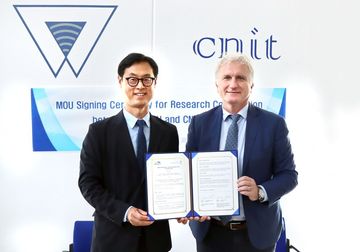
Korea Automotive Research Institute Signs MOU with Italy National Institute for Wireless Communications
The Korea Automotive Research Institute will sign an MOU with Italy's National Institute for Wireless Communications and launch joint research on next-generation mobility technologies based on 6G, V2X, and connected vehicles. The two organizations will conduct research to apply advanced wireless communication technologies to vehicles and discover international joint projects to advance next-generation connected vehicle technology development.
2026.10.12by 배종인 기자
Color Accuracy Issues in Vehicle Interior Ambient Lighting and Intelligent LED Drivers
Vehicle interior ambient lighting is spreading across all price segments, and the level of color accuracy required of lighting designers is rising accordingly. This white paper quantitatively addresses why temperature drift and individual variations of RGB LEDs cannot be corrected by standard constant-current drivers, and explains an intelligent LED driver approach that integrates an MCU, calibration data, and a LIN network interface into the driver. It covers implementation details of the LITIX Interior TLD4020-3ET currently in production, portfolio roadmap, and evaluation/development environments, and clarifies application boundaries including lack of 48V support, lack of RGBi/ISELED support, and absence of direct optical degradation diagnostics.
2026.10.08by 명세환 기자
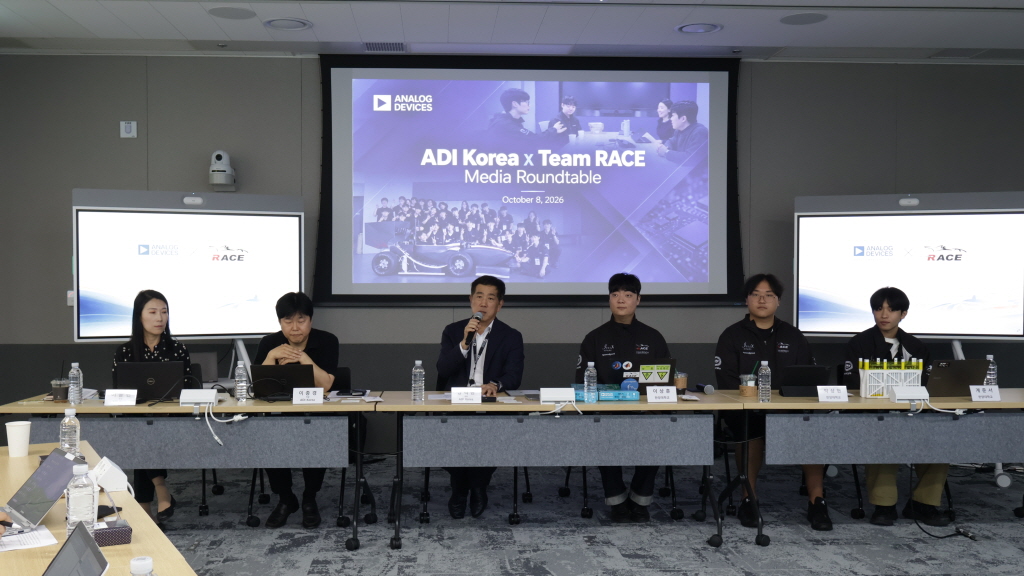
ADI, "Fostering Future Engineers Beyond Component Support"
Global semiconductor company Analog Devices (ADI) is drawing attention for moving beyond simply sponsoring university student car projects to serve as a partner in nurturing future engineers. Over the past three years, ADI has collaborated with Hanyang University's automotive research club Team RACE to support electric formula vehicle development, and recently has been providing technical consultation and semiconductor solutions to enable students to directly develop battery management systems (BMS), creating a model case of industry-academic cooperation.
2026.10.08by 배종인 기자











