


Five ITU-T international standards including Korea's proposal for 5G adopted
 Published2022.07.19 09:05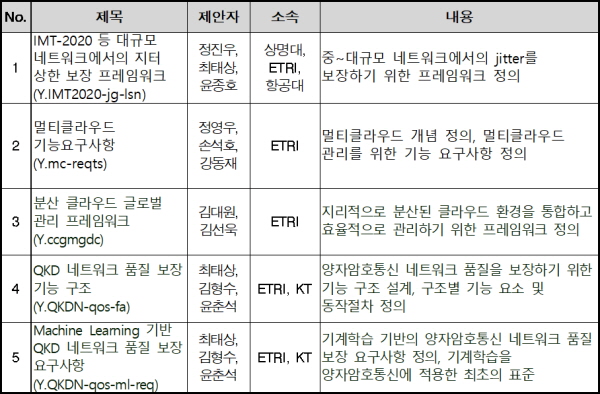
▲List of pre-adoption ITU-T international standards (draft)
Our country is leading international standardization in the future network field, with five international standards proposed by our country, including 5G, cloud computing, and quantum cryptography, being adopted and securing a total of 11 research group chairs.
The Ministry of Science and ICT (MSIT)'s National Radio Research Agency announced on the 18th that at the International Telecommunication Union Telecommunication Standardization Sector (ITU-T) Future Network Study Group (SG13) (Chief Representative of the Korean Delegation: Dr. Hyung-soo Kim of KT) meeting held in Geneva, Switzerland from July 4 to 15, five international standards (drafts) developed by Korea in the fields of 5th generation (5G), cloud computing, and quantum cryptography were pre-adopted, and 11 seats in the SG13 international chair were secured.
There are five international standards (drafts) adopted this time.
The standard 'Jitter Upper Bound Guarantee Framework in 5th Generation Mobile Communication (IMT-2020) Large-Scale Networks' prevents data delays in large-scale networks, providing stable and deterministic services. Based on this, it is expected to contribute to the activation of industries related to ultra-low latency services in 5G, the Internet, and the metaverse.
The 'Multi-cloud Functional Requirements' standard is the world's first multi-cloud technology standard developed by Korea, and provides multi-cloud concepts and functional requirements.
The 'Distributed Cloud Global Management Framework' standard defines the requirements for distributed clouds, a key application technology for fifth generation (5G).
The two standards are expected to form a new market that expands the existing cloud computing environment and serve as a guide for it.
The standards for 'Quantum Key Distribution Network (QKDN) Network Quality Assurance Function Structure' and 'Machine Learning-based QKDN Network Quality Assurance Requirements' contain technologies for quality assurance of quantum cryptography communication networks, which are attracting attention as future security communication technologies, and are expected to be of great help in commercialization through construction of quantum cryptography communication networks utilizing the technologies and service quality evaluation in the future.
Meanwhile, as a new study period (2022-2024) began following the World Telecommunication Standardization Assembly (WTSA) held in March, the reorganization of the leadership of the organizations under the Future Network Research Group (three working groups, 13 research task groups, etc.) was also discussed.
Our country secured 11 seats in the SG13 leadership, 9 seats were re-elected, and 2 additional seats were added, including the Cloud and Big Data Working Group and the Joint Coordination Group on Machine Learning (JCA-ML), which was newly established under our leadership.
The National Radio Research Agency said, “We will continue to work with industry, academia, and research to continue to lead international standardization in future network fields such as quantum, space, 6G, artificial intelligence, and cloud.”
Comments
Related news
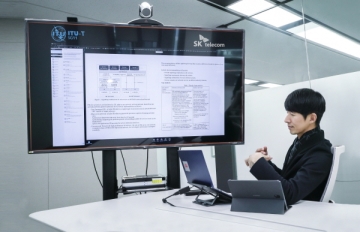
SKT's 'AI Integration Package' Approved as ITU-T Standard Project
SK Telecom has secured a leading position in AI global standards as its 'AI-Integrated Package (AI Full Stack)' standardization proposal, submitted to ITU-T, has been approved as a new project.
2021.12.13by 배종인 기자
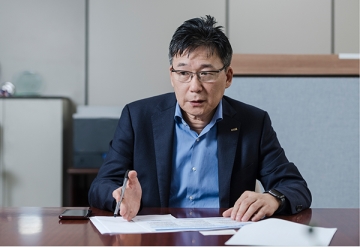
ETRI Director Kim Hyung-jun appointed as ITU Chairman
EETRI Director Kim Hyung-jun has been elected as the chair of ITU-T SG20, the international standardization group for the Internet of Things (IoT) and smart fields.
2022.03.28by 김예지 기자
Ministry of Science and ICT Leads 6G International Standardization
The Ministry of Science and ICT announced that Korea completed the development of the '6G Future Technology Trend Report' on 6G vision and future technology research at the 41st International Telecommunication Union Radiocommunication Sector Working Party on IMT for 2030 and beyond (ITU-R WP5D) meeting held in Geneva, Switzerland from the 13th to the 24th.
2022.06.28by 김예지 기자
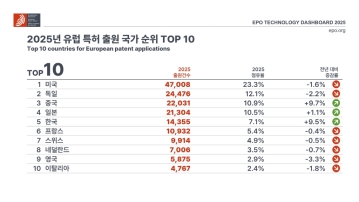
European Patent Applications Surpass 200,000 for the First Time… South Korea Maintains 5th Place, Led by Batteries and Telecommunications
According to the European Patent Office (EPO)'s 'Technology Dashboard 2025', European patent applications last year reached 201,974, surpassing 200,000 for the first time. Korean companies and inventors filed 14,355 applications, representing a 9.5% increase from the previous year and maintaining 5th place by country. Battery, digital communication, and semiconductor technologies led the growth, with Samsung ranking as the top EPO applicant for the second consecutive year and LG reaching 3rd place. The presence of major domestic cities such as Seoul, Suwon, and Yongin was also confirmed. It was also revealed that Korea's European patent strategy is expanding beyond individual technologies to span the entire industry.
2026.03.24by 명세환 기자

SK Telecom First Applies AI-Based Network Operations at Gwanghwamun K-Pop Concert
SK Telecom announced that it applied an AI-based network operation system for the first time at a large-scale K-pop concert held in the Gwanghwamun area of Seoul on March 21st, managing communication quality throughout the event. Mobile data usage during the three hours before and after the concert reached 12.15TB, approximately doubling compared to the same time slot the previous weekend. SK Telecom monitored traffic using the AI system 'A-One' in five-minute and 50-meter units to respond to potential overload situations, while also operating temporary communication facilities and on-site personnel in parallel. This case is interpreted as confirmation of the practical applicability of AI-based autonomous network operation in an environment where demand from dense events and foreign users increases simultaneously.
2026.03.23by 명세환 기자











