


[ETRI②] ETRI: "5G NR latency expected to be 1-3ms."
 Published2022.07.20 10:03
Infrastructure base stations must be deployed with communications and sensing coverage in mind.
Min Kyung-wook, director of the Electronics and Telecommunications Research Institute (ETRI), said that when 5G NR is developed and introduced, latency will be reduced by about 100 times compared to LTE V2X, to 1-3 ms, which will be of great help in ensuring the safety of autonomous driving.
In the past there was WAVE, now there is LTE V2X, and in the future there is 5G NR V2X.
The existing LTE V2X technology has a limitation in that its performance deteriorates when there are many communication devices in the vicinity, and improves when there are few, but it has a latency of about 100ms.
5G NR's latency is expected to be dramatically reduced to 1-3ms, which will likely play a major role in ensuring safety, which is the top priority in autonomous driving.
Regarding the difference between 5G for mobile phones and V2X, he explained that the frequency bands are different, and while 5G for mobile phones is charged, the frequency band is provided free of charge for vehicle-to-vehicle communication or communication between infrastructure and vehicles.
He also shared information about autonomous driving infrastructure.
Infrastructure may also be equipped with cameras, lidar or radar sensors. These sensors have a sensing range, and the communication also has its own coverage range.
Current communication coverage is about 1 km, but sensing coverage is as long as 200 m, or even as short as 100 m.
He said that the location where the infrastructure is installed should be given priority at intersections where autonomous vehicles may have blind spots, and that the base stations of the infrastructure should be placed taking into account communication coverage and sensing coverage.
Director Min Kyung-wook said, “We will do our best to achieve the goal of Level 4 by developing autonomous driving recognition/judgment/control software that is safer in various irregular environments, rainy environments, and night environments by 2027,” and “If the public encourages and supports our technological development, we will be more motivated and work hard on research and development.”
Interviews related to the article can be found in the video above the article and on the e4ds YouTube channel 'Electronic's for Design and Software'.
Comments
Related news
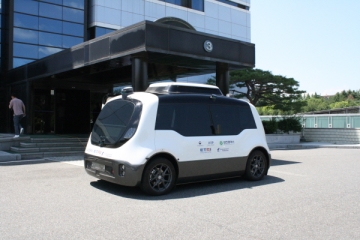
ETRI Accelerates Research on Safe Driving on Irregular Roads and Adverse Weather Conditions
The Electronics and Telecommunications Research Institute (hereinafter ETRI) unveiled "AutoVi" last year, completing preparations for a truly Level 4 autonomous vehicle era without a driver's seat. In 2022, efforts continue to showcase more advanced technology.
2022.05.31by 성유창 기자
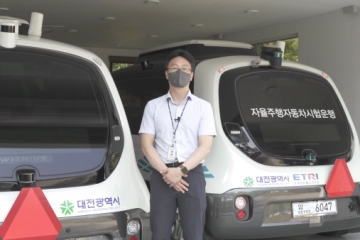
[Interview] ETRI Director Min Kyung-wook: "We will reduce the technology gap with leading autonomous driving countries within five years."
ETRI has developed core AI technologies that recognize and predict driving environments and situations based on the fusion of cameras and lidar to enhance the accuracy of autonomous driving sensors, and provides AI learning and inference models to implement perception and prediction functions.
2022.07.05by 성유창 기자
.jpg)
[ETRI①]ETRI, “We will strive to achieve the goal of level 4 autonomous driving by 2027”
ETRI (Electronics and Telecommunications Research Institute) announced that it is currently carrying out an autonomous driving technology development innovation project through government R&D, with the goal of advancing to Level 4 fully autonomous driving technology, and is conducting research to enable seamless driving in unstructured roads (residential roads) and adverse weather conditions.
2022.07.20by 성유창 기자
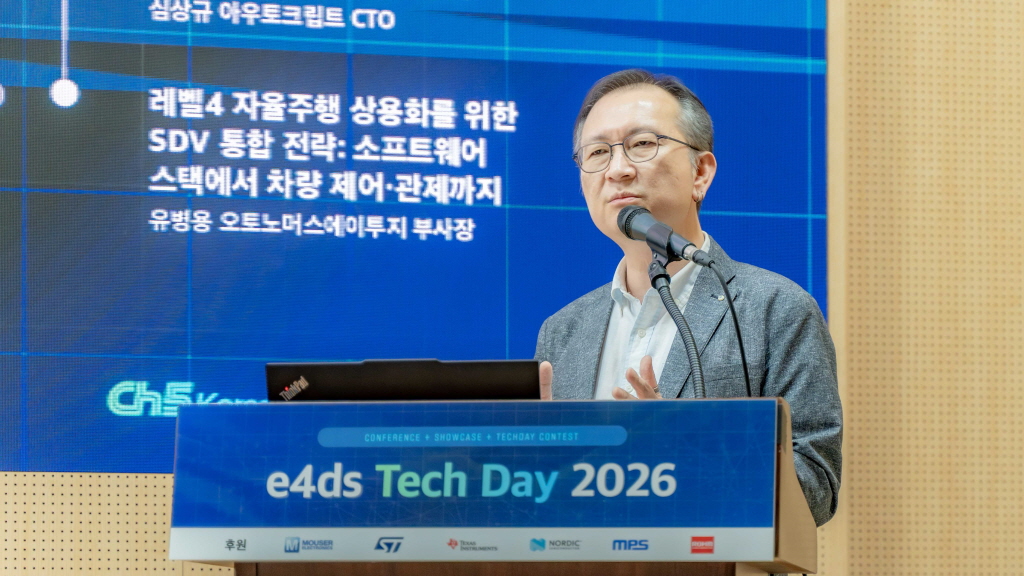
[e4ds Tech Day 2026 ⑨] Sim Sang-gyu, Autocrypt CTO: "In the Physical AI Era, Automotive Security Must Extend Beyond the Vehicle"
At e4ds Tech Day 2026, Sim Sang-gyu, CTO of Autocrypt, explained automotive cybersecurity strategies in the era of Physical AI and SDV (Software-Defined Vehicle). Automobiles are evolving as part of an ecosystem connected to AI, cloud, chargers, IoT, and robots, and he emphasized that the scope of security must expand beyond the vehicle interior to the entire connected environment. In particular, AI model tampering, adversarial attacks, OTA updates, and EV charger hacking were identified as major threats. He explained that response measures require zero trust, AI model integrity protection, intrusion detection, Security by Design and Default, and full lifecycle security management, and that proactive security system establishment beyond regulatory compliance is critical for securing future mobility competitiveness.
2026.10.12by 배종인 기자

Practical HIL Construction Strategy for Automotive and Off-Highway Controller Validation
As vehicle E/E architecture transitions to zonal structures and shifts to software-defined vehicles (SDV), the number of controllers (ECUs) requiring validation and software complexity are surging dramatically. Meanwhile, real vehicle testing cannot provide repeated verification under identical conditions and entails lead time and safety concerns. This white paper explains the principles of HIL (Hardware-in-the-Loop) validation and the structure of the NI platform composed of PXI, SLSC, and VeriStand, and through two actual implementation cases—Camera Record & Replay HIL for In-Cabin Monitoring Controller (ICMU) and Forklift Controller (VCU) HILS—describes how controller-level regression testing becomes possible. Additionally, it explicitly states application boundaries and limitations, such as lack of A2B support.
2026.10.12by 편집부











