



Raw material prices hit auto parts hardest
 Published2022.07.26 15:45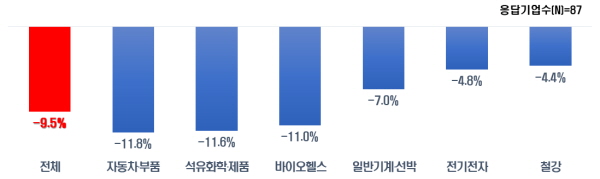
▲Operating profit growth rate by major industry for the second half of the year (year-on-year) forecast
As the profitability of major domestic companies plummets due to rising international raw material prices and rising exchange rates, the operating profit of auto parts companies is expected to decline the most.
The Federation of Korean Industries (FKI) commissioned a survey by Monoresearch, a market research firm, to investigate the “impact of rising international raw material prices on businesses” among the top 500 companies in terms of sales (100 companies responded), targeting large corporations operating in the 12 major export industries. As a result, 87.0% of respondents said that rising international raw material prices had a “negative impact” on the business environment. ‘No effect’ and ‘positive effect’ were only 9.0% and 4.0%, respectively.
The 12 major export industries are semiconductors, general machinery, automobiles, petrochemicals, steel, petroleum products, ships, automobile parts, displays, biohealth, computers, and mobile communication devices.
If the rise in international raw material prices continues in the second half of the year, the profitability of most companies (93.1%) is expected to deteriorate, with the average operating profit decreasing by 9.5%.
By major industry, the decline was the largest in the following order: △Automobiles and Parts -11.8% △Petrochemicals and Products -11.6% △Biohealth -11.0% △General Machinery and Shipbuilding -7.0% △Electrical and Electronics -4.8% △Steel -4.4%.
It was found that the operating profits of large corporations decreased by an average of 8.7% during the first half of the year due to the soaring international raw material prices.
The proportion of companies that stated that they would raise product prices if the international raw material price trend continues in the second half of this year was 63.0%.
The remaining 37.0% of companies said they had no plans to increase product prices. The average price increase for companies planning to increase product prices was expected to be 9.6% of the manufacturing cost burden.
The product price reflection ratio of manufacturing cost burden in the second half of the year by major industry was as follows: △Petrochemicals and petroleum products 13.6% △General machinery and ships 11.7% △Electrical and electronics 8.1% △Biohealth 7.5% △Automobiles and parts 7.2% △Steel 6.9%.
It was found that 49.0% of companies raised product prices due to rising international raw material prices in the first half of the year.
The Federation of Korean Industries explained, “Companies that had been absorbing the burden of the surge in raw material prices during the first half of the year are now suffering from the continued surge in international raw material prices, the surge in exchange rates, and the pressure on profitability due to wage increases. As a result, they are in a situation where they have no choice but to reflect some of the cost burden in product prices in the second half of the year.”
Regarding the duration of the high international raw material prices, about half of the responding companies, 49.0%, predicted that it would continue until next year (25.0% in the first half and 24.0% in the second half), 23.0% predicted that it would continue until the end of this year, and 23.0% predicted that it would be 'unpredictable'.
The government policy tasks to address the soaring international raw material prices were surveyed as follows: △Reducing raw material import tariffs (42.3%), △Securing a stable source of raw materials such as supporting overseas resource development (36.3%), △Release of government raw material reserves (11.3%), △Support for recycling of waste resources (5.3%), △Support for development of process technologies to reduce raw material use (4.0%), and △Others (0.8%).
“Domestic companies are experiencing a decline in sales and worsening profitability due to high prices, high interest rates, and high exchange rates amid the continued high demand for international raw materials,” said Choo Kwang-ho, head of the economic division of the Federation of Korean Industries. “We need to reduce the cost burden on companies by lowering tariffs on major raw materials and corporate tax cuts, while also taking proactive measures to stabilize the supply and demand of raw materials, such as overseas resource development.”He claimed, "Everything."
Comments
Related news

Chairman Jin Dae-je: "National preparation for semiconductor hegemony is essential."
Supply will remain tight relative to semiconductor demand for a considerable period, and opinions have been presented that national-level countermeasures need to be established in preparation for semiconductor hegemony competition. The Federation of Korean Industries (hereinafter referred to as FKI) held a seminar on the 30th at the FKI Hall Conference Center with the theme of "The Semiconductor Industry is Shaken: Semiconductor Industry Paradigm and Future."
2021.03.30by 배종인 기자

Semiconductor Industry Issues and Response Strategies Seminar to Be Held
With continued global semiconductor supply instability, interest in semiconductors is at an all-time high. Seminar Hub will hold the "2021 Semiconductor Industry Key Issues and Response Strategies Seminar" both online and offline on July 1st (Thursday) at the Korea Chamber of Commerce and Industry building in Yeouido, Seoul.
2021.06.03by 이수민 기자
FKI: “Digital Tax Should Be Limited to Revenues Over $20 Billion”
The Federation of Korean Industries (Chairman Huh Chang-soo) asserted that the digital tax should be limited to digital service companies with annual sales exceeding $20 billion.
2021.06.09by 배종인 기자

[e4ds Tech Day 2026 ⑨] Sim Sang-gyu, Autocrypt CTO: "In the Physical AI Era, Automotive Security Must Extend Beyond the Vehicle"
At e4ds Tech Day 2026, Sim Sang-gyu, CTO of Autocrypt, explained automotive cybersecurity strategies in the era of Physical AI and SDV (Software-Defined Vehicle). Automobiles are evolving as part of an ecosystem connected to AI, cloud, chargers, IoT, and robots, and he emphasized that the scope of security must expand beyond the vehicle interior to the entire connected environment. In particular, AI model tampering, adversarial attacks, OTA updates, and EV charger hacking were identified as major threats. He explained that response measures require zero trust, AI model integrity protection, intrusion detection, Security by Design and Default, and full lifecycle security management, and that proactive security system establishment beyond regulatory compliance is critical for securing future mobility competitiveness.
2026.10.12by 배종인 기자

Practical HIL Construction Strategy for Automotive and Off-Highway Controller Validation
As vehicle E/E architecture transitions to zonal structures and shifts to software-defined vehicles (SDV), the number of controllers (ECUs) requiring validation and software complexity are surging dramatically. Meanwhile, real vehicle testing cannot provide repeated verification under identical conditions and entails lead time and safety concerns. This white paper explains the principles of HIL (Hardware-in-the-Loop) validation and the structure of the NI platform composed of PXI, SLSC, and VeriStand, and through two actual implementation cases—Camera Record & Replay HIL for In-Cabin Monitoring Controller (ICMU) and Forklift Controller (VCU) HILS—describes how controller-level regression testing becomes possible. Additionally, it explicitly states application boundaries and limitations, such as lack of A2B support.
2026.10.12by 편집부











