


Autonomous vehicles and camera module competition intensifies.
 Published2022.08.02 10:19
2020년 340억불·2026년 590억불 시장
테슬라, 탑재 카메라 8개 2년만 세 배 ↑
과학기술정보통신부는 ‘과학기술&ICT 정책·기술 동향 217호’를 통해 자율주행시대가 다가오면서 카메라 모듈이 미래 먹거리로 주목받고 있다고 전했다.
도요타, 테슬라 등 글로벌 완성차 업체에서 카메라 모듈을 활용한 기술 개발이 활발하게 일어나고 있다.
도요타의 자율주행 자회사인 우븐 플래닛은 카메라를 활용한 자율주행 기술 개발에 착수했다.
레이더와 라이다가 부착된 자율차에서 수집되는 양이 매우 부족하고, 카메라를 통한 영상만으로 주행 중 정보 수집과 학습이 가능할 것으로 기대되기 때문이다.
가격적인 면도 카메라가 유리하다. 레이더와 라이다에 비해 약 90% 저렴해 활용도가 훨씬 높다는 의견이다.
일론 머스크 테슬라 CEO도 라이다의 높은 가격과 큰 소비전력을 이유로 카메라 센서만을 이용해 자율차를 개발하겠다고 못박았다.
2020년 2~3개에 불과했던 테슬라 차량의 카메라 수가 세 배 정도 늘어났다.
8개의 카메라와 신경망 처리에 의존한 ‘테슬라 비전’ 시스템이 오토파일럿과 완전자율주행 기능을 제공해 차선, 신호등, 주변 차량 등을 인식하기 때문에 레이더도 제거할 것이라고 전했다.
2020년 2~3개에 불과했던 카메라 수가 세 배 정도 늘어난 것이다.
테슬라는 카메라 여러 대가 동시에 물체를 입체적으로 촬영하면 물체의 형태, 거리 및 깊이를 측정하는 데에 문제가 없다고 설명했다.
현재 북미 자율주행차 판매 물량에서만 레이더를 제거했으나 추후 다른 지역에 판매하는 차량의 레이더도 제거할 것으로 예상된다.
시장조사 전문기관 Yole은 자율주행에 필요한 카메라뿐만 아니라 사이드미러 대신 설치된 버추얼미러 시스템 등으로 차량에 탑재되는 카메라 개수가 늘어날 것으로 전망하며 시장 규모도 2020년 340억달러에서 2026년 590억달러로 성장할 것으로 내다봤다.
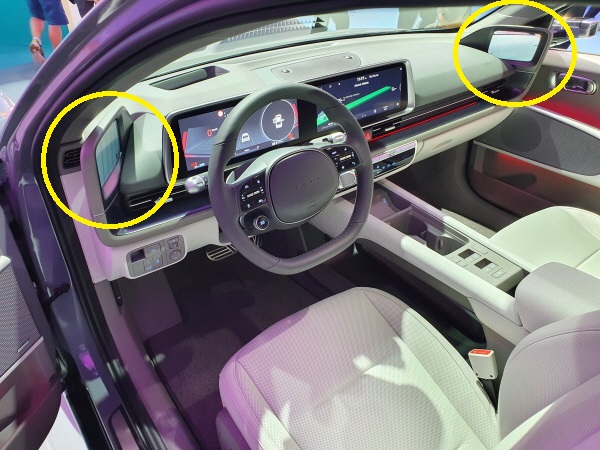
▲아이오닉6 버추얼미러
이에 삼성전기와 LG이노텍 등 국내 전자부품 업계는 자율차 카메라 모듈 수주에 적극적으로 나서고 있다.
삼성전기는 테슬라의 자율차에 탑재되는 카메라 모듈 수주를 따냈다. 상하이와 베를린에서 모듈을 본격적으로 양산해 부품을 납품할 계획이다.
본래 테슬라 공급 비중은 LG이노텍이 70%, 삼성전기가 30%였으나, 이번 계약으로 비중이 뒤바뀔 것으로 전망된다.
LG이노텍은 구미 LG전자 A3 공장을 인수하고 카메라 모듈 생산에 활용할 것이라는 계획을 발표했다.
LG이노텍은 현대자동차 등 완성차 업체에 전장용 카메라 모듈을 공급하고 있다.
이에 더불어 테슬라 오스틴 공장에 공급하는 카메라 모듈 수주 입찰 경쟁에 참여할 것으로 보이며, 재규어랜드로버, GM, 콘티넨탈에는 기존 전장부품 공급을 넘어 카메라 모듈을 공급할 수 있을 것이라는 예상이 나온다.
Comments
Related news
[Interview] ETRI Director Min Kyung-wook: "We will reduce the technology gap with leading autonomous driving countries within five years."
ETRI has developed core AI technologies that recognize and predict driving environments and situations based on the fusion of cameras and lidar to enhance the accuracy of autonomous driving sensors, and provides AI learning and inference models to implement perception and prediction functions.
2022.07.05by 성유창 기자
[Interview] Hyunjung Kim, Infineon Manager - “Need for angle sensors to detect rotation speed and angle increases”
We arranged a meeting with Kim Hyun-jung, Manager at Infineon Technologies Korea, a global semiconductor solutions company, to discuss trends in automotive components, magnetic angle sensors, and magnetic circuits.
2022.07.18by 성유창 기자

Ministry of Land, Infrastructure and Transport: "Will prioritize commercialization of Level 3 autonomous vehicles within the year"
The Ministry of Land, Infrastructure and Transport has announced a plan to visualize outcomes by prioritizing the commercialization of Level 3 autonomous vehicles.
2022.07.19by 성유창 기자
.jpg)
[ETRI①]ETRI, “We will strive to achieve the goal of level 4 autonomous driving by 2027”
ETRI (Electronics and Telecommunications Research Institute) announced that it is currently carrying out an autonomous driving technology development innovation project through government R&D, with the goal of advancing to Level 4 fully autonomous driving technology, and is conducting research to enable seamless driving in unstructured roads (residential roads) and adverse weather conditions.
2022.07.20by 성유창 기자

[e4ds Tech Day 2026 ⑨] Sim Sang-gyu, Autocrypt CTO: "In the Physical AI Era, Automotive Security Must Extend Beyond the Vehicle"
At e4ds Tech Day 2026, Sim Sang-gyu, CTO of Autocrypt, explained automotive cybersecurity strategies in the era of Physical AI and SDV (Software-Defined Vehicle). Automobiles are evolving as part of an ecosystem connected to AI, cloud, chargers, IoT, and robots, and he emphasized that the scope of security must expand beyond the vehicle interior to the entire connected environment. In particular, AI model tampering, adversarial attacks, OTA updates, and EV charger hacking were identified as major threats. He explained that response measures require zero trust, AI model integrity protection, intrusion detection, Security by Design and Default, and full lifecycle security management, and that proactive security system establishment beyond regulatory compliance is critical for securing future mobility competitiveness.
2026.10.12by 배종인 기자











