


Hydrogen City Act, Key to the 'World's First Hydrogen City'
 Published2022.08.10 10:38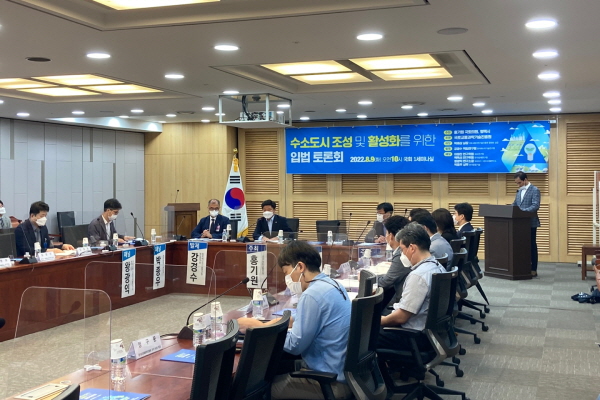
State- and Public-Led Hydrogen Economy Must Shift to Corporate and Private Sector Leadership
Carbon Neutrality through Hydrogen Cities, Increased Potential for Export Models
Pyeongtaek City and Assemblyman Hong Ki-won held a 'Legislative Forum for the Creation and Revitalization of a Hydrogen City' at the National Assembly Members' Office Building on the 9th and discussed the construction of a hydrogen city.
In his congratulatory remarks, Kim Jong-hak, Vice President of the Korea Institute of Construction Technology, stated, “Hydrogen is an energy source capable of solving environmental problems such as global warming,” adding, “Concerns regarding safety and technical limitations exist, so a strategic approach through pilot projects is necessary.”
He further emphasized, “We must expand our scope through hydrogen supply infrastructure and the diversification of hydrogen mobility, and establish a structure where hydrogen functions as an energy source in urban life,” adding, “It is necessary to shift the hydrogen economy, which has been led by the state and the public sector, to a model led by companies and the private sector.”
Participants in the legislative debate agreed that a legal framework must be established promptly to build a hydrogen city.
According to the Ministry of Land, Infrastructure and Transport's carbon neutrality roadmap, the land, infrastructure, and transport sector accounts for 2% of Korea's total carbon emissions.It accounts for 1%.
This means that carbon neutrality in space and transportation is the core of 2050 carbon neutrality.
Kang Kyung-soo, a principal researcher at the Korea Institute of Energy Research, stated, “The existing legal framework has limitations in terms of acceptance,” and expressed his hope for the swift enactment of the Hydrogen City Act. He noted, “The Act on the Construction and Operation of Hydrogen Cities (hereinafter the Hydrogen City Act) stipulates the transition to a hydrogen economy society by establishing a hydrogen ecosystem across all urban sectors, and by encouraging the participation of private companies, it will serve as a model to complete the hydrogen economy.”
As an example of the limitations of acceptance, Senior Researcher Kang stated that there are cases where the buildings that can be constructed in Class 3 general residential areas are limited to solar power facilities under the urban planning ordinances of each city and province, making it impossible to install 400kW-class building/power generation fuel cells utilizing hydrogen.
Senior Researcher Kang's opinion is that the enactment of the Hydrogen City Act should provide a basis for local governments to enact or amend related ordinances.
Lee Jeong-chan, a research fellow at the Korea Institute of Land Research, argued, “Global carbon neutrality is a mid-to-long-term megatrend that will last for at least 50 years in the economic and industrial sectors,” adding, “The model for local and national carbon neutrality achievement through hydrogen cities is highly likely to become an advanced case for the whole world to benchmark and an export model.”
Just as Korea initiated smart cities with the world's first legislation, it is once again pursuing the world's first hydrogen city initiative at the stage of global carbon neutrality.
This research fellow also suggested that now that the potential has been confirmed, the Hydrogen City Act should be enacted and implemented quickly to secure a brand advantage and generate economic innovation effects, such as overseas exports.
Park Jong-woo, Managing Director of Korea Engineering & Construction, represented the construction industry's views on the Hydrogen City Act.
The construction industry is hydrogenIt was reported that there is ambiguity in relevant laws when implementing the Ryojeonji combined heat and power generation facility project.
Executive Director Park stated, “The determination criteria for hydrogen fuel cell facilities are missing among the facilities defined in the ‘Rules on the Determination, Structure, and Installation Standards of Urban and County Planning Facilities.’” He added, “If hydrogen fuel cell facilities are interpreted as electricity supply facilities, power generation facilities classified as new and renewable energy facilities cannot be installed in exclusive residential areas or general residential areas.”
He went on to emphasize the need to push for the enactment of regulations to exclude solar power facilities and hydrogen fuel cell facilities, which are becoming widespread and can be introduced as distributed power generation systems within urban areas.
While the rapid expansion of infrastructure such as related energy production and supply facilities and transportation facilities is essential for establishing a hydrogen city, government support measures for cargo vehicles and construction machinery, which are the main culprits of CO2 emissions, are insufficient.
Therefore, Executive Director Park stated that when creating a hydrogen city, it is also necessary to establish the necessary infrastructure through measures such as mandating the installation of hydrogen refueling stations for commercial vehicles within urban logistics facilities or providing support.
Finally, he announced that many businesses are facing difficulties in project implementation due to complaints arising from the lack of domestic awareness regarding hydrogen facilities, and expressed his hope that the enactment of the Hydrogen City Act would improve public perception of hydrogen facilities and establish a legal foundation for future projects.nbsp;
Comments
Related news

Completion of 'Pyeongtaek Hydrogen Production Base,' the Capital Region's First Hydrogen Supply Hub
Hydrogen charging stations in the Seoul metropolitan area, which previously could only produce 2 tons per day, are now expected to enable daily hydrogen production of 7 tons from the Pyeongtaek hydrogen production base, which is anticipated to provide momentum to the domestic hydrogen industry.
2022.07.27by 성유창 기자
Hyundai Motor Accelerates Entry into Germany with Hydrogen Electric Trucks
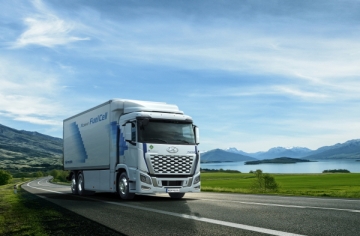
Hyundai Motor's XCIENT Fuel Cell hydrogen electric truck has confirmed its entry into Germany, the largest commercial vehicle market in Europe, and is actively targeting the German market.
2022.08.03by 성유창 기자

Nvidia invests $5 billion in Intel
NVIDIA and Intel, leaders in global AI computing technology, are now forging ahead in providing cutting-edge solutions through NVLink-based architecture integration. NVIDIA and Intel have officially announced a strategic partnership and stated that they will jointly develop customized data center and personal computing products to accelerate diverse applications and workloads ranging from hyperscale to enterprise and consumer markets, thereby laying the foundation for the next generation computing era.
2025.09.22by 배종인 기자
.jpg)
Applied Materials Launches Environmental Protection Campaign to Mark World Cleanup Day
Applied Materials Korea (CEO Park Kwang-seon) is carrying out environmental cleanup activities with employees and their families around the Dongtan Sinricheon area on the occasion of World Cleanup Day, evolving into a company that engages with the local community beyond technological innovation.
2025.09.22by 명세환 기자
.jpg)
The combination of electrical and electronic technologies like AI, semiconductors, and electric vehicles with renewable energy will determine industrial competitiveness.
Professor Lim Chun-taek from Gwangju Institute of Science and Technology (GIST) stated in his keynote speech at the '2025 e4ds Tech Day' on the 9th, "Global energy investment is already shifting from fossil fuels to renewable energy, and the trend of electrification combined with electrical and electronic technologies is changing the industrial landscape."
2025.09.12by 배종인 기자











