



KIMS Accelerates the Era of Green Hydrogen Production
 Published2022.08.11 15:52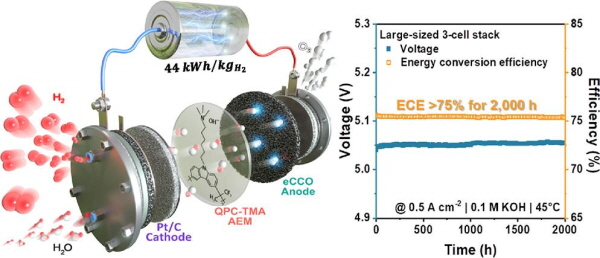
▲음이온교환막 수전해 스택 모식도(왼쪽) 및 장기 내구성 성능 평가 그래프(오른쪽) (그림제공: 한국재료연구원)
음이온교환막 수전해 스택 기술 국산화
수전해 소재·부품 등 수입 의존도 ↓
한국재료연구원(이하 재료연) 최승목 박사 연구팀은 한국화학연구원(KRICT, 이하 화학연) 이장용 박사 연구팀과 융합연구를 통해 고활성·고내구 비귀금속 촉매·전극 소재와 고성능 음이온교환 소재를 개발하고 이를 수전해 시스템에 적용한 것이 주요했다고 11일 전했다.
본 기술은 재료연이 △고활성·고내구 비귀금속 촉매 소재 합성 기술 △대면적 전극 공정 기술 △막전극접합체 제조 기술 △스택 조립·운전 기술을 맡았으며 화학연이 △음이온교환 소재 및 고분자 분리막 제조 기술을 융합해 핵심 소재 부품을 모두 국산화한 것이다.
공동연구팀은 본 기술을 상용 대면적 다중셀 스택에 적용해 저위발열량기준 수소 발생 효율 75.6%, 수소 1kg 생산에 필요한 소비 전력 44kW/h, 연속 운전 2,000시간 동안 성능 감소율 0.2%를 달성했다.
기존 연구는 개발된 소재가 수전해 시스템에 적용되지 못하고 소재 단위의 성능 평가에 그치는 한계가 있었다.
공동연구팀은 소재 및 미니셀 단위의 연구를 넘어서는 핵심 원천 소재 및 부품을 상용 가능 수준의 스택에 적용해, 실증 수준의 연구성과를 보여주는 데 성공했다.
재료연은 개발된 비귀금속 코발트구리(CuCo) 산화물 촉매를 가지고 데칼코팅법을 이용해 균일한 대면적 전극을 제조하고, 해당 전극의 반응 활성 면적을 증가시켜 약하게 결합된 불순물(촉매)을 제거한 결과 기존 전극 대비 1.5배 활성이 우수한 고내구성을 지닌 산소 발생 전극을 개발할 수 있었다.

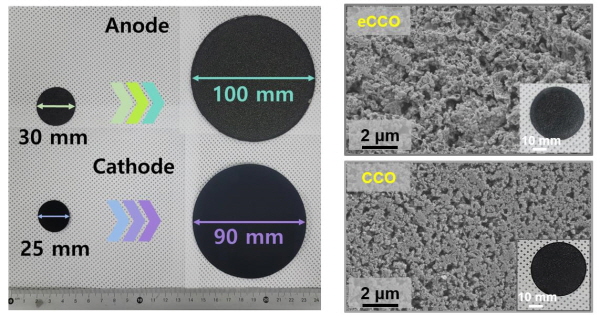
▲대면적 산소발생전극과 수소발생전극(왼쪽) 및 표면처리된 신규 산소발생전극(eCCO)과 기존산소발생전극(오른쪽) (그림제공: 한국재료연구원)
한편 화학연은 기존 음이온교환 소재보다 주쇄구조가 강화되고 이온전도도와 내구성이 향상된 폴리카바졸 기반의 QPC-TMA를 개발하고, 이를 수전해 시스템에 적합하도록 음이온교환막을 대면적화했다.
마지막으로 재료연은 개발된 전극과 음이온교환막을 이용해 막전극접합체를 제조한 후, 소면적 크기의 단위셀에서 이의 성능을 확인했다.
또한 이를 상용 가능한 수준인 원형의 대면적 3셀 스택에 적용함으로써, 높은 수소 발생 효율과 낮은 성능감소율의 안정적인 음이온교환막 수전해 스택을 개발했다.
그린수소 생산을 위한 수전해 세계시장 규모는 2030년 기준 약 1,800조로 예상된다.
국내에서도 2.5MW급 수전해 기반 수소생산 기지 구축사업이 시작되는 등 수전해 시장이 확대되고 있지만 수전해 관련 소재 및 부품 등은 수입에 의존하는 경향을 보인다.
이번 개발로 인해 원천 소재 및 부품을 대면적 상용 스택에 적용한 것으로 소재, 부품, 시스템 국산화에 의한 수입 대체 효과는 물론, 해외로의 수출도 가능할 것으로 기대된다.
최승목 재료연 책임연구원은 “장수명 고내구 수전해 스택을 국내 기술로 개발한 이번 연구성과는 수전해 시스템 상용화에 가장 중요한 난제 중 하나를 해결한 것”이라며 “본 기술이 상용화되면 수전해 소재 및 부품의 국산화와 함께 글로벌 수전해 시장을 선도하는 결과를 가져올 것으로 기대한다”라고 말했다.
Comments
Related news
Materials Research Institute, Titanium Material Self-Sufficiency Contribution Recognized
The Korea Institute of Materials Science (KIMS), a government-funded research institute under the Ministry of Science and ICT, has been recognized for its contributions to achieving domestic self-sufficiency in titanium (Ti) materials.
2022.07.07by 배종인 기자
Lee Jeong-hwan, President of the Korea Institute of Materials Science, emphasizes response to the weaponization of rare earths.
Lee Jung-hwan, President of the Korea Institute of Materials Science, conveyed specialized knowledge on preemptive response measures to the global rare earth industry crisis.
2022.07.20by 배종인 기자
KIMS and Gyeongbuk Technopark Join Hands for Materials and Components Technology Innovation
The Korea Institute of Materials Science (KIMS, Director Lee Jung-hwan), a government-funded research institute under the Ministry of Science and ICT, and Gyeongbuk Technopark (Director Ha In-sung) have joined forces to foster the materials and components industry and promote regional economic development.
2022.07.21by 배종인 기자
Materials Research Institute Develops Ultra-thin Coating Water Electrolysis Catalyst Technology
The Korea Institute of Materials Science has simultaneously resolved the performance and durability trade-off problem in water electrolysis catalysts by applying ultra-thin surface coating technology. Achieving 1.9 times higher performance compared to conventional catalysts while demonstrating 1,000-hour long-term stability, the institute has developed technology scalable to industrial water electrolysis systems through a simple process.
2026.10.07by 배종인 기자
Gigaphoton Develops Neon Gas Recycling System for ArF Excimer Lasers...Achieves 50% Recycling Rate
Gigaphoton announced that it has developed a gas recycling system for ArF excimer lasers and achieved a 50% neon gas recycling rate.
2026.10.02by 배종인 기자











